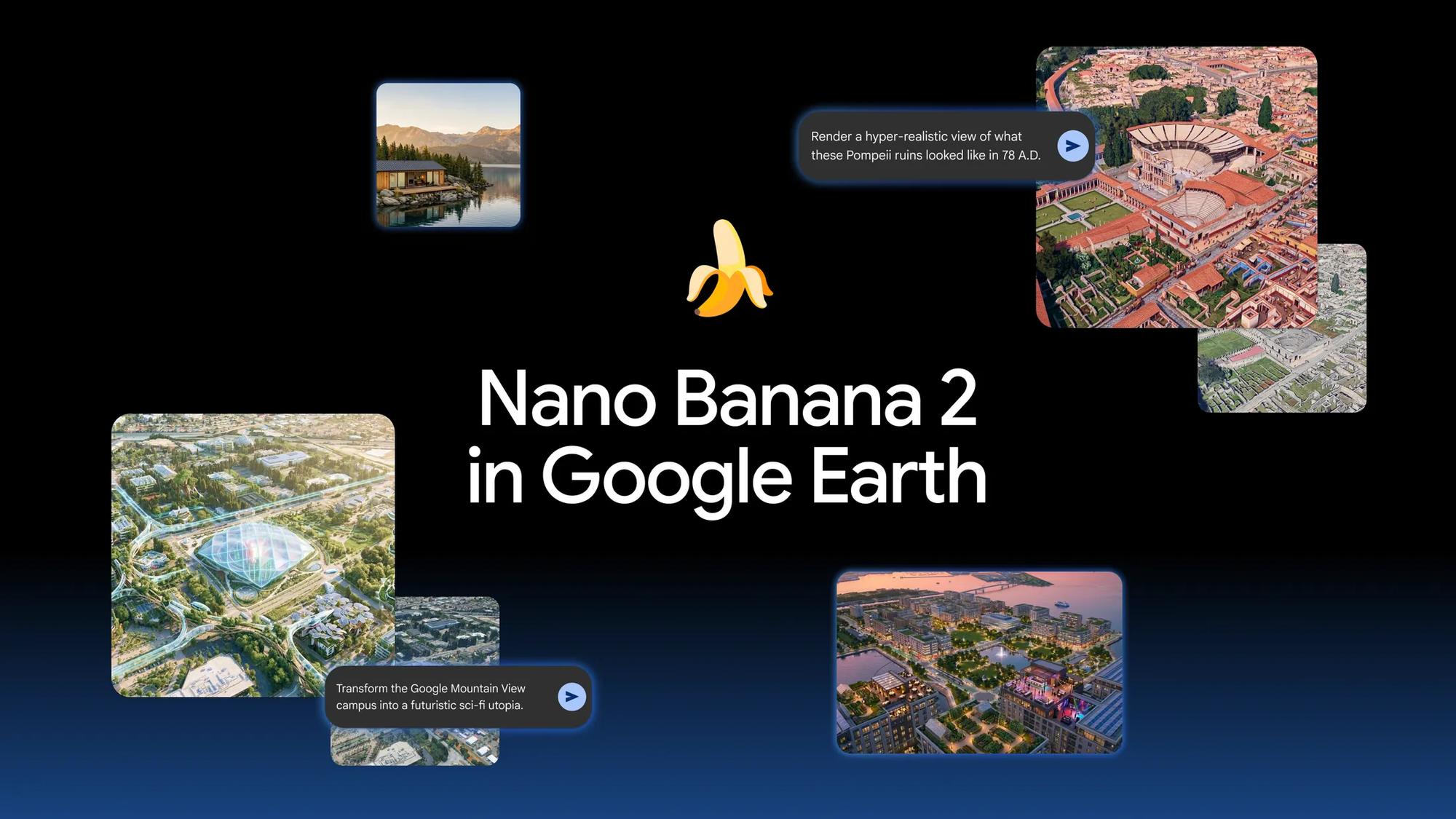
Imagine: a student is preparing a report on Pompeii, opens Google Earth, enters a query — and sees a flourishing ancient city before the eruption of Vesuvius. It looks like a popular science film. In reality, it's an AI fabrication built on statistical assumptions, not archaeological data.
Google has integrated the Nano Banana image generator into Google Earth, allowing users to create visualizations of real locations — in particular, how historical sites may have looked in the past. The company immediately issues a warning: this is artistic interpretation, not fact. But disclaimers are usually read by those already cautious, not by someone who simply needs a picture for a presentation.
Not just the past — but also the future
A more practical scenario concerns not archaeology, but real estate. Nano Banana generates a visualization of future development on an empty lot — for example, how a residential complex might look on the site of a vacant lot in your neighborhood. For developers and urban planning discussions, this is a faster and cheaper tool than ordering a render from a studio.
Here, a different risk emerges: a visualization generated in seconds can become an argument in public discussion about development before an actual project even exists. People perceive images as proof of intentions, though this is only one of millions of possible variations suggested by the algorithm.
Who will verify accuracy
Google does not disclose whether the feature works for all locations in the service, or only for a limited list of popular sites. An unmoderated generator of historical reconstructions for billions of points on the map is a different task in complexity than showing the Colosseum or Stonehenge, for which there are thousands of reference images and scientific reconstructions.
For less studied locations — say, a small Ukrainian town or a forgotten fortress — AI will be forced to fantasize more heavily, and the difference between reconstruction and fabrication will become even more blurred.
The question is not whether it's interesting to look at AI-Pompeii. The question is whether Google will add clear markers of credibility to the service — and whether a small disclaimer will be enough when the image spreads across social networks without context.