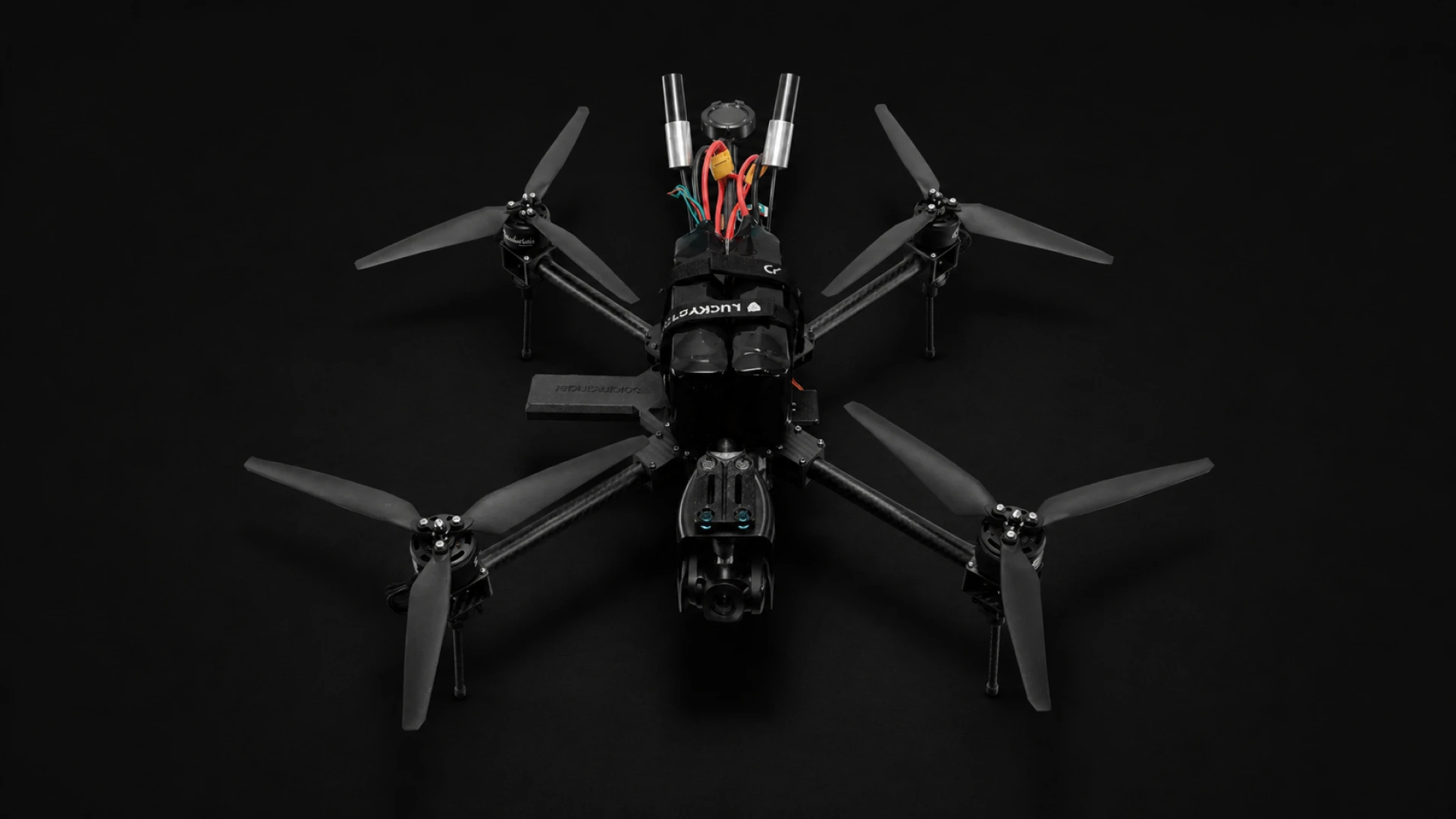
Russian electronic warfare systems are systematically jamming GPS on the front lines — in 2024 this has become one of the main causes of drone losses. PG Robotics responded concretely: the updated Lucky Strike-2.1 received the Salamandra module, which allows the drone to navigate without satellite signal at all.
How Salamandra replaces GPS
The module analyzes images of the Earth's surface received from the onboard camera and determines the apparatus's position in space — the same way a person recognizes terrain by landmarks. The drone can continue its route, maintain position and automatically return to the launch point even after complete GPS loss.
"GPS has long been for drones what road signs are for drivers. But modern warfare forces us to anticipate that at some point these signs may not be there. That's why we taught Lucky Strike-2.1 to navigate not only by satellite signal, but also by what it sees during flight".
Vladislav Plaksin, co-owner of PG Robotics
The computational foundation of Salamandra consists of a Raspberry Pi Compute Module 5. According to the developers, its power is sufficient for the drone to process video data directly during flight — without overloading the operator or communication channel.
What else changed in version 2.1
Salamandra is not the only change. Updates covered all three platform modifications:
- Day Optical, Day Digital, Day Night — all three variants have been redesigned based on frontline feedback from AFU units.
- New power plant and battery pack increase reliability in extended missions.
- Updated onboard electronics improve communication channel stability.
- Digital communication with automatic frequency switching is preserved: if one channel is jammed, the drone switches to another.
Tactical sense: platform preservation
Lucky Strike is a reusable drone. The previous version could withstand up to 135 flights, with a tactical radius of 7 km. This is why automatic return is critically important: loss of communication does not mean loss of the apparatus with cameras and equipment.
As 24 Kanal notes citing sources, optical navigation does not make Lucky Strike-2.1 completely immune to EW — it removes critical dependence on a single source of coordinates. The difference is fundamental: the drone degrades under jamming influence, but does not stop or get lost.
The context is broader than one product. IEEE Spectrum notes that visual navigation to overcome GPS jamming has only this year made its way to the real battlefield — Lucky Strike-2.1 finds itself among the first serial platforms with such a solution, rather than just among prototypes.
Whether Salamandra will become a standard for subsequent serial versions depends on how the module performs in conditions of dense EW in the east, rather than just in developer tests.







