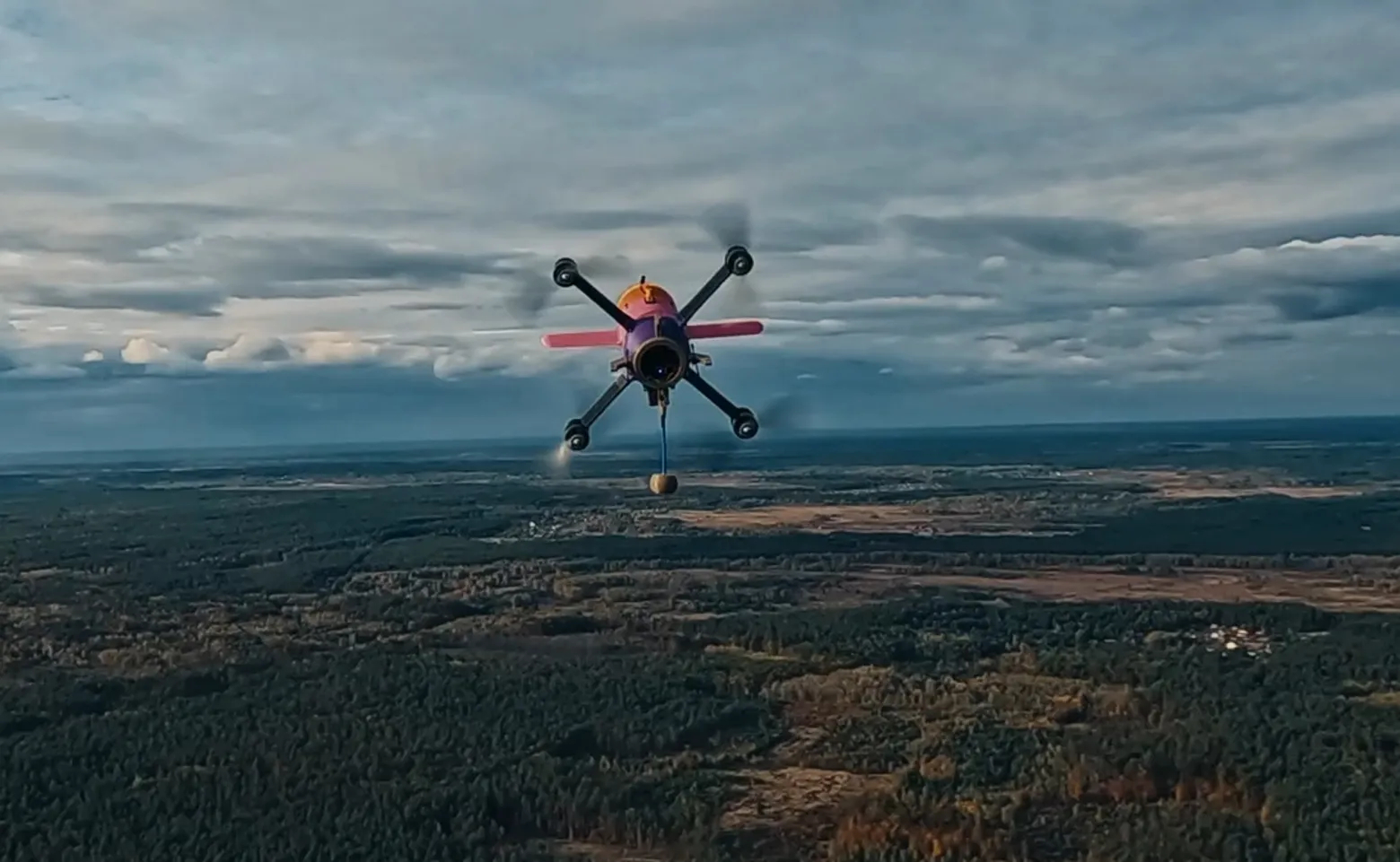
Defense Minister Mikhaylo Fedorov published a video of combat use of a new-generation interceptor drone in the Kharkiv region. The system was developed by MaXon Systems startup — a participant in the Brave1 defense cluster — and has already proven its combat effectiveness under real conditions.
How it works
The operating principle differs from classic FPV interception, where an operator manually guides the drone to collision with a target. Here, a person makes only one decision.
«The operator sees target movements in real time, selects a target and gives the strike command. After that, the system independently guides the drone to the target, autonomously recognizes and locks onto the Shahed»
Mikhaylo Fedorov, Minister of Defense of Ukraine
According to Brave1, the system automates approximately 95% of the interception process — from launch to destruction. At the same time, the so-called "human in the loop" is preserved: the operator can cancel the attack at any moment before impact. This is fundamental for compliance with regulations on the use of lethal autonomous systems.
From prototype to the field in a year
Alexey Solntsev founded MaXon Systems in early 2025. In less than seven months, the company moved from a basic prototype to combat trials — an atypical pace even for wartime. In parallel, with Brave1's support, the company attracted an investment round from American venture fund Green Flag Ventures for $300,000.
The system achieved a technology readiness level of TRL 8 — meaning full qualification through testing and demonstration in a real environment. According to Solntsev, deploying 20–25 MaXon systems would theoretically be sufficient to protect all of Kyiv from Shahed attacks.
Context: why this is needed now
Russia is systematically increasing the number of unmanned vehicles in night attacks, compensating for losses in cruise missiles. Traditional anti-aircraft artillery and FPV interceptors remain the foundation of anti-drone defense, but require a large number of trained operators. Autonomization removes this limitation: one specialist can track multiple targets simultaneously.
For comparison: Wild Hornets with its $2,500 FPV interceptor Sting has shot down over 3,900 drones since May 2025, according to Military Times. MaXon operates in a different segment — not the cheapness of a unit, but reducing operational burden on people.
What remains unknown
- Scaling: Fedorov noted that it has already begun, but specific production figures are unavailable.
- Effectiveness in swarm attacks: trials documented single targets; the system's behavior during a massive assault with dozens of Shaheds simultaneously has not been publicly confirmed.
- Vulnerability to electronic warfare: autonomous guidance via onboard AI is theoretically more resistant to GPS jamming than classic FPV, but developers did not reveal details.
If MaXon confirms its claimed effectiveness in swarm scenarios and reaches serial production by autumn, it will change the economics of anti-drone defense: not more missiles per Shahed, but fewer operators per night of attacks. The question is whether scaling can outpace the growth in Russian unmanned vehicles.







