What happened
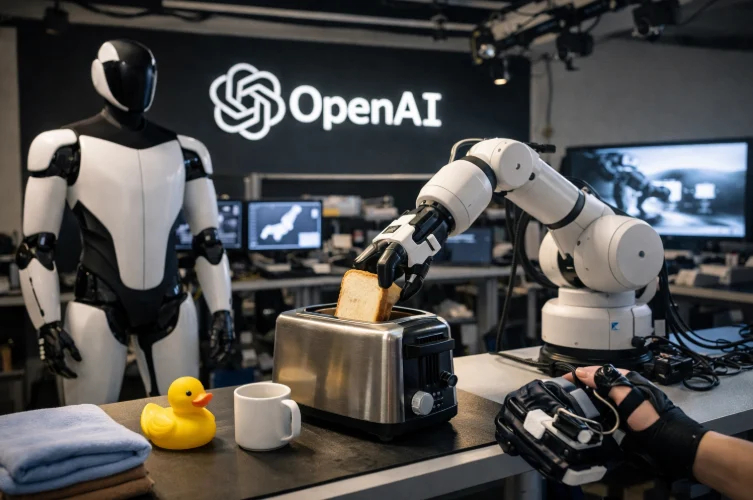
According to IT Home, OpenAI has opened a robotics lab in San Francisco where robotic manipulators are being tested around the clock. They are being trained to perform basic actions — from toasting bread to folding clothes. The project involves more than a hundred operators and at least 12 engineers; the company is also preparing a second laboratory in California.
Why they're training on simple tasks
This is not training for Hollywood-style humanoids, but the construction of a corpus of motion data: special controllers mimic human movements and produce training data for models. In this way OpenAI aims to teach manipulators with a large number of repeatable examples — an approach similar to how language models were once trained on text. The result is not a single super-machine, but cheaper, more reliable solutions for everyday tasks.
"The project focuses not on creating humanoids, but on developing affordable robots that can operate in household environments."
— IT Home
Practical implications (and why this matters for Ukraine)
The technological trend toward cheap, versatile manipulators has several implications relevant to Ukraine:
• logistics and warehouse operations: simple robotic arms can automate sorting, packing, and assist at damaged infrastructure sites;
• recovery and reconstruction: robotic tools will speed up preparatory and repair work in hard-to-reach or dangerous conditions;
• medicine and rehabilitation: the deployment of affordable manipulators could lower the cost of assistive devices for the wounded;
• labor market and IT exports: Ukrainian engineers and startups can integrate algorithms and data-collection into their own solutions, turning the challenge into an opportunity to export expertise.
What experts say
Analysts point out that training on a large number of simple examples increases robots' reliability and scalability. This means investments in such technologies are more likely to pay off not through a single "miracle device," but through mass adoption in homes and industry.
Conclusion
OpenAI is betting on scalability and practicality — an approach that changes the rules not only in Silicon Valley but also in countries undergoing reconstruction. For Ukraine, this is a signal: investing in education, infrastructure, and international cooperation is a far more effective strategy than trying to catch up with technology leaders in their niches. Whether Ukraine's robotics sector can turn these trends into a competitive advantage is a matter of time and the right decisions at the state and business levels.