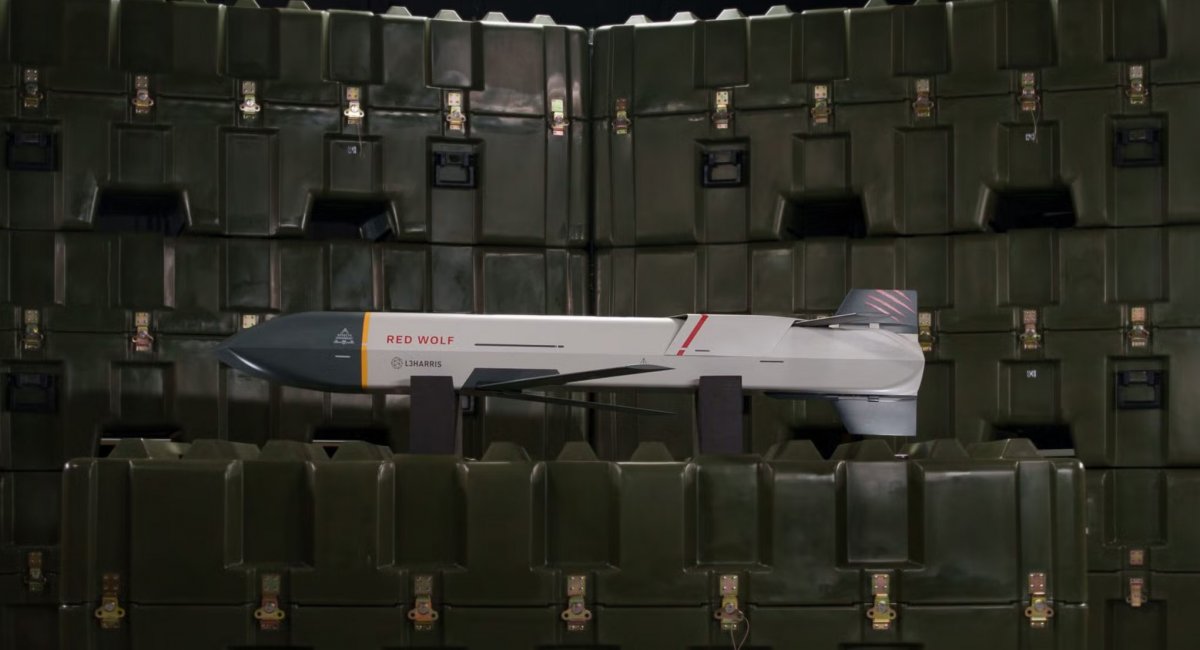
On October 20, 2025, Bell Textron, Ukraine's Ministry of Economy, and UkraineInvest signed letters of intent in Washington regarding the supply of AH-1Z Viper and UH-1Y Venom attack helicopters. Three months later, on January 30, 2026, the U.S. Navy's Naval Air Systems Command (NAVAIR) awarded L3Harris Technologies a $86.2 million contract for the development, testing, and serial production of the Red Wolf missile specifically for this platform.
The two processes remain legally unconnected for now: Ukraine does not have a signed FMS contract, and Red Wolf is officially being developed for the needs of the U.S. Marine Corps. However, the technical picture is already taking shape.
What is Red Wolf and why it's not just another missile
Red Wolf is a six-foot turbofan-powered mini-cruise missile that flies at extremely low altitude. Based on 52 successful test flights, including a launch from an AH-1Z over the Atlantic Range in September 2025, a confirmed range of over 200 nautical miles (370 km) has been demonstrated. For comparison: the next longest-range standard ammunition for Marine Corps helicopters is the Spike NLOS with a range of approximately 32 km.
"Red Wolf is lethal, modular, affordable and ready to hunt… with significant advantage in closing engagement chains at extended ranges"
Ed Zoiss, President of Space and Airborne Systems, L3Harris
The PASM (Precision Attack Strike Munition) program provides for two versions: Red Wolf — kinetic, Green Wolf — for electronic warfare. Both are classified as Long-Range Attack Missiles (LRAM) and were designed for strikes against naval targets and coastal infrastructure — primarily in the context of a possible conflict in the South China Sea. The unit cost is estimated at $300–500 thousand, which is significantly lower than most cruise missiles of comparable range.
The contract obligates L3Harris to deliver all units along with documentation, trainers, and support equipment by the end of fiscal year 2027. The quantity of ordered missiles is not disclosed.
Where Ukraine fits in
The current air force fleet of the Armed Forces of Ukraine consists of Soviet Mi-24 and Mi-8 helicopters, with the maximum range of standard missiles not exceeding several dozen kilometers. The AH-1Z and UH-1Y share 85% of common components, which simplifies logistics — this is one of the arguments Bell Textron presents for Ukraine.
The October 2025 agreement provides not only for supply, but also for local assembly, maintenance, and crew training. Bell Textron stated it would work with the U.S. government to arrange deliveries through the Foreign Military Sales (FMS) mechanism. However, a letter of intent is not yet a contract: the FMS procedure requires separate approval from the State Department and Congress.
- First actual Red Wolf launch from AH-1Z — November 2024, Yuma Range, Arizona
- Confirmed range in tests — over 370 km
- NAVAIR contract with L3Harris — $86.2 million, signed January 30, 2026
- Letter of intent from Bell Textron — Ukraine — October 20, 2025, Washington
- Serial deliveries of missiles to the Marine Corps — no earlier than end of FY2027
A fundamental question remains open: if the State Department approves an FMS contract for the AH-1Z by the end of 2026, will it include compatibility with Red Wolf — or will Ukraine receive the platform without the ammunition it is essentially designed for.