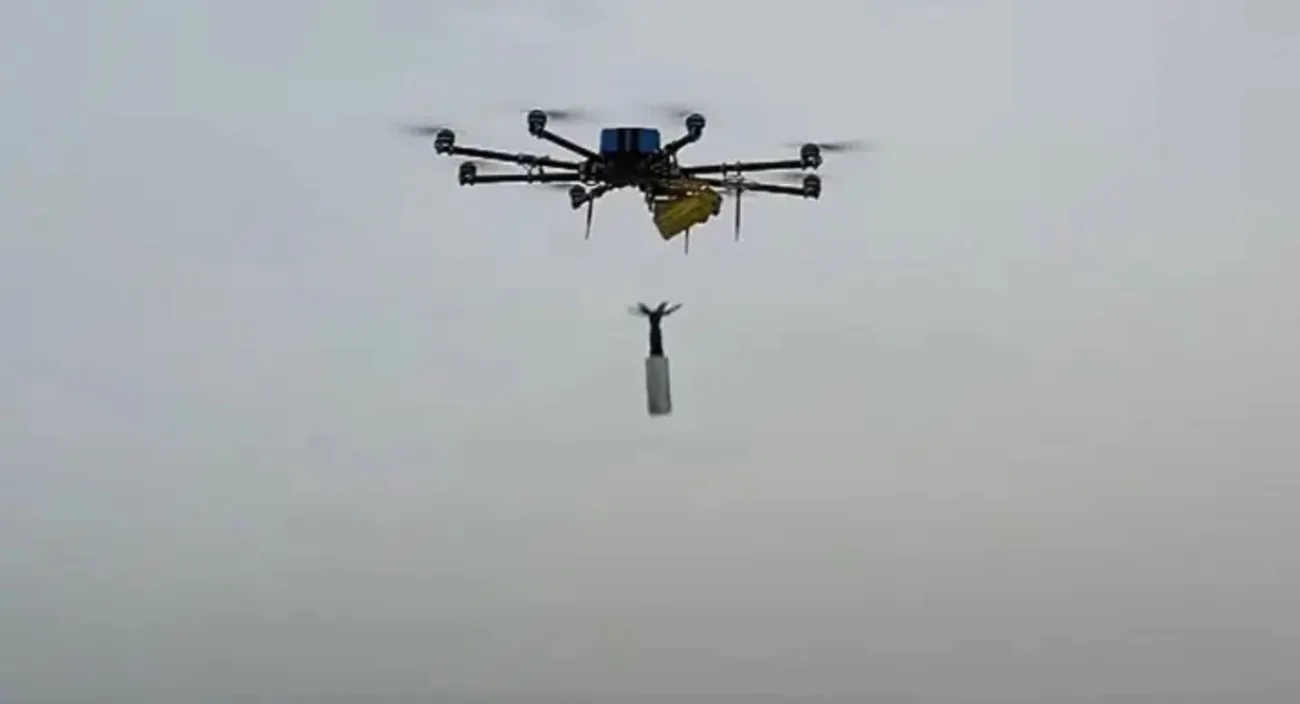
On the night of August 5th, a staff member at Leipzig/Halle airport's cargo zone spotted a drone with an attached explosive device — literally dozens of meters from an Antonov Airlines plane that had just delivered military ammunition from France. The detonator failed to activate, and the explosives — likely PETN and Semtex — were destroyed in a controlled detonation. But the most important detail of the incident is not what happened, but what didn't: the drone detection system didn't register the device at all.
Leipzig/Halle is not a random point on the map. It's one of Europe's largest cargo aviation hubs, and this is where Antonov Airlines relocated some of its An-124s after its Hostomel base was destroyed in 2022. Military cargo flights here are not a rarity but routine. If someone wanted to find a target with maximum impact and minimal risk of civilian casualties, a cargo zone at night would be almost ideal.
The Drone That Went Unseen
Germany's Interior Minister Alexander Dobrindt called the incident a new level of threat and a possible hybrid attack scenario. His words deserve unpacking into facts: preliminary data suggests military-grade explosives were used, and preparing such an operation requires specialized technical knowledge and experience handling explosives — this is not a hobby drone from a store.
A journalistic investigation adds a detail that troubles more than the sabotage attempt itself: the device may have been specially modified to bypass the airport's counter-drone defenses. If confirmed, this is not a matter of luck or bad luck, but of deliberate engineering preparation for an attack on critical infrastructure in the heart of Europe.
The unmanned aircraft detection system at the airport failed to register the drone — despite it being an aircraft with explosives near a plane carrying military cargo.
A Second Object and an Unresolved Question
After the drone was detected, flights at the airport were halted. One of the cargo planes didn't manage to land and collided with an unknown object while climbing again — damage was found on the fuselage after landing in Hanover. Whether it was a second drone or a random object remains unestablished by police. But the very fact that debris is still being searched for, and the connection to the first incident is neither confirmed nor denied, leaves the investigation in a state of uncertainty much longer than German authorities would prefer.
Ukrainian Ambassador Oleksiy Makeev and some German politicians directly name a possible contractor — Russia. The investigation has not disclosed official evidence, and this is a fundamental difference between political assessment and forensic conclusion. The investigation is being conducted by a unit of the Dresden General Prosecutor's Office specializing in extremism — the jurisdiction itself suggests how Berlin is classifying the event.
A Patch on a System Tested by Explosives
Germany's response is already visible: eight of the country's largest airports, including Frankfurt and Berlin, are installing new drone defense systems. Frankfurt already has one operational, with the rest receiving upgrades by year's end. Leipzig is on this list, and not by chance — the technology was tested there not in training, but in a real attack attempt.
The question that remains open: if the modified drone indeed bypassed existing defenses, how prepared are the new detection systems for devices designed specifically to evade detection rather than randomly appear on radar?