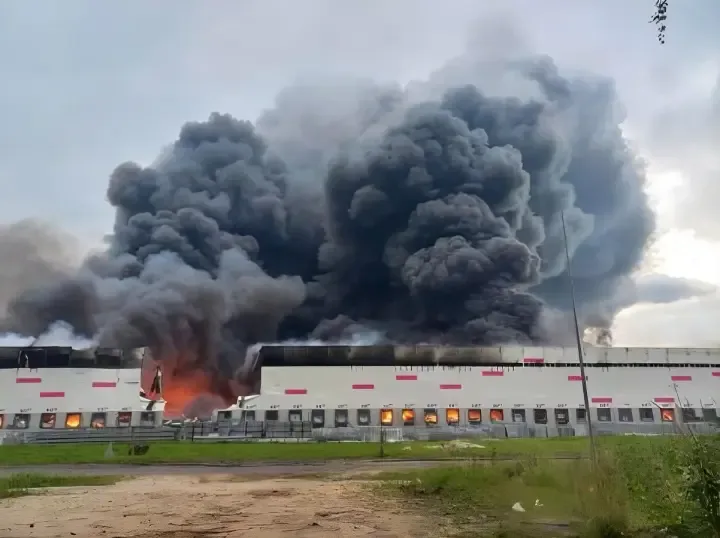
Ukrainian long-range strikes, which for a long time have been focused primarily on the oil refining industry, have recently begun hitting new targets – logistics centers of Russia's largest marketplace Wildberries. Beyond the impact on the company and sellers, this strategy could have more significant consequences for the Russian economy.
Of 20 major logistics hubs, 10 Wildberries warehouses have already been destroyed with a total area of over 960,000 square meters. According to Russian sources, this is more than 15% of all the company's warehouse space.
The largest loss is the hub in the Moscow region city of Elektrostal with 250,000 square meters. A warehouse in Ryazan with an area of 170,000 square meters was completely destroyed. Four more warehouses ranging from 100 to 108,000 square meters burned in Kotovsk in Tambov Oblast, Krasnodar, Nevinnomyssk, and the Shushary district of St. Petersburg. Fires also affected smaller facilities in the Pitera Utkina Zavod district and in annexed Simferopol. On July 30, the destruction of warehouses in Penza and Sarapul was reported.
The scale of the company
Last year, Wildberries' revenue reached 6.1 trillion rubles, with a 47% share of the Russian e-commerce market. According to analysts' estimates, approximately 2% of Russia's GDP passes through the marketplace. The company has 25 major logistics hubs and over 200 smaller facilities, with the largest warehouses potentially employing up to 15,000 people.
In early July, the RWB group, which includes Wildberries, announced plans to expand into foreign markets, including a pilot project for supplies to China. Now the company's stable operations are under threat.
Beyond the destroyed premises, sellers' goods worth billions of dollars were lost in the fires. These entrepreneurs likely will not receive compensation.
"The failure of war risk insurance in Russia was already visible through the lack of payments for destroyed refineries, but the Wildberries situation made this problem public, since hundreds of entrepreneurs lost their goods," notes economist and former NBU Council member Vitaliy Shapran.
Connection to the banking system
The state bank VTB, which already closely cooperates with the marketplace, could play a major role in potential state support for Wildberries.
Denys Stileriman, chief designer and co-owner of the Ukrainian company Fire Point, believes that strikes on Wildberries and its competitor Ozon are capable of shaking Russia's financial system, as the marketplace is one of the country's largest corporate borrowers.
"VTB was already in bad shape, and now trillions of rubles in loans will turn out to be irrevocably lost. This could topple Russia's second-largest bank," says Stileriman.
Shapran confirms the tight connection between the bank and the marketplace: VTB planned to close a hole in its balance sheet through Wildberries, while the latter used insurance services under the bank's control. The attack derailed these plans.
VTB's financial indicators had already been deteriorating before the attacks: net profit for the first half of the year turned out to be almost 20% below forecast, with expectations for the second half revised downward. The bank has already begun restricting depositors' access to funds – according to Shapran, this could become a long-term measure. Liquidity from the Central Bank is theoretically possible, but it's in no hurry to provide it – it's expensive.
What this means
Marketplace turnover has fallen by at least 10%. Thousands of Russians have lost their jobs, entrepreneurs' funds are frozen, and goods are destroyed or facing delivery problems.
A large-scale collapse of the banking system solely due to these strikes should not be expected – analysts' assessments of the consequences vary. But destabilization is likely: the financial sector will have to deal with a wave of non-performing loans, and there's an added socio-economic effect from losses for ordinary Russians.
This comes on top of the already existing blow to the oil refining industry, where the domestic fuel consumption deficit reaches 35%.
"The Kremlin has no stabilization tools except agreements with Iran and the Houthis about destabilizing the Middle East to increase oil prices. But treating the current crisis with high oil prices would take at least half a year – the Kremlin is unlikely to manage that," sums up Vitaliy Shapran.
The question is whether Ukraine has enough resources to continue pressure on logistics infrastructure simultaneously with strikes on refineries – it is precisely the combination of these directions, not a single strike, that determines how deep the destabilization of Russia's financial sector will be.