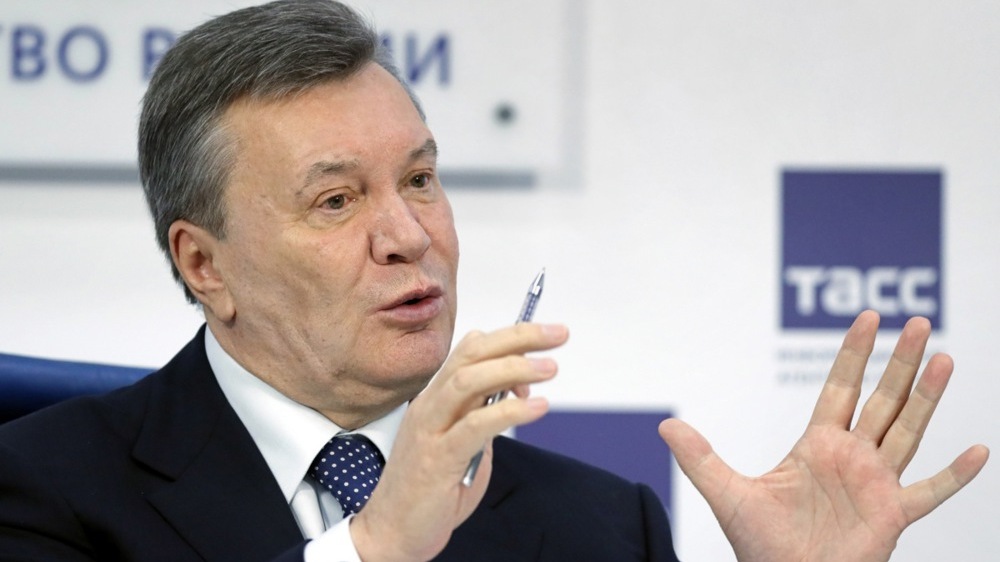
The Higher Anti‑Corruption Court convicted the ex‑president in absentia in the Sukholochchya embezzlement case
The Higher Anti‑Corruption Court (HACC) convicted Viktor Yanukovych in absentia and sentenced him to 15 years in prison in the case concerning the takeover of land in Sukholochchya. The court also ordered the complete confiscation of all the defendant’s property and disqualified him from holding public office for three years. The verdict has not yet come into legal force — it can be appealed within 30 days.
What the court found
The case concerns a plot of forest fund land on the territory of the Sukholuchchya village council (Kyiv region) measuring 17.5 hectares, with an estimated value of more than UAH 22 million. The actions were qualified under Part 5 of Article 191 of the Criminal Code of Ukraine (misappropriation, embezzlement of property, or seizing it through abuse of official position).
“Later, in 2009–2011, a hotel and restaurant complex was built on this plot, which was used by the ex‑president for personal needs.”
— Specialized Anti‑Corruption Prosecutor's Office (SAP)
Chronology and procedure
Key stages of the case: in 2007, while Yanukovych was prime minister, decisions were made that resulted in the land leaving state ownership. In 2009–2011 a complex appeared on the plot that, according to the investigation, was used for personal purposes. After Yanukovych fled to Russia in 2014, the case was investigated by the Department of Special Investigations of the Prosecutor General’s Office (GPU), and since 2019 it has been handled by the National Anti‑Corruption Bureau (NABU). The case was referred to court on 29 September 2023; at the end of 2022 Sukholochchya was confiscated under sanctions.
Why this matters
The HACC decision has two layers of significance. First, it is a symbolic establishment of accountability for the seizure of state land: the state has documented the facts of the unlawful loss of an asset and secured a conviction. Second — a practical effect: the complete confiscation opens the way to returning the asset to state ownership or to another form of use for the benefit of society.
What’s next
The verdict can be appealed, and until it comes into legal force the question of enforcing the sentence remains open, especially given that the accused is outside Ukraine. However, even in that case the verdict matters as a legal precedent and as a tool for civil‑law actions related to compensation and management of confiscated property. Experts emphasize: the key question now is how effectively the state will implement mechanisms for returning and managing these assets.
A question for the future: will this verdict be not only a legal finding but also a practical change in favor of the community that has so far been denied access to its resources?







