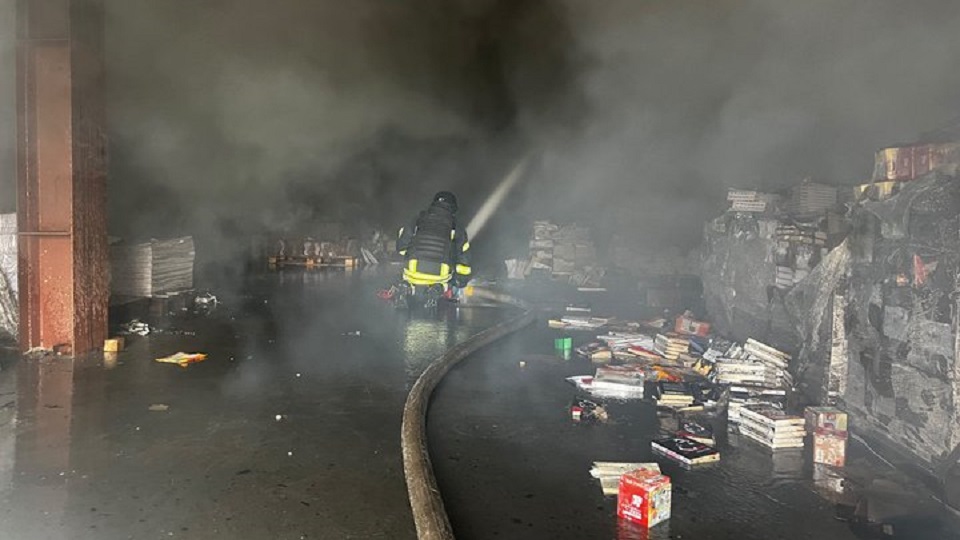
On Saturday, August 1, two Shahd attack drones hit a warehouse of the Ranok publishing house in Kharkiv – the same one that supplied orders for the KnigoLend bookstore chain. The fire covered approximately 10,000 square meters, with temperatures inside reaching hundreds of degrees, and firefighters could not guarantee extinguishing the flames by the end of the day. There were no casualties among employees. However, behind this fire lies arithmetic that deserves separate analysis beyond photos of the flames.
Who exactly was left without books
Ranok is the country's leading children's publishing house, and the warehouse caught fire at a moment when the company was delivering textbooks to schools before September 1. The publishing house's CEO Viktor Kruglov told Suspilne Kharkiv that estimated losses could reach 300 million hryvnia and emphasized: "This was not a random strike, but a deliberate attack on the book warehouse."
According to his assessment, along with goods from the KnigoLend distribution center, several million copies were destroyed – approximately 15-20% of all publishing products currently available in Ukraine, Ukrainian books. This is not a metaphor for scale, but the share of the entire industry's inventory that disappeared in one strike.
The most concrete consequence – schoolchildren. Kruglov explained why "reprinting" is not a quick solution: "We will negotiate with printers to reprint books. First and foremost – textbooks. But I want to say that tens of thousands of titles cannot be reprinted faster than in a year." This means some textbooks will not physically arrive by September 1, and schools will have to manage – with photocopies, electronic versions, or old editions.
This is not Ranok's first warehouse hit
The August 1 strike was not the first attack on this company. In 2022, Russian shelling damaged the Ranok publishing house's logistics center in Kharkiv, destroying part of the book inventory and causing damage worth tens of millions of hryvnia. The difference in the scale of damage – from tens of millions to 300 million – shows how much the scale of targets has grown and how much more precise strikes on civilian publishing logistics have become.
July was already a record month of losses
The attack on Ranok occurred against a backdrop of a series of strikes that made July the worst month for the industry regardless. On July 23, Culture Minister Tetiana Berezhna announced that as a result of occupier attacks, over 1.5 million books and textbooks from Ukrainian publishers were destroyed. The Konvi Plus printing house suffered the most: over 600,000 finished books and textbooks burned there, as well as approximately 350,000 copies that were in production.
The list of July losses includes several more incidents:
- July 2 – A warehouse of Denka Logistics, a logistics partner of BookChef publishing house, was destroyed in Kyiv, with approximately 800,000 books lost.
- July 8 – A premises of the children's publishing house "Mamyne Sonechko" was damaged along with a stock of finished books and magazines.
- July 19 – A strike on Kyiv destroyed the warehouse of Knigolaw publishing house – nearly 200,000 books were destroyed, with the publisher's preliminary losses around 20 million hryvnia.
Following this series of strikes, Oleksandra Koval, head of the Ukrainian Institute of the Book, announced the need to allocate 150-200 million hryvnia to restore the lost million books. Compare this amount with Ranok's losses alone for one night – 300 million hryvnia – and it becomes clear: the state compensation discussed before the August strike is already insufficient even for a single publishing house.
The state promised a mechanism – but still without funds
On July 27, Prime Minister Sergiy Koretsky tasked preparing a state support mechanism for the book publishing industry, emphasizing the importance of restoring publishers' operations and replenishing library funds. The task exists, but specific amounts and compensation timelines do not yet. Meanwhile, publishers are calculating losses not in abstract millions, but in concrete print runs of textbooks that will not be on desks on September 1.
The question for the coming month is simple: will the state manage to turn the prime minister's task into real payments and printing capacity faster than the school year begins – or will schools again compensate for industry losses with their own photocopies.







