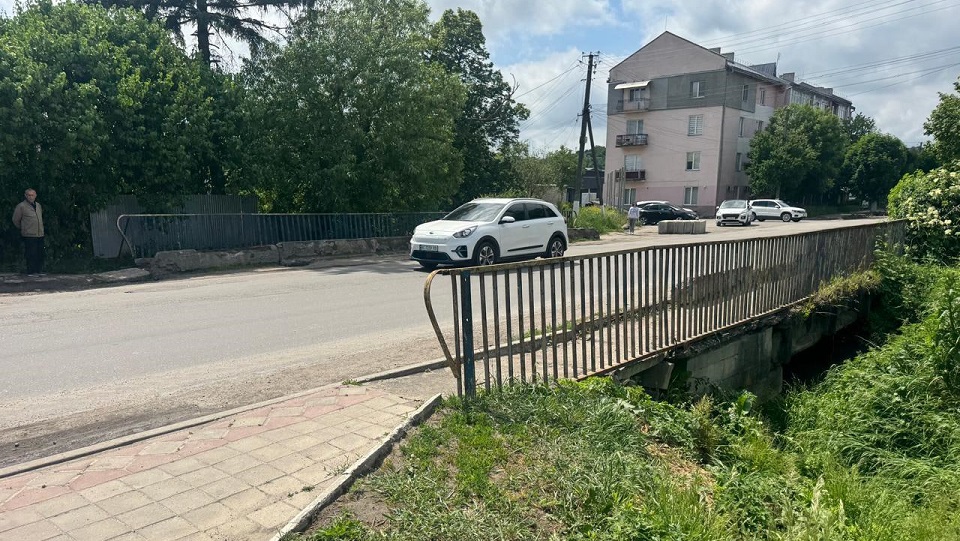
On the international highway M-19 in Terebovlia, a major repair of a bridge built in 1938 has begun. But "major repair" in this case does not mean reinforcing old structures: the emergency structure will be completely dismantled and a new one will be erected in its place.
The bridge over the Gnizna River is the last unfixed link of the M-19 route "Domanove – Kovel – Chernivtsi – Tereblechye" in Ternopil region. All other sections have already been upgraded. The route is one of the main land arteries connecting Ukraine with Poland and further with the EU.
Polish partner and joint project
The project is being implemented not only in Ukraine. Its full name is "Improving cross-border mobility through the construction of regional road No. 627 Kosów Lacki – Sokółka Podlaska and major repair of the bridge in Terebovlia". The Polish part — a new regional road in Masovia — is being built in parallel.
"For the first time in Ternopil region, we are implementing a major road infrastructure project funded by the EU"
Service for Restoration and Development of Infrastructure of Ternopil Region
Financing: 3.2 million euros total budget, of which 90% is provided by the EU under the Interreg NEXT "Poland – Ukraine 2021–2027" programme, with the remaining 10% covered by local budgets. The overall priority "Accessibility" of this programme — 42 million euros for road cross-border infrastructure of both countries.
What it means for drivers
The repair is not cosmetic, so traffic on the section km 354+689 – km 355+566 will be completely closed. According to road authorities, restrictions apply to all types of transport, and a temporary bypass scheme has been coordinated with the patrol police. The entire complex of road and construction work is scheduled to be completed in 2025.
- The bridge will be completely dismantled, a new structure will be erected
- Technical category of the road section — II (international highway)
- Approaches to the bridge are also being repaired
- Closure — for the entire construction period
Terebovlia City Mayor Oleg Prodan and Regional Military Administration Chief Taras Pastukh personally visited the site — a signal that the project is being treated as a symbolic precedent rather than routine road work.
The question that remains open is: if Ternopil region received for the first time a major EU road grant through a cross-border format with a Polish partner — how many similar "paired" projects can still be launched before the Interreg NEXT programme ends in 2027, and is there infrastructure in Ternopil region ready for this format?