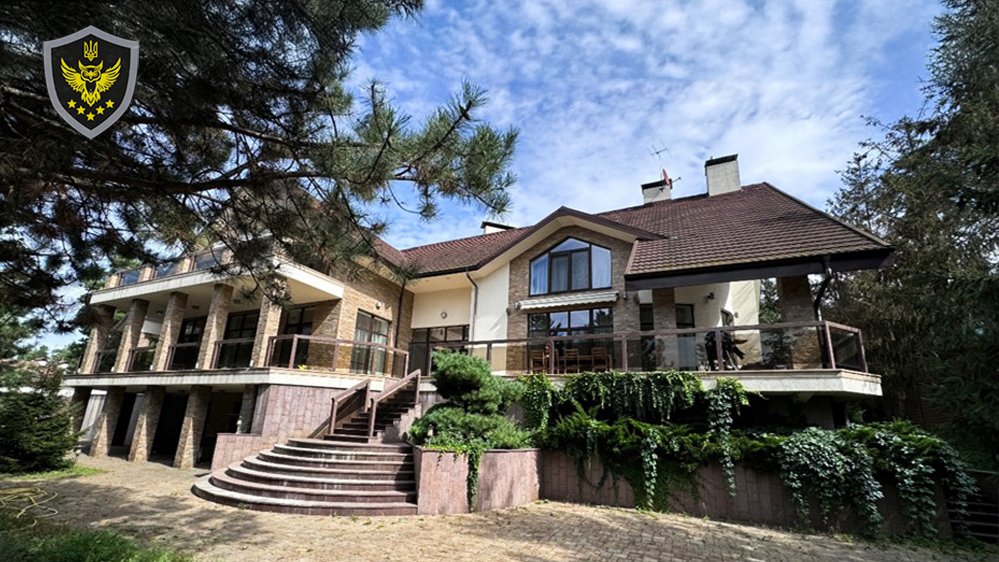
On April 1, 2026, employees of the National Agency for Finding and Managing Assets came to inspect a property in Kyiv's "Tsarskoe Selo" and discovered unauthorized people there. They presented a sublease agreement. ARMA classified the document as invalid and notified law enforcement.
A House That Supposedly Didn't Exist
The estate on Dobrovolchykh Batalioniv Street — formerly Panfilovtsi Street — belongs to Vitali Zakharchenko, interior minister during the Yanukovych era, who is hiding in Russia. Four land plots with a total area of a quarter hectare and a two-story residential building. The estimated value as of June 2025 was 48.48 million hrn. An arrest was imposed back in 2021.
Despite this, the property has effectively existed outside state control for years. As documented by the Anti-Corruption Center, ARMA had no official manager for it for several years. The first tender to appoint a management company failed due to lack of applications.
"He Paid 130 Dollars a Day to Some Guy"
In February 2026, at a VACS hearing, it became clear that Herman Halushchenko — former energy and justice minister, suspected in the "Midas" case concerning corruption around Energoatom — had been living in this house without hindrance. Halushchenko was detained on the night of February 15 while attempting to cross the border.
"I learned about Zakharchenko from the media… The house was freely accessible. It was offered through real estate agents"
Herman Halushchenko, at a VACS hearing
When asked if he knew about the asset seizure, the former minister said he had arranged the rental not with ARMA, but through a person who showed him a "relevant agreement." "What difference does it make to me?" said Halushchenko.
Acting ARMA Director Yaroslava Maksimenko confirmed at a parliamentary anti-corruption committee hearing that the agency had not established physical control over the property and had not taken the keys.
A Scheme Easy to Repeat
The April incident is structurally identical. An unidentified person concludes a "sublease agreement" with residents of seized property that the state nominally controls but physically does not. ARMA qualifies this as a violation of Article 388 of the Criminal Code of Ukraine — illegal actions regarding property subject to seizure — and initiates entry into the unified registry.
- The arrest has been in effect since 2021 — over four years
- The property had no official manager for several years
- Two different "tenants" in two different scandals cited an intermediary with a "contract"
- ARMA learns about residents only after the fact
The key question is not who exactly lived in the house this time. The question is how many other seized objects under ARMA's management are currently just as "freely accessible through real estate agents" — and whether the agency will develop a tool for physical control before a third such incident occurs.







