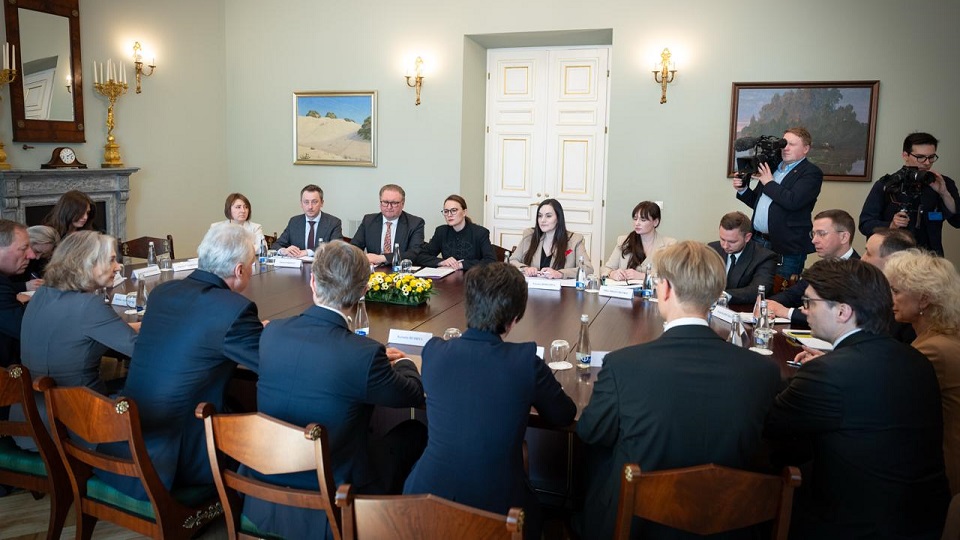
Deputy Minister of Community and Territorial Development Oleksiy Balesta met in Vilnius with Lithuania's Minister of Transport and Communications Yuras Taminskus. On the agenda was the transfer of some Lithuanian locomotives held in reserve for the needs of Ukrzaliznytsia. According to Balesta, the Lithuanian side is currently evaluating the request.
Why now
The shortage of traction rolling stock at Ukrzaliznytsia is not an abstract problem. According to the technical director of the Ukrainian Locomotive Manufacturing Company Volodymyr Krot, the actual shortage is 100–200 units. Approximately half of the registered fleet is idle: outdated, under repair, or unsuitable for operation. The average age of a locomotive is 46 years, with wear exceeding 96%.
«Under these conditions, in 2–3 years the shortage of traction will not allow transporting the necessary volumes of cargo, which will significantly limit the capabilities of export industries».
Ukrzaliznytsia analysts, November 2025
The situation is also complicated by track gauge: it is impossible to purchase locomotives in Europe right now due to the difference in track width standards — the Ukrainian network uses 1520 mm, while most of the EU uses 1435 mm. Lithuanian Railways, like Ukrainian Railways, still operates on a broad gauge — meaning Lithuanian locomotives are technically compatible with the Ukrainian network without retrofitting.
What Vilnius offers and what is still missing
The parties have not publicly named specific figures — neither the number of units, nor timelines for transfer, nor conditions (free transfer, leasing, or sale). The Ministry of Community and Territorial Development limited itself to the statement: «the Lithuanian side is evaluating this request». This means negotiations are at the stage of technical analysis, not agreement signing.
In parallel, Ukraine is seeking solutions through other channels. In November 2025, an agreement was signed with French Alstom for the supply of 55 new dual-system electric locomotives worth approximately 475 million euros — but the first locomotive will not arrive before 2027. Ukrzaliznytsia is also developing a mechanism to attract private locomotives through operational leasing to close the deficit now.
Context: Lithuania is phasing out broad gauge
Three Baltic states — Lithuania, Latvia, and Estonia — are implementing the Rail Baltica project: a new railway line of European standard (1435 mm) that will connect them with Poland and the rest of the EU. After the project's completion, Lithuania's need for rolling stock for broad gauge will significantly decrease — making the transfer of reserve locomotives to Ukraine logical for Vilnius itself.
Thus, Lithuanian locomotives are not charity, but the utilization of assets that are losing strategic value for Lithuania, but remain critically needed for Ukraine.
If Lithuania confirms the transfer by the end of 2025, this will become the first documented example of the transfer of compatible traction rolling stock as part of support for Ukraine — and could set a precedent for similar requests to Latvia and Estonia, where the Rail Baltica situation is identical.







