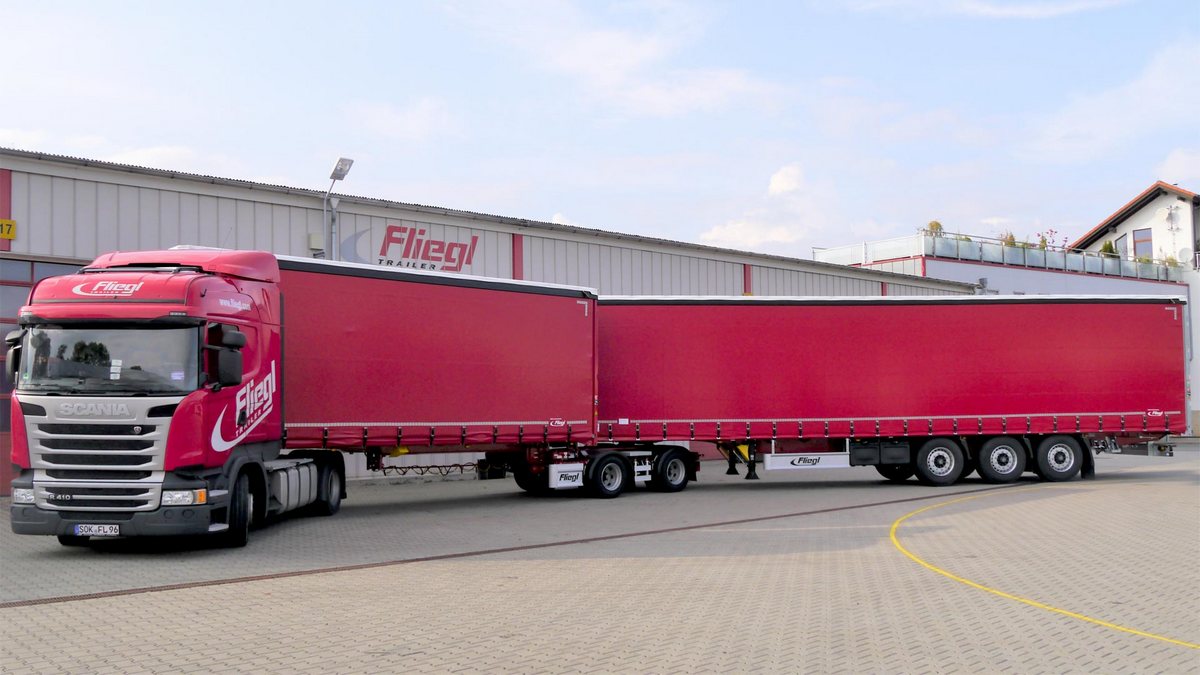
One driver, one cab — and twice the cargo. That's the basic logic of a three-unit road train (TURT): a tractor connected to two trailers, with a total length of up to 26 meters and a weight of up to 46 tons. Until this week, such vehicles could only travel in Ukraine with an individual permit from the National Police, and only without cargo. Now the Cabinet of Ministers has launched a two-year experiment on the M-05 highway Kyiv — Odesa.
What was allowed and on what conditions
The Cabinet resolution, announced by Vice Prime Minister Oleksiy Kuleba, provides for a temporary suspension of paragraph 22.5 of the Traffic Rules — it was this that prohibited commercial use of TURTs. For two years, carriers participating in the experiment will be able to transport divisible cargo (that is, cargo that can physically be unloaded onto a standard road train) without a one-time police permit.
The resolution establishes requirements for monitoring and reporting by participants. A "safety valve" is also provided: carriers who systematically violate weight standards during the year will be excluded from the program early.
Can the road handle it
The key objection to heavy trucks is road wear. Here we have verified data. A study by the National Infrastructure Development Institute, conducted in 2024, confirmed the technical suitability of the M-05 for TURTs and recorded a paradoxical result: the axle load coefficient for such vehicles is 0.583, which is 1.9–2.5 times lower than for standard road trains. The number of load applications on the road surface is 2.7–3.7 times less. In other words, one TURT replaces several standard semi-trucks and causes less asphalt damage — provided the weight limit is observed.
How much this costs business — and what EU experience shows
The published draft resolution contains no direct Ukrainian calculations of savings. But there is a Finnish precedent. After Finland raised the permitted truck weight to 76 tons in 2013 and allowed longer combinations,
"fuel savings reached up to 30%, and personnel costs fell by 10–15%. No negative effects on traffic safety were detected."
Springer Nature, a study of Finland's heavy-load transport experience
For the Ukrainian market, this means potential reduction in delivery costs for grain, building materials, and industrial cargo to the ports of Greater Odesa — the country's largest export hub. At the same time, as railinsider.com.ua notes, increased competition for Ukrzaliznytsia on this route is inevitable — although the resolution does not directly address this issue.
Where the weak point is
The main risk is not technical, but regulatory. The advantage of TURTs over standard semi-trucks completely disappears if the carrier overloads the vehicle: then the axle load increases and the road deteriorates faster. The current "safety valve" of the resolution — exclusion from the experiment for systematic violations — works after the fact, not before it. How many weighing stations will be placed on the M-05 and how often controls will be conducted is not detailed in public documents.
If over two years the Ministry of Infrastructure publishes monitoring data and shows that the average actual weight of TURTs does not exceed the permitted limit, the state will have an argument to expand the experiment to other routes. If not, the question of who pays for repairs to the M-05 will become much more acute.







