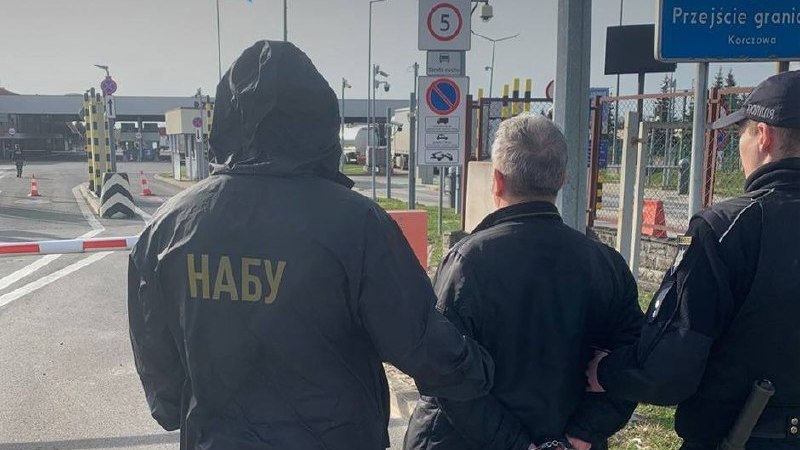
On April 10, the NABU press service reported: Igor Trushenko — an entrepreneur and director of two private companies — was transferred to the Ukrainian side after the Federal Republic of Germany satisfied the extradition request. This means that a person sentenced in absentia by the court will, for the first time, face Ukrainian justice in person.
What, according to the prosecution, happened
According to NABU and SAP, Trushenko acted as an accomplice in a scheme that caused damage to the state enterprise "Center for Certification and Examination of Seeds and Planting Material" (CSESPM) of 13,407,841 hryvnias. The former director of the state enterprise abused his official position — by prior arrangement with Trushenko. The entrepreneur, according to the investigation, ensured the implementation of the scheme through controlled private structures.
On December 11, 2025, the VAKS court handed down a verdict: the former director of CSESPM was found guilty under Part 2 of Article 28, Part 2 of Article 364 of the Criminal Code of Ukraine (abuse of official position by conspiracy of a group of persons). Trushenko — for complicity in the same acts. The court sentenced him to 3 years and 10 months of imprisonment and a ban on holding management positions for 2 years and 10 months, as well as a fine of 12,750 hryvnias.
The verdict was handed down in absentia — the entrepreneur was wanted and did not appear in court.
VAKS website, December 11, 2025
In addition to criminal punishment, VAKS satisfied the civil claim of CSESPM: from both convicts, 13.4 million hryvnias in damages are to be collected jointly and severally.
Where the case stands legally now
An important caveat: the verdict is being appealed and has not yet become final. An appeal may be filed within 30 days of the announcement — proceedings in the appellate chamber of VAKS are therefore ongoing. Trushenko remains an accused rather than finally convicted person in the procedural sense.
Why Trushenko specifically — and why now
The CSESPM case is not an isolated instance. The state enterprise is subordinate to the Ministry of Agrarian Policy and traditionally falls within the risk zone in the agricultural sector. Following the 2024 verdict against the former head of DPSCU (10 years for grain schemes involving over $60 million), this is already the second NABU case to result in a conviction in the grain sector in two years.
- Trushenko was declared wanted in August 2023 — after he failed to appear at a pre-trial hearing
- The verdict in absentia was handed down in December 2025
- Detention in Germany and transfer to NABU — April 2025 (before the in absentia verdict was handed down), which means: he was wanted during the investigation process
- One of the previous defendants in the CSESPM case, Chuyasov, reached an agreement with investigators in October 2024 and received a suspended sentence in exchange for cooperation
The extradition took place after more than 18 months of search — a standard timeframe for EU countries, where each request undergoes judicial review for compliance with human rights. Previously, Germany refused extradition in the Onishchenko case — precisely due to concerns about detention conditions in Ukraine.
If the appellate chamber of VAKS leaves the verdict unchanged, Trushenko will become one of the few defendants in anti-corruption cases whose sentence was successfully enforced despite remaining abroad during the trial. The question is whether NABU can repeat this result in cases where the accused are hiding in jurisdictions without extradition agreements with Ukraine.







