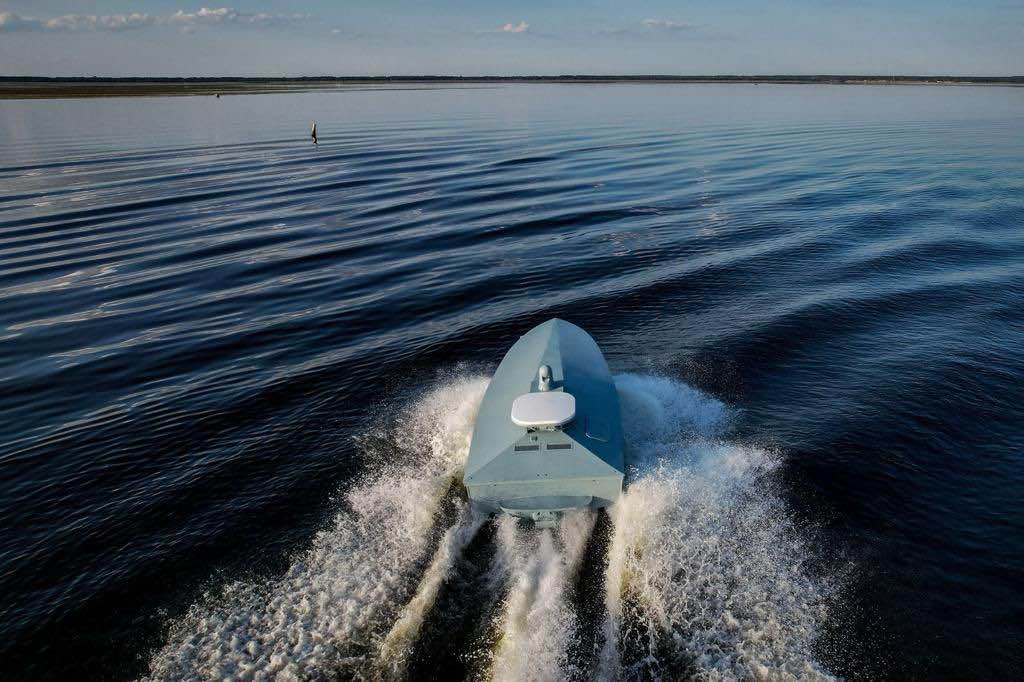
Norway will allocate 1.2 billion Norwegian krones—approximately 110 million euros—for the development and procurement of marine drones for Ukraine. This was announced by the Norwegian government's press service following a meeting between Prime Minister Jonas Gahr Støre and President Zelensky at the NB-8 summit in Tallinn.
Formally, this is another tranche within the Nansen Support Programme—an eight-year aid package for Ukraine worth 155 billion krones through 2030, approved by all parties in the Norwegian Storting. However, in its details, it represents a fundamental shift in logic.
Not Supply, But Production
The program provides for the supply of vessels by both Norwegian and Ukrainian industry. In parallel, a separate agreement «Build with Ukraine» was signed in April 2025 in Kyiv: under it, a pilot production line for Ukrainian drones will be launched in Norway by 2026. The agreement was signed by Ukraine's Deputy Defense Minister Sergiy Boyov and Norwegian Ambassador Lars Ragnar Aalerud Hansen.
The goal is specific: to deliver the 200th unmanned vessel by the end of 2025. The drones will have various configurations—for reconnaissance, strike operations, and defense against attacks—and will be able to carry sensors, weapons, or aerial drones.
«Norwegian maritime industry is among the best in the world. I am pleased that this expertise can be used to support Ukraine's struggle for freedom».
Jonas Gahr Støre, Prime Minister of Norway
What Stands Behind the Numbers
Unmanned vessels have already changed the balance in the Black Sea. According to weapons researcher Roy Gardiner (former officer of the Canadian Armed Forces), the asymmetric victories of Ukrainian drones forced Russia's Black Sea Fleet to retreat to the eastern part of the sea—and this very fact restored the grain corridor along the coast. Since September 2023, this route has already seen over 200 million tons of cargo, of which 118 million tons is grain delivered to 35 countries.
Ukrainian marine drones also demonstrate unprecedented cost asymmetry: in May 2025, a vessel with an AIM-9 Sidewinder missile (~$300 thousand) shot down two Russian fighter jets worth $50 million each. According to open-source estimates, Ukrainian unmanned systems have damaged Russian ships at least 21 times, with 10 vessels confirmed destroyed.
Norway's Bet
For Oslo, this is not only a security investment but also an industrial one. Norway has already allocated approximately $330 million in 2025 for the purchase of equipment directly from Ukrainian manufacturers and $57 million for drones. The Gardar program—a new Norwegian defense fund worth 80 million euros—is also focused on dual-use technologies, with marine unmanned robotics as a priority.
- 1.2 billion krones (≈110 million euros)—current tranche for marine drones
- 85 billion krones—total volume of Norwegian support under Nansen in 2025
- 200 vessels—target deliveries by year-end
- 2030—program horizon, minimum binding volume—155 billion krones
A critical question remains open: the program creates production capacity but does not contain a public verification mechanism for delivery rates. If the target of 200 vessels by the end of 2025 is met, it will become a precedent for joint weapons production between NATO countries and Ukraine at a real wartime pace. If not, the question of the effectiveness of the "production in both countries" scheme will resurface with renewed force.