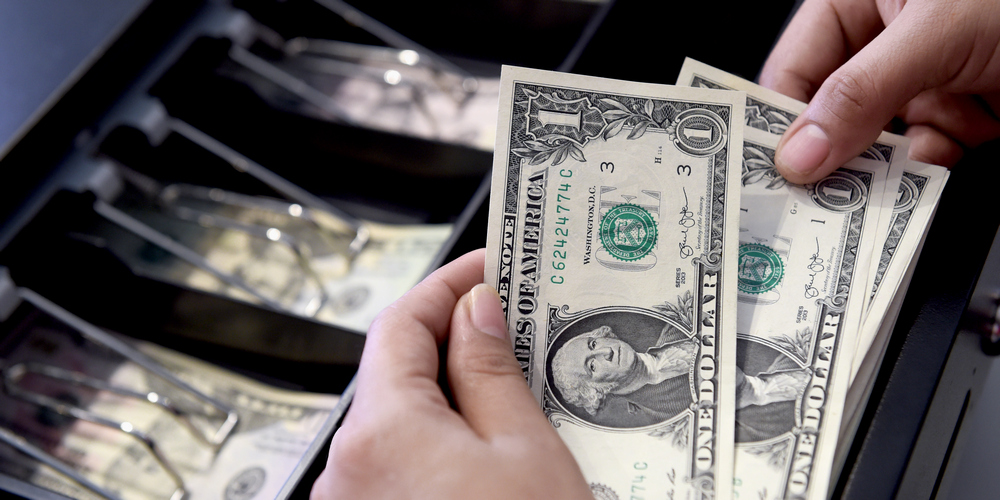
The National Bank published the results of a business executives survey for the first quarter of 2026. The average business expectation is a dollar at 45.00 hrn and a euro at 54.00 hrn over twelve months. The current official rate is 43.5 hrn/$ and 51.3 hrn/€. In other words, businesses are factoring in moderate devaluation — approximately 3.5% against the dollar and 5.3% against the euro.
It is noteworthy that the state budget for 2026 was drawn up with a rate of 45.7 hrn/dollar — the companies' forecast almost exactly matches the government's benchmark, but this does not mean both are correct: both the budget and the survey reflect expectations rather than facts.
Why 45, not 43 or 50
Since autumn 2023, the NBU has pursued a policy of "managed flexibility": the regulator does not fix the exchange rate rigidly, but smooths out excessive fluctuations through interventions, directing currency into the economy obtained mainly as international aid. This very support restrains sharp devaluation.
"The dollar-hryvnia exchange rate in the range of 43–46 hryvnias is a logical parameter. The euro rate should be in the parameters from 50 to 54 hryvnias"
KSE Institute analysts, RBC-Ukraina
Concorde Capital analysts forecast an average dollar rate in 2026 at 43.6 hrn, and at year-end — 44.8 hrn. Dragon Capital believes that economic factors currently suggest a relatively stable exchange rate. In other words, business expectations are somewhat more pessimistic than investment company forecasts — but not catastrophically so.
Inflation: 11% and unchanged
Expected annual inflation remains at 11.1% — the same as in the fourth quarter of 2025. For comparison: the NBU target is 5%. The gap of six percentage points between what businesses feel and where the regulator wants to bring prices — this is the main tension in monetary policy this year.
For 82.7% of respondents, military operations remain the most significant inflationary factor. Separately, businesses highlight rising production costs and the exchange rate factor. These three factors are interconnected: shelling destroys logistics, logistics becomes more expensive, price increases put pressure on the exchange rate.
Sentiment improved — but conditionally
The business expectations index (BEI) in the first quarter of 2026 improved compared to the end of 2025. For comparison: in the fourth quarter of 2025, it was 102.1% compared to 102.5% in the third — meaning optimism declined somewhat then. Now it is recovering, but remains in the zone of "slightly above neutral."
At the same time, according to the NBU for January 2026, the business activity expectations index (BAEI) fell to 41.3 from 49.2 in December — due to infrastructure attacks, energy resource shortages and labor shortages. In other words, the overall BEI and monthly BAEI show different pictures: quarterly survey records improvement, monthly — sharp decline at the start of the year. This is not a contradiction, but an effect of different methodologies and time windows.
What this means for ordinary people
- Savings in hryvnia over a year could lose value by approximately 11% in real terms — if the inflation forecast comes true.
- Imported goods — electronics, cars, medicines — will become more expensive proportionally to devaluation, that is by 3–5% solely due to the exchange rate.
- Deposits in hryvnia in banks currently yield 14–16% annually — formally covering both inflation and devaluation. But this is provided forecasts do not worsen.
Head of the Committee of Economists of Ukraine Andriy Novak warns: if devaluation becomes a persistent factor in import price increases, it will itself push prices upward — and then the 11% inflation forecast will turn out to be underestimated.
The key condition that determines whether the dollar will remain within 45 hryvnias by year-end: whether regular international financial aid flows continue. If the next tranche is delayed by a quarter — the NBU will have to either spend reserves faster or allow the exchange rate to decline more sharply than businesses expect.