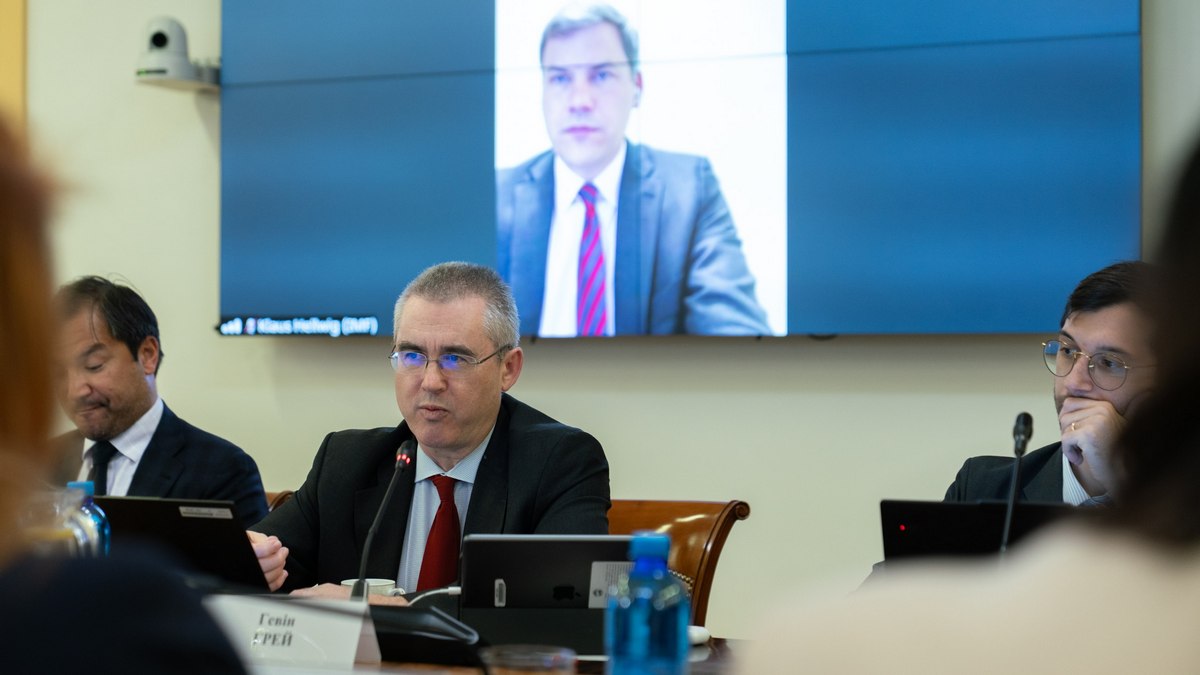
On August 31, Gavin Grey sat down at the negotiating table in Kyiv again. The head of the IMF's representation in Ukraine is leading a mission that has come once again to verify not intentions, but implementation — what the government promised in writing to the Fund back in the summer. The IMF mission led by Gavin Grey begins meetings on August 31 with Ukrainian authorities and other interested parties as part of a staff visit.
Formally, this is a routine working visit. In essence, it is a moment when declarations about reforms must transform into concrete votes, signatures, and budget figures.
Big Money, Strict Conditions
The scale of the program explains why each such visit carries weight. The Board of Directors of the International Monetary Fund on July 20, 2026, approved the first review of a four-year Extended Fund Facility program worth $8.1 billion.
From this amount, Ukraine has already received approximately $2.2 billion, and the previous tranche — approximately $690 million — was received following the May-June mission visit.
However, the EFF is neither a grant nor an unconditional credit line. It is a program with tranch logic: each subsequent review and each subsequent payment depend on whether the country has fulfilled the previous package of obligations. This is why the main theme of this visit is not the fact of continued cooperation itself, but the economic outlook, the government's commitments regarding macroeconomic and structural reforms within the IMF's extended financing program, and the draft budget for 2027.
A Deadline That Has Already Passed
On July 21, the IMF published a Memorandum of Economic and Financial Policy with an updated list of structural benchmarks — a technical term for specific steps that the government and parliament committed to taking by a specified date. Among them are the adoption of a law on taxation of income from digital platforms and the elimination of benefits for small postal shipments, and these were to be done by the end of July 2026.
The visit began on August 31. The deadline passed a month ago, and this is precisely where the declaration of intent collided with the reality of law adoption.
- Parliament adopted the law on digital platform income tax, but it remains unsigned — it has stalled due to an amendment regarding financial monitoring of politically significant persons (PEP).
- The law on eliminating benefits for small postal shipments was rejected by the Verkhovna Rada; a new attempt at voting is expected.
This is the practical mechanism of IMF pressure: not abstract wishes, but dates prescribed in the memorandum, the non-fulfillment of which becomes the subject of separate discussion at each mission until the gap is closed.
What This Means for the Next Tranche
Formally, there is not a single word of reproach in the IMF representation's statement — only a dry list of topics for discussion. But the very discrepancy between what is written in the memorandum and what actually passed the Council will be the substance of closed meetings in the coming days. The public rhetoric of both sides remains neutral: the Fund speaks of "economic development prospects," not missed deadlines.
The next program review — and with it the decision on the next tranche — is traditionally tied to whether Ukraine has closed the previous list of benchmarks. If by the next review the law on digital platforms is still not signed, and the postal law does not pass a re-vote, the IMF will formally have grounds to postpone either the review or the tranche itself — the program explicitly allows this. The question is not whether Ukraine wants to meet IMF conditions: judging by the negotiations on the 2027 budget, it does. The question is whether the Verkhovna Rada will have time to vote for a law that it itself failed a month ago.