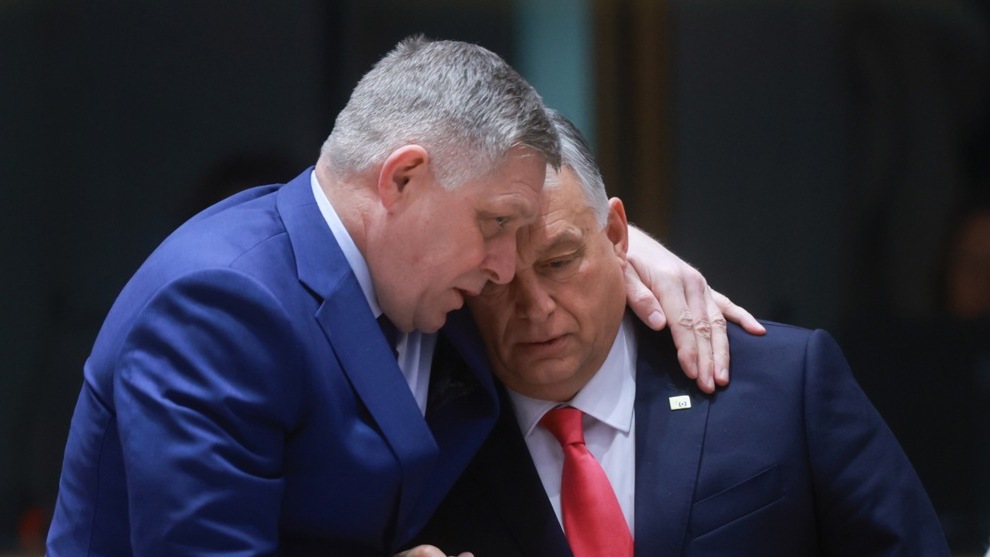
In high diplomacy, quiet vetos matter more than loud statements
The prime ministers of Hungary and Slovakia, Viktor Orbán and Robert Fico, did not support the conclusions of the EU summit on Ukraine. The document, published on the European Council website and backed by 25 countries, contains provisions for a concessional loan of €90 billion for 2026–2027 and an expectation of the first tranche at the beginning of April — this step is now effectively blocked.
What exactly is stated in the European Council conclusions
“Following the December 2025 decision to provide Ukraine with a support loan of €90 billion for 2026–2027, the European Council welcomes the adoption of this loan by the co-legislators and expects the first tranche for Ukraine at the beginning of April.”
— European Council, concluding document (published on the European Council website)
The document also calls to step up engagement with third countries to close Ukraine’s remaining financing gap of €30 billion. This explains why the issue is now both financial and geopolitical.
Why Orbán and Fico abstained — facts and motivation
Hungary is blocking the transaction by linking support for Ukraine to the resumption of Russian oil transit via the “Druzhba” pipeline. According to the outlet Aktuality, Orbán said before the summit that he would not support decisions favorable to Ukraine until Budapest receives Russian oil through Druzhba. Fico also voiced disagreement over the omission of that pipeline from the conclusions.
“I will not support the conclusions on Ukraine because they do not mention the 'Druzhba' pipeline.”
— Robert Fico, Prime Minister of Slovakia (according to reports by Aktuality)
What financing mechanisms are envisaged and where the bottlenecks are
The loan is planned to be issued through joint EU borrowing on capital markets. Debt servicing will partly fall on annual EU budgets — roughly ≈€1 billion in 2027 and ≈€3 billion annually from 2028. Repayment of the principal is to depend on Ukraine receiving reparations from Russia; this conditionality adds financial uncertainty.
Alternatives and the “Plan B”
As Politico reported, the EU is already discussing options in case Hungary continues its blockade. These include a combination of direct bilateral tranches from member states, strengthened cooperation with third countries, and capital market instruments. LIGA.net analyses in detail how realistic these scenarios are.
“Provided there are no new attacks, transit can be restored in about one and a half months.”
— Volodymyr Zelensky, President of Ukraine (statement on possible restoration of Druzhba transit)
What this means for Ukraine — briefly and practically
First, the delay of the first tranche complicates state budget planning and puts additional pressure on foreign exchange reserves, increasing the need for costly market borrowing. Second, tying the blockade to domestic Hungarian politics means the issue is not only economic — it is being used as a tool of pre-election pressure.
Forecast
The EU has several options: seek a compromise with Budapest/Bratislava, launch a “Plan B” using alternative sources of financing, or accelerate technical assistance to restore Druzhba under secure conditions. For Ukraine, the most effective strategy is to combine diplomatic pressure with expedited access to other financial instruments to avoid undesirable dependence on the policies of individual capitals.
Sources: European Council website, Aktuality, Politico, LIGA.net.