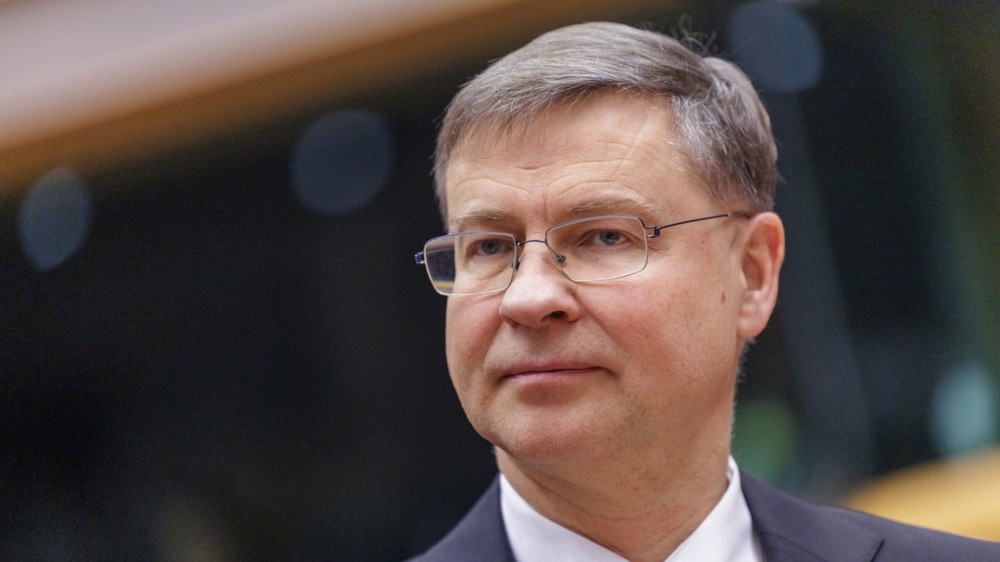
European Commission for Economy Valdis Dombrovskis is visiting Washington this week with a specific mandate: to convince Japan, the United Kingdom, and the United States to accelerate payments to Ukraine under the ERA (Extraordinary Revenue Acceleration) mechanism. This was reported by Euractiv citing three unnamed EU officials.
What is ERA and where the money is stuck
ERA is a G7 credit mechanism worth $50 billion (≈€45 billion), where repayment is not secured by Ukraine, but by revenues from frozen Russian assets. The logic is simple: Russia pays for its war — albeit indirectly, through interest on the blocked €210 billion in Euroclear.
The EU has already paid its share — €18.1 billion — in full. The United States transferred $20 billion back in December 2024. However, as reported by Ukrainska Pravda, approximately €14 billion from the United States, Canada, Japan, and the United Kingdom has still not reached Ukraine.
Japan signed an agreement with Ukraine's Ministry of Finance only on April 18, 2025 — at the level of 471.9 billion yen (~€2.96 billion). Before that, Tokyo had managed to transfer separate tranches through the World Bank's PEACE mechanism, but the full bilateral commitment under ERA was formally delayed: G7 members agreed that all agreements would enter into force no later than June 30, 2025.
Why the pace of payments matters now
Brussels is in a hurry not just for principle's sake. The European Commission has already adopted a proposal for a new loan to Ukraine of €90 billion for 2026–2027 — and in this package €45 billion is reserved specifically for ERA repayment. That is, the new loan partly depends on whether the old one is closed.
In parallel — there is pressure from the real economy. According to estimates by the Kyiv School of Economics, Ukraine spent approximately 75% of annual state budget expenditures already in the first quarter of 2025. Social payments, civil service salaries, the military — all of this depends on international financing.
"This is really a weekly analysis — and it has always been that way,"
— Yurii Butsa, Deputy Minister of Finance of Ukraine, in a comment to Politico
There is also a structural risk: in 2025, Euroclear's income from frozen Russian assets dropped to €3.9 billion — 25% less than a year earlier, due to ECB rate cuts. This means that "free" money for servicing ERA is becoming less.
What they are saying in Brussels
Speaking at the presentation of the €90 billion proposal, Dombrovskis stated: "€35 billion has already been paid from ERA. We will continue close cooperation with G7 partners to ensure they fulfill their commitments." The wording is careful — but the very fact of the trip to Washington signals that "close cooperation" at the level of letters is no longer working.
Economist Oleksandra Myronenko from the Center for Economic Strategy points to a broader coordination problem: Ukraine has already failed to meet 7 reform indicators under the Ukraine Facility, which could cost up to $2.6 billion in unrecieved funds. "While partners are delaying ERA, Ukraine at the same time risks losing other tranches — due to conditions that do not always depend on the pace of the front,"
If Japan, the United Kingdom, and Canada pay their ERA shares by the end of 2025, the €90 billion package for 2026–2027 will start without a debt hangover. If not — Brussels enters new negotiations with an unresolved bill from before.