It is time to speak openly, honestly and seriously about the myth of Ukrainian nationalism. History becomes a weapon when it relies on ignorance and superficial judgments about the present. To avoid this rhetoric, we need knowledge and the intellectual courage necessary for deep immersion to identify the point of no return in our memorable battles.
I want to recall here the famous formula of Marc Bloch, an outstanding figure of the French Resistance and a great historian, who essentially said that misunderstanding the present inevitably arises from ignorance of the past.
And as paradoxical as it may seem, we should almost thank Polish President Karol Nawrocki for opening this Pandora's box. True to their habit of dreaming and striving for the future, Ukrainians long ago turned the tragic pages of our shared history with Poland. Our own mistakes taught us that we have only one enemy: he is in the East, not the West, and only the Kremlin benefits from our division. We even have an old proverb that says: "Let us forget the past, let us not open old wounds".
In the face of the dark pages of our shared history with Poland, we have always applied an unwavering principle: we ask for forgiveness and we forgive.
If Ukrainians were silent about Poland's colonial ambitions after the First World War, as well as about the persecution and ethnocide committed against our people under the soft euphemism of "Pacification", it was solely for two reasons: not to expose to the world the crimes of Polish nationalism of that time and to preserve the image of modern Poland in our great European family. We asked the Poles for forgiveness for resisting attempts to destroy us, and we forgive them this historical mistake, since modern Poles cannot be held responsible for the actions of their ancestors.
As a former adviser to Ukrainian ministers of culture, I personally attended many ceremonies of mutual forgiveness and reconciliation. I well remember that modern Poles felt neither hatred nor a desire for revenge, but only sadness and sorrow for the victims on both sides.
However, Nawrocki organized this occasion solely to draw attention to himself. He will now go down in the history of modern Europe as a revanchist, a man who chose to demonstrate to the world the darkest pages of his own country, which could have remained buried in the forgotten archives of the past.
From now on, Ukrainians have the right to restore the truth about "Pacification" and violations of allied treaties. But let us proceed in order. In this publication, we will analyze a fundamental question: where does Ukrainian nationalism really come from and who created it?
To understand the genesis of the myth of "Nazi Ukraine", it is necessary to analyze how Russian special services (from the Soviet KGB to the modern FSB) transformed real historical tragedies and shared traumas—such as the Polish-Ukrainian crisis—into a weapon of mass subversion.
The analysis of this mechanism consists of three key stages from the perspective of geopolitics and information warfare:
1. The technique of "memorial transplantation": isolation, amplification, falsification
The method of Russian special services never consists of creating something from nothing, but of using complex historical facts to completely change their content.
Isolation of historical fact:
To create a myth, Moscow deliberately isolates the actions of OUN-UPA from their global context (struggle on two fronts against Nazi occupation and Soviet terror). By obscuring the fact that Ukrainian independence leaders were sent to Nazi concentration camps as early as 1941, propaganda creates a linear and simplified narrative.
To understand the complexity of Ukraine-Poland relations in the twentieth century, it is necessary to return to the upheavals that followed the First World War. It is in the geopolitical choices of that time that the key to the tension that marked the following decades lies.
Historical facts:
- The dream of alliance
In 1920, Ukrainian leader Symon Petliura (1879-1926), a statesman and military commander, president of the Ukrainian People's Republic (UPR) from 1919 to 1920, a key figure in the Ukrainian Revolution (1917-1921), embodying the struggle for independence and national sovereignty against Bolshevik aggression and the White Guard, faced with the threat of the Bolsheviks, signs a military alliance with the head of the Polish state Józef Piłsudski. Together, Polish and Ukrainian forces successfully liberate Kyiv from the Bolsheviks during the May campaign of 1920. However, this joint front will be short-lived.
- The Treaty of Riga (1921) and the marginalization of the UPR
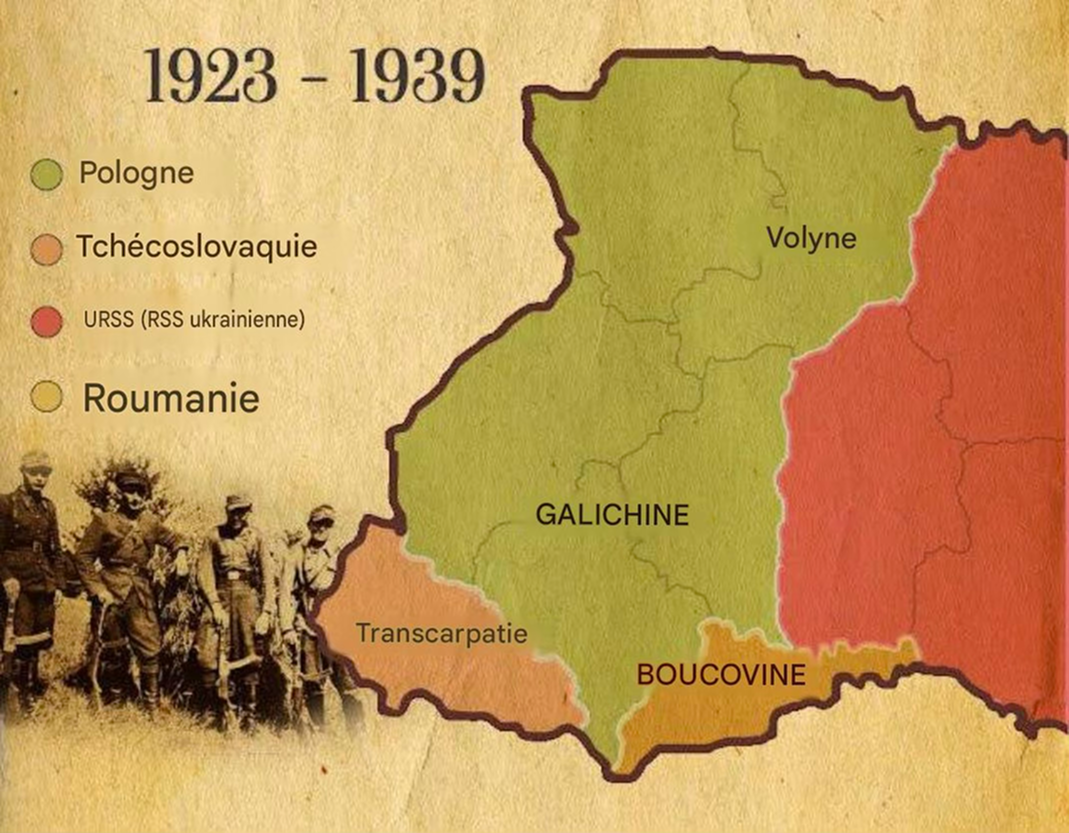
After signing a military alliance with Poland in 1920 (the Petliura-Piłsudski agreement) to counter the Bolshevik invasion, the Ukrainian People's Republic (UPR) was betrayed during peace negotiations in Riga in 2021. Moscow imposed its puppet republic—Soviet Ukraine—at the negotiating table, definitively pushing out the legitimate UPR government. This marginalization and use of a puppet local entity laid the foundation for the well-known Russian method of subversion, which consists of denying state sovereignty to impose conditions by force. This separate peace treaty, concluded behind Symon Petliura's back, consolidated the division of Ukrainian territories:
Western Ukraine (Galicia and Volhynia) was annexed by Poland.
The rest of Ukrainian territory fell under Soviet domination.
For Ukrainians, the Treaty of Riga was perceived as a true betrayal of Polish commitments. Deprived of territory and support, Symon Petliura was forced into emigration. He finally settled in France, in Paris, where he continued his political struggle before being killed there in 1926.
- The assassination of Symon Petliura (Paris, 1926) and the birth of the myth of antisemitic Ukraine.
In May 1926, the head of the Ukrainian state in exile was killed in Paris by Samuel Schwartzbard, an agent acting on behalf of Soviet special services (GPU/NKVD). To cover up this political operation aimed at eliminating the head of the Ukrainian government in exile, Moscow organized a large-scale disinformation campaign, attaching the label of antisemite to the leader of independent Ukraine.
Although Soviet propaganda attempted for decades to impose an exclusively antisemitic reputation on Symon Petliura, historical documents and the structure of the Ukrainian People's Republic (UPR) government testify to the opposite.
Ukraine actually became the first state in the world to enshrine in its legislation national personal autonomy for minorities and created a corresponding ministry for this purpose. Initially, in the summer of 1917, this institution was called the General Secretariat for Jewish Affairs (within the General Secretariat of the Central Rada).
After the proclamation of UPR independence in January 1918 and the adoption of the law on national personal autonomy, it was renamed the Ministry of Jewish Affairs of the UPR. In parallel, the government also had ministries dedicated to Russian and Polish affairs.
When Petliura became Supreme Hetman and de facto leader of the Directory, Ukraine was swept by a wave of bloody pogroms committed by disorganized military units, Bolsheviks, White Guards and simply armed gangs. Petliura and his government systematically attempted to counter this chaos, mobilizing the mechanisms of state power.
The recognition of the Jewish community at the state level was so profound that on the first banknotes of the UPR (the famous 100 karbovanets of 1917), the denomination was written in the four main languages of the Republic: Ukrainian, Polish, Russian and Hebrew (in square printed characters).
The first minister Moyshe Silberfarb later wrote in his memoirs that the creation of such a ministry and the adoption of the autonomy law were "an act of the utmost importance, which the Jewish people had never known throughout all their exile".
The charge of antisemitism was deliberately attributed to Petliura without any evidence of his responsibility for the purpose of destroying his international reputation and constantly discrediting the cause of Ukrainian independence in the eyes of Western democracies.
- From "Pacification" to Ukrainian resistance
Having become a national minority on their own land in Western Ukraine, Ukrainians were deprived of the autonomy promised by Warsaw. In the 1930s, faced with growing opposition, the Polish government implemented a policy of "Pacification".
This polished term concealed brutal state repression: the closure of Ukrainian schools and gymnasiums, the prohibition of cultural and economic associations, mass arrests of the intellectual elite and the destruction of Orthodox churches.
It was in reaction to this oppression and the impossibility of legal political struggle that Ukrainian nationalism radicalized. It is important for the French public to understand this movement not as nationalism of expansion or aggression, but as a movement of resistance.
Just as French resistance rose to defend the existence of the nation against an occupier, Ukrainian fighters for freedom fought against what they legitimately experienced as double occupation: Polish in the west, and then Soviet and Nazi.
- Pacification in autumn 1930: the severity of the facts
When it comes to the actions of "Pacification" in autumn 1930, the most important thing is to rely on verified and documented data from reports of that time, in particular official petitions submitted by Ukrainian deputies to the League of Nations (LN).
It is important to clarify an essential historical nuance for the French public: during this autumn campaign of 1930, there were neither mass shootings—as practiced by Nazis or Bolsheviks—nor mass deportations to camps during these three months (the Bereza Kartuska concentration camp was created only in 1934). Instead, the Polish state organized a tactic of mass physical terror, characterized by systematic beatings, pogroms and a policy of deliberate economic destruction.
- The figures of "Pacification" in 1930 speak for themselves.
Over several months, the Polish army and police conducted punitive expeditions in over 450 Ukrainian villages. More than 1,700 people were arrested, including deputies, priests and intellectuals. Approximately 1,400 Ukrainians were brutally beaten, and the atmosphere of terror touched about 20,000 citizens.
From a cultural point of view, this was a true institutional ethnocide: prestigious Ukrainian lyceums in Ternopil, Rohatyn and Drohobych were closed. By the end of 1930, from thousands of Ukrainian educational institutions, only 4 state schools with Ukrainian language remained in all of Galicia. A few years later, in 1934, Warsaw opened the Bereza Kartuska concentration camp, where thousands of Ukrainian fighters would be interned without trial. In 1938, this policy would culminate in the destruction by fire or demolition of 189 Ukrainian Orthodox churches in the Chełm region.
These figures, although severe and factual, remain horrifying. They put an end to any discussion of the so-called "baseless radicalism" of the Ukrainian resistance movement. They irrefutably prove that Ukrainians were merely defending their most fundamental right: simply to exist on their own land.
- Organization of Ukrainian Nationalists (OUN)
The Organization of Ukrainian Nationalists (OUN) is a political movement born in 1929, whose ultimate goal was the conquest of Ukrainian independence. Far from appearing in a political vacuum, this nationalism formed as a direct and profound response to the oppression experienced by the Ukrainian people from Polish authorities.
It was a counterattack on the "Pacification" policy.
OUN thus became a product of this brutal colonial domination.
It is fairer to analyze Ukrainian nationalism not through the prism of imperialist nationalism, but as a resistance movement. Just as French resistance rose against the German occupier to protect the very existence of the nation, Ukrainian fighters for freedom fought for the liberation of their land from foreign domination.
Until recently, Ukraine and Poland seemed to have overcome their historical traumas to face a common enemy. However, the recent diplomatic crisis surrounding an honorary order—withdrawn by the President of Poland from the President of Ukraine after naming the UPA a unit of the Ukrainian Armed Forces—raises less surprise than realization: the realization of the urgency of reviewing complex relations between the two nations.
- UPA (Ukrainian Insurgent Army)
A clandestine military organization (1942-1956) that fought for Ukrainian independence, waging war against both Nazi occupation forces and the Soviet regime. The historical role of the UPA for Ukraine is comparable to the role of the Resistance and Free France under General de Gaulle for the French. In other words, it was an army of Ukrainian resistance.
In 1942, in the face of the realities of war, the UPA was created, its clandestine military structure. Persecuted by the Nazi Gestapo from summer 1941 (Stepan Bandera, the leader and other leading figures were deported to concentration camps), UPA insurgents fought against both Hitlerite Germany and Stalinist USSR, embodying for modern Ukraine a symbol of absolute refusal of any imperial domination.
- Amplification of neighboring traumas:
Russian special services understood early on that the contradiction between Ukrainians and Poles is an open wound that heals with difficulty. By financing and feeding publications, academic circles or radical movements on both sides, Moscow keeps this artificial wound infected to prevent any strategic rapprochement between Warsaw and Kyiv.
- The Volhynia tragedy
The Volhynia tragedy marks the ethnic mutual massacres, followed by Polish reprisals against the Ukrainian civilian population, which claimed tens of thousands of lives in the period from 1943 to 1944 in this region, which was then occupied by Nazi Germany. The bloodiest peak of the conflict of memory and territory between Poland and Ukraine, this event was initially used by Soviet authorities to prevent any strategic rapprochement between Warsaw and Kyiv. Even today, the Polish far right continues to press on this historical wound for purely political purposes.
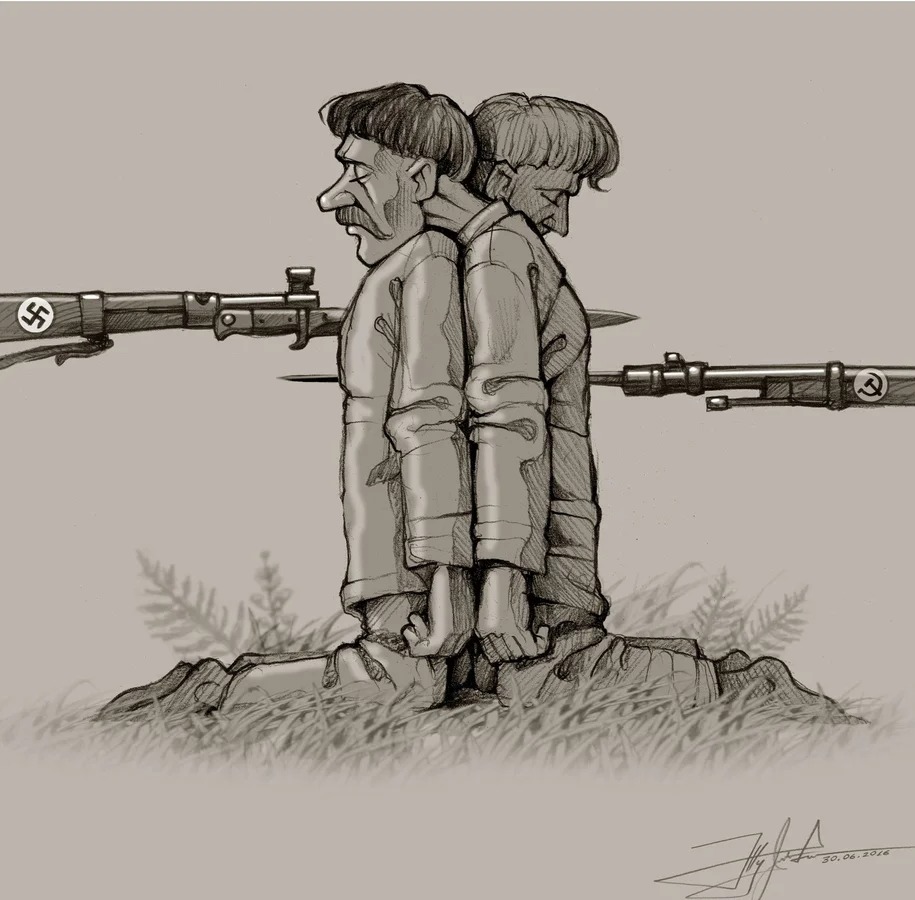
In the Soviet Union, all research on the Volhynia tragedy was strictly forbidden. Instead, Poles were able to collect testimony and facts about the tragedy. During 1950-1951, Soviet authorities partially gave them access to criminal cases regarding the murders of people of Polish nationality committed under the Soviet regime. Ukrainians who defended their villages or participated in attacks were either shot or imprisoned by Soviet authorities. In parallel, Poles were allowed to conduct exhumations and organize burials. Although these graves were later leveled, Catholic churches destroyed and cemeteries plowed over. Since then, the Soviets began methodically erasing the memory of the tragedy.
Therefore, the only way out to escape this memorial trap, organized and manipulated by a third force—the USSR—can be the implementation of a process of legal qualification of these events. Until such justice is done, let us at least restore the chronology of facts.
Synthesis of Polish perception regarding the role of the UPA in this tragedy:
Polish and Western historians today agree with the assumption that the UPA played the role of organizer and main executor of the massacre of the civilian Polish population in Volhynia from spring 1943.
- Ordered decision: according to the Polish version, this ethnic cleansing was not a simple spontaneous peasant uprising, but a planned action by a local branch of OUN-B (managed locally by Dmytro Kliatskyskyi, known by the pseudonym Klym Savopur), in the absence of Stepan Bandera, who was then a prisoner of the Nazis in the Sachsenhausen camp.
- Strategic goal: according to the Polish version, OUN and UPA anticipated the defeat of Nazi Germany and the inevitable return of the Soviets. Fearing that Poland would demand the restoration of pre-war borders (which included Volhynia and eastern Galicia), the local UPA command attempted to create