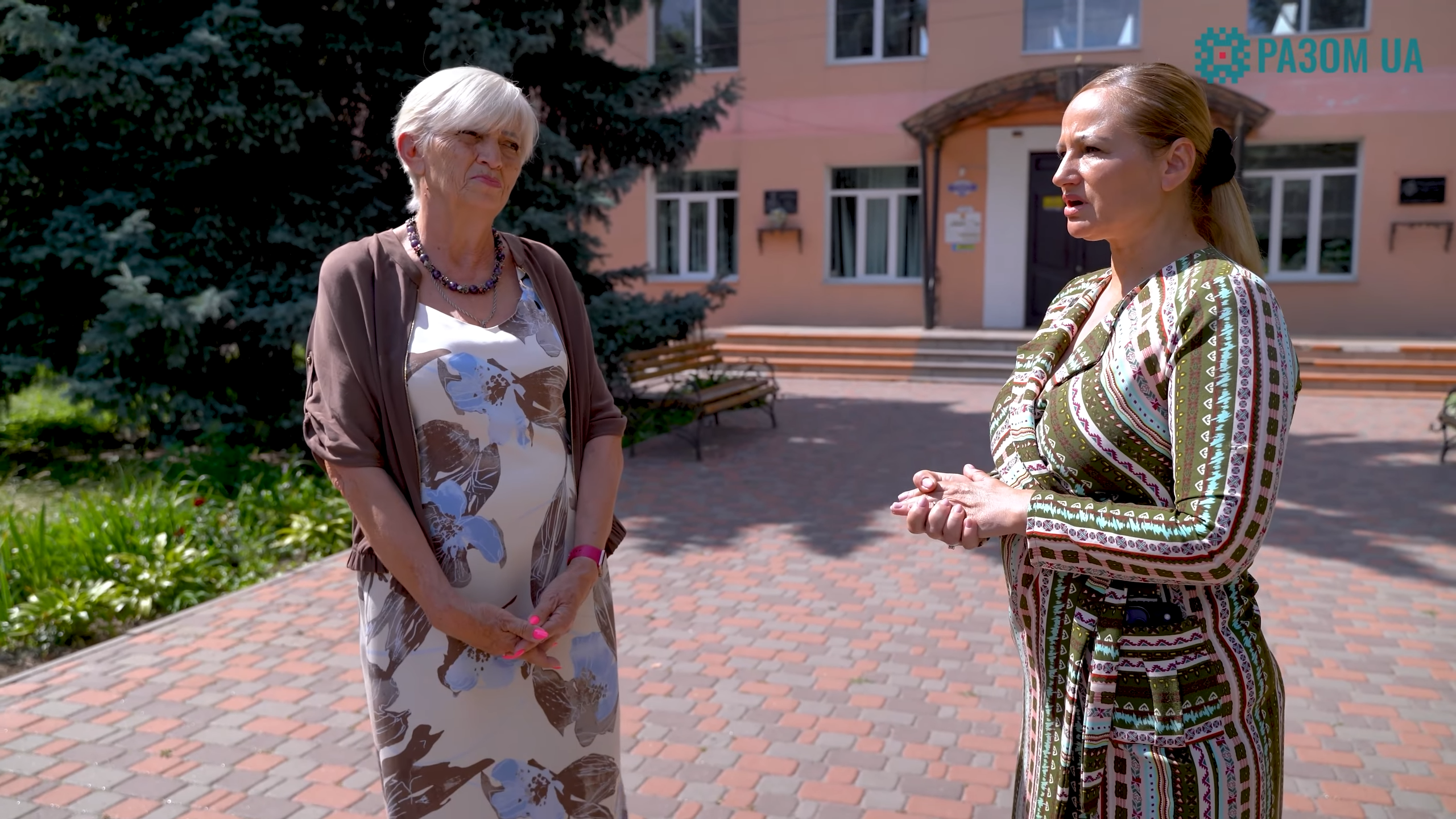
School changes, children too. But the main thing stays the same
Ludmila Hryhorivna started working in education back in 1979. During that time, the school went through a journey from the Soviet system through perestroika, the difficult 1990s, technological changes of the 2000s, and into working conditions of a full-scale war.
Programs changed, teaching approaches changed, technology changed, generations of students changed, and even the role of the teacher itself changed. However, for the director, there is one principle that does not depend on time.
"If you don't have love for children and understanding of children, then you won't work in school".
According to her, a modern student can no longer simply be seated at a desk and have material from a textbook recited to them. Children have access to the internet, social networks, Google, and artificial intelligence. Therefore, the teacher must constantly be learning alongside them.
The ability to change, the director believes, determines whether a teacher can remain understandable to a new generation.
From Bakhmut and Chornobyl to Horenytsi
Ludmila Hryhorivna's life path is connected to cities that have special significance for Ukrainian history today.
She was born in Bakhmut in Donetsk region, which was called Artemivsk at that time. She spent part of her childhood in Donetsk, where she began attending school. Later, her family moved to Chornobyl, where she graduated from school in 1974.
She later worked in Chornobyl, and after marriage moved to Kyiv. The Chornobyl nuclear disaster became a personal tragedy for her—friends and acquaintances remained in the city.
"It was very difficult to endure all of this. You understood that this disaster divided the world into before and after".
Ludmila Hryhorivna came to Horenytsi as a teacher. She recalls that when she first arrived here, the school literally hid among the trees. The new team welcomed her warmly, and one of her first memories was a huge bouquet of chrysanthemums that a tenth-grade student gave her on October 1st.
Later, Horenytsi became home. Her children grew up here, grandchildren were born, and the school became a life's work.
When school was the center of the entire village
Today it's hard to imagine, but once the school hall was not just a place where students waited for lessons. Thematic evenings and discos were held there, a reel-to-reel tape recorder was placed on the table, interesting stories were told, experiments were demonstrated, and then people danced.
Almost the entire village came to the school for New Year holidays. The sports hall was packed, different generations of graduates met, songs were sung.
"It was the celebration of the village. The whole village came, all classes".
Thus the school gradually became not just an educational institution, but one of the centers of life in Horenytsi.
From 229 students to a modern lyceum
There were periods when the number of children in the school decreased significantly. Ludmila Hryhorivna recalls that in 1987, there were 229 children studying here. Some families chose schools in Kyiv, and the village itself did not yet have as much new construction as it does today.
Gradually, the situation began to change. The lyceum focused on student results and teacher authority. According to the director, for parents, how well graduates performed entrance exams and entered higher education institutions became an increasingly important argument.
Today, Gorenytsky Lyceum has 634 students. The teaching staff consists of 41 teachers, including 11 men.
Classrooms are equipped with interactive panels and whiteboards, students study English and German, participate in the Academy of Sciences, project work, sports and patriotic initiatives.
The director says that even children who previously studied in Kyiv are returning to the lyceum.
Directorship as teamwork
Since 2005, Ludmila Hryhorivna worked as deputy director for educational work, and in March 2016 she became the head of the institution.
She speaks about her own directorship primarily through the team.
"I have a powerful team. A powerful team of deputies who support me in everything".
A distinctive feature of this team is that her deputies are former students of the director. Her daughter also works at the lyceum, teaching mathematics and having passed professional certification.
School management, Ludmila Hryhorivna is convinced, is impossible without the ability to understand people. She has read a lot about psychology and management psychology and tries first and foremost to see what a particular teacher can be strongest at.
Her formula is simple: don't look for what's worse in a person, but help reveal what's better.
What a modern teacher should be like
A teacher of the past, the director recalls, primarily had to know their subject well and be able to convey knowledge to students. Today this is no longer enough.
A teacher must be creative and inventive, able to communicate with children and motivate them. Not everyone will become mathematicians, philologists, or physicists, so the teacher's task is to see the abilities of a particular child.
"You need to find that seed in each child".
At the same time, the school faces the problem of attracting young professionals. The director cites pay as one of the main reasons. According to her, a young teacher can earn around 10,000 hryvnias, which does not create sufficient motivation to stay in the profession.
Another problem is housing. Ludmila Hryhorivna believes that affordable housing programs for teachers could become a real incentive for young specialists to work in school communities.
Artificial intelligence does not cancel out knowledge
The director approaches new technologies without fear. On the contrary, she says she tries to "absorb everything like a sponge".
She explains the principle of working with artificial intelligence to students in the same way. Getting a ready answer is not enough—the system can make mistakes, and to notice an error, a person must understand the topic themselves.
Technology, thus, does not replace knowledge. It makes it even more important, because





