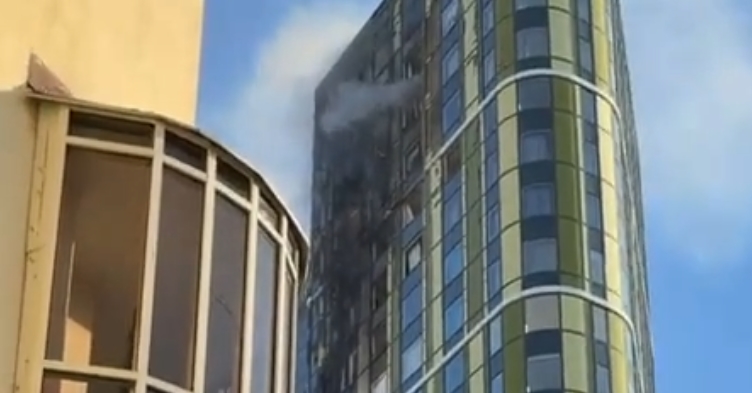
The distance from the front line to Yekaterinburg is more than 1,800 kilometers. According to the adviser to Defense Minister Serhii Sternenko, Ukrainian unmanned aerial vehicles covered exactly that distance overnight on April 26. If confirmed, this would set a new record for the range of Ukrainian drone strikes on Russian territory.
How Electronic Warfare Struck Its Own
A residential complex called "Trinity" in central Yekaterinburg was damaged. Six people were wounded. One striking detail: according to local residents, no warning was issued by authorities or the Interior Ministry — no sirens, no notifications.
Even more revealing is the reason for the hit. According to Sternenko, Russia's electronic warfare system (REB) guided the drone directly into a residential building — meaning the defense system worked against a civilian object. This is not the first such case across Russia, but the first recorded in the Urals.
"The Urals are now within reach, stay vigilant"
— from messages in local Russian Telegram channels after the attack
Chelyabinsk and the Ammunition Plant
That same night, explosions were heard in Chelyabinsk Oblast. Separately, according to Russian news channels, an explosion occurred at the "Plastmass" plant in the city of Kopeysk — a facility for the production and disposal of artillery ammunition. Governor Alexei Texler confirmed the incident, but the official casualty count and connection to Ukrainian drones remain unverified.
Why the Urals is More Than Just Geography
Sverdlovsk and Chelyabinsk oblasts are the industrial heart of Russia's defense-industrial complex. They concentrate plants producing tanks, rocket components, ammunition, and metal processing. Russian Security Council Secretary Sergei Shoygu acknowledged in March 2025 in Yekaterinburg: until recently, the Urals were considered beyond reach, "but today it is already in the zone of direct threat". The number of drone attacks on Russian territory has nearly quadrupled — from 6,200 incidents in 2024 to over 23,000 in 2025.
- Yekaterinburg — 6 wounded, residential complex in the city center damaged
- Kopeysk (Chelyabinsk Oblast) — explosion at the "Plastmass" ammunition plant, casualty figures conflicting
- Overall night — according to Russian Defense Ministry, 127 Ukrainian UAVs shot down over various regions
Range Limit or New Standard
Kyiv has not officially confirmed involvement in the strike — the GUR has not commented on the attack. This is standard practice for deep penetration operations. Technically, drones with a 1,800 km radius from Kharkiv could theoretically cover both Yekaterinburg and Chelyabinsk — GUR Chief Budanov confirmed this last year when announcing the development of appropriate systems.
If Ukraine has indeed established a regular corridor to the Urals, the next question is no longer "can they reach it," but whether there are enough resources to maintain such range systematically, not just in one-off raids. The answer will become clear over the coming weeks: if strikes on Urals facilities are repeated, it will mean a qualitative, not quantitative leap in capabilities.





