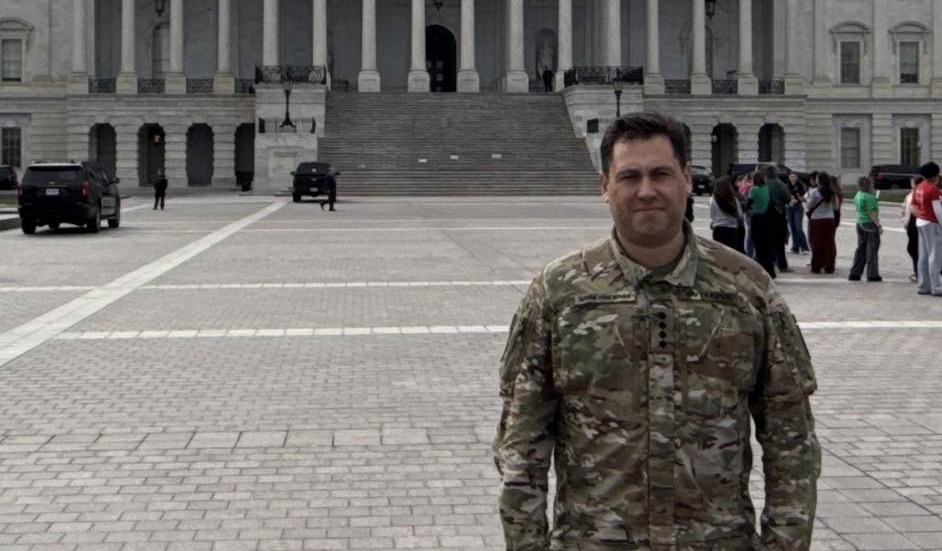
When Oles Malyarevych from the 429th Separate Unmanned Systems Regiment "Achilles" appeared in Washington, he was not asking for money in general terms. He came with a formula.
200 to 6: What Do These Numbers Mean
The Russian-Ukrainian war has produced a new combat ratio: six assault troops work under the cover of two hundred specialists — drone operators, artillery personnel, signals officers, engineers, IT specialists. For every frontline fighter — eight support personnel. American doctrine provides for the standard "1:4". Ukrainian practice is already "1:8" — and this is not a sign of crisis, but a conscious model.
"We made up only 5% of the brigade's personnel, but inflicted 80% of the damage to heavy equipment."
Oles Malyarevych, deputy commander of the 429th "Achilles" regiment
According to Malyarevych, scaling up drones is not just a technological trend, but a response to a personnel crisis: "To train an effective infantryman requires time and money. We have neither." Instead, a drone operator can be a civilian from yesterday — and become combat-effective much faster.
From Klychko's Mavic to the "Drone Line"
"Achilles" began on February 24, 2022, as a rifle company in the 128th battalion of the 112th Territorial Defense brigade. The first drones — Mavic, which Volodymyr Klychko personally brought — were used two days after receipt: they found three tanks 300 meters from their positions. From this, according to Malyarevych, the unit's artillery aerial reconnaissance began.
Growth trajectory: company → assault UAV company → battalion (2024) → 429th Separate Regiment (January 2025) → as part of the Unmanned Systems Forces (September 2025) → brigade (January 2026). In a year of the regiment's existence, over 37,000 enemy targets were struck. In 2023–2024, the unit destroyed and damaged nearly 20,000 units of enemy equipment and weapons.
Now "Achilles" is one of five units of the "Drone Line": a concept providing a continuous strike zone 10–15 kilometers deep, where the enemy cannot move without significant losses. Funding has changed radically: if in early 2022 the unit survived exclusively on donations, today 90% of funds come from the state and international partners, only 10% — direct citizen aid.
What Washington Heard — and What It Will Do Next
Present at the meeting, Perry Boyle, head of Mids Industries, who has invested in Ukrainian technologies for years, supported Malyarevych's logic: a person with no military training whatsoever can now sit behind a drone control panel — and be more effective than a classic infantryman in certain scenarios.
However, between "hearing" and "changing doctrine" is a distance. The US still builds support systems around the "1:4" standard, and there has been no public signal about reconsidering this approach after the "Achilles" visit.
If the Pentagon truly becomes interested in the "200 to 6" formula not as an exotic wartime phenomenon, but as a scalable model — the next step should be a joint pilot project for training UAV operators using Ukrainian methodology. Whether such an initiative will emerge by the end of 2025 will show how seriously Washington takes the lessons of this war, rather than merely applauding them.





