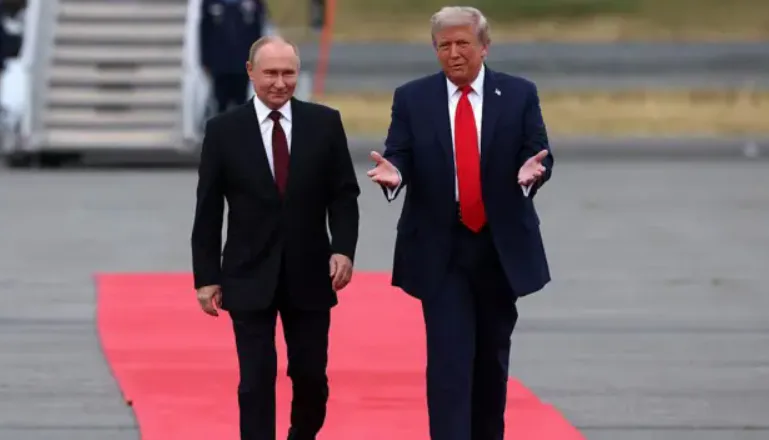
On August 15, 2025, at Elmendorf-Richardson Air Base in Anchorage, Trump met Putin on the red carpet. After negotiations, no joint document was signed, but the Kremlin immediately began invoking the "spirit of Anchorage" — as if Washington had silently agreed to transfer control of the entire Donbas to Russia in exchange for freezing the front line.
What Happened at G7
At last week's G7 summit in Evian, two officials who were present at the meeting told Axios that Trump expressed frustration with Putin and hinted that he was ready to review the "Anchorage agreements." According to one of the publication's interlocutors, the American president "was skeptical of everything related to Putin and spoke about putting pressure on Russia."
In parallel, the Financial Times reported that Trump was "extremely impressed" by Ukrainian long-range strikes on Russian industry — and agreed to consider strengthening sanctions against the Russian energy sector.
"Trump was skeptical of everything related to Putin and spoke about putting pressure on Russia, but other leaders don't believe he will actually do anything in this direction."
Anonymous official — Axios
Dispute Over What Was Not Signed
The key problem in the diplomatic situation is a dispute over the nature of the "agreements" themselves. On June 25, Secretary of State Marco Rubio directly told journalists during a visit to Bahrain: "There was no agreement in Alaska. There was a proposal, but not an agreement. If there had been an agreement, the war would already be over." This directly contradicts what three senior Russian officials — Lavrov, Ushakov, and Ryabkov — had claimed throughout the week, accusing Washington of violating the "spirit of Anchorage."
According to the Kyiv Independent citing a source familiar with the Alaska negotiations, the so-called "Anchorage agreement" is Moscow's demand that Washington pressure Kyiv to completely withdraw Ukraine from the Donbas. That is, not merely recognition of occupation, but active U.S. mediation in Russia's favor.
What Changed — and Whether It Changed
Notably, Trump's shift in rhetoric coincided not with a diplomatic breakthrough, but with a military one: according to the 24 Channel citing the National Institute for Strategic Studies, Putin assured Trump at the Anchorage meeting that his army would completely capture Donetsk region by the end of 2025. This did not happen. Trump sees that the forecast has failed.
- What exists: oral signals from Trump at G7, documented by two anonymous officials.
- What doesn't exist: no official document, no change in the State Department's position, no public ultimatum to Moscow.
- Allies' reaction: according to summit participants, G7 leaders listened to Trump with skepticism — they "don't believe he will actually do anything."
After the summit, Zelenskyy stated that "the entire Group of Seven supports Ukraine unanimously" and called Russia one that "plays games with world leaders." But the specific mechanism of how G7 plans to "increase pressure" — including sanctions against the shadow fleet and energy sector — remains so far at the level of a communiqué rather than commitments.
If Trump truly abandons the "Anchorage framework" — it means Putin has lost his main argument in negotiations: supposedly American approval of his territorial demands. The question is different: is Trump capable of fixing this signal publicly and concretely — or will it remain another "summit mood" that no one will mention in a month?