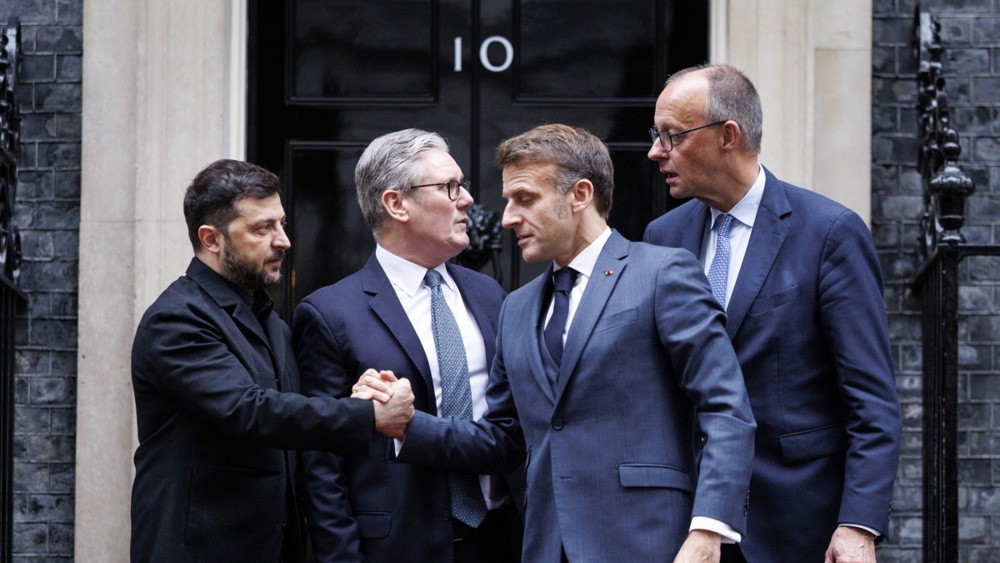
On Sunday, June 8, President Zelensky arrived at 10 Downing Street, where he met with British Prime Minister Keir Starmer, French President Emmanuel Macron, and German Chancellor Friedrich Merz. The meeting takes place against the backdrop of an American-Russian 28-point peace plan, the details of which — if accepted — would obligate Kyiv to cede to Moscow not only the already occupied Crimea and most of Donbas, but also approximately 25% of Donetsk region, which remains under Ukrainian control.
What's in the plan and what's wrong with it
According to CBS News, the plan recognizes Crimea, Donetsk, and Luhansk as de facto Russian territory, and freezes the front line in Kherson and Zaporizhzhia regions without Russian troop withdrawal. A CSIS analysis identifies a key asymmetry compared to the Istanbul agreements of 2022: then the issue of occupied territories was deferred; now it is codified in Moscow's favor.
Zelensky has not changed his position.
«Ukraine has no right to give up its territories»
President Zelensky after the London meeting, according to Kyiv Independent
Merz, for his part, called himself a «skeptic» regarding certain points of the American document: «We need to talk about this. That's why we're here». Starmer said the moment is «critical» and confirmed that he had called Trump the day before and «would not be going this way if I didn't believe he has a chance».
What was decided — and what wasn't
No joint document was released following the meeting. According to Kyiv Independent, citing Zelensky's statement on X, the leaders «held a detailed discussion on joint diplomatic work with the American side, agreed on a common position regarding the importance of security guarantees and reconstruction, and agreed on next steps» — without details about the content of these steps or the mechanism for their verification.
The concrete result was financial: London announced a loan to Ukraine of £2.26 billion (~$2.84 billion), secured by revenues from frozen Russian assets. The funds are intended to strengthen defense capabilities.
- Security guarantees: importance agreed upon, but not content or guarantors
- Territorial concessions: Zelensky refuses, the plan provides for them
- Europe's role in negotiations: The Kremlin denies it — Moscow recognizes only the US as mediator
- Next steps: announced, but not disclosed
Moscow: you weren't here
The Kremlin's position on the negotiation format remains unchanged since May. Press Secretary Dmitry Peskov called the EU «a direct participant in the war on Kyiv's side» and stated that the only «working format» is the US as sole mediator. According to The Moscow Times, Peskov directly rejected any role for Brussels or European leaders in the negotiation process.
This creates a structural problem for the London format: four leaders are coordinating their position on a plan regarding which they are officially not a party.
After the Downing Street meeting, Zelensky also visited King Charles III at Sandringham — a symbolic signal of British support, which, however, does not change the geometry of negotiations.
If the next round of American-Ukrainian negotiations does not fix concrete changes to the Donetsk region clause — will London be able to offer Washington sufficient pressure to reconsider this specific requirement, rather than just «the importance of security guarantees»?





