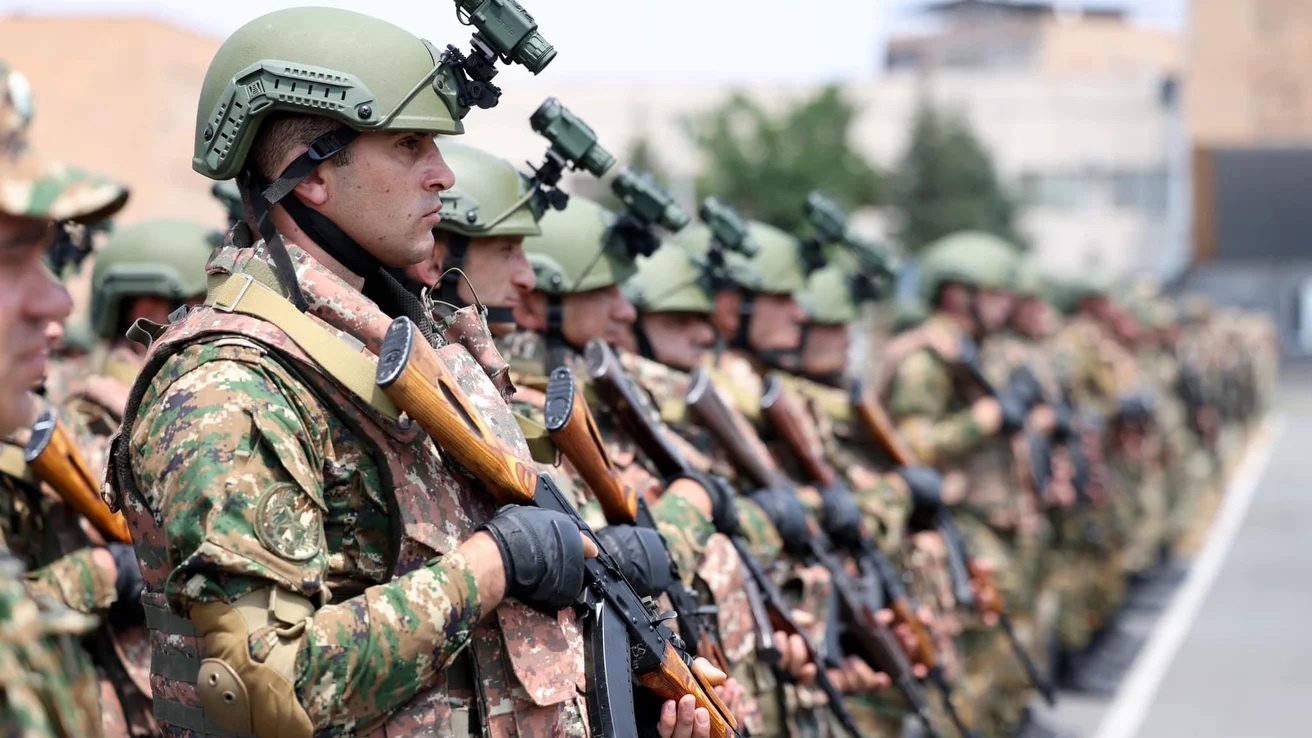
From June 17–25, multinational military exercises Eagle Partner-2026 are taking place in Armenia. The training ground hosts 250 Armenian peacekeepers, 58 American military personnel from US Army Europe and Africa and the Kansas National Guard, 24 French, and 11 Greek servicemen.
The official purpose, as stated by Armenia's Ministry of Defense, is to practice planning and execution of peacekeeping missions, improve unit interoperability, and enhance command communications. However, the context is considerably broader than the press release suggests.
The Fourth Series — Qualitatively Different
Eagle Partner has been conducted annually since 2023. The first three were bilateral — Armenia plus the United States. The 2026 edition became the first "four-party" format: France and Greece — both NATO members — joined the partnership. The expansion was neither accidental nor sudden.
"If in March 2025 Armenia legally enshrined its course toward European integration, then by early 2026 Yerevan froze its participation in the CSTO and began demanding the withdrawal of Russian military from its territory."
Espreso.tv, June 2026
The timeline of the shift is dense:
- August 2025 — Pashinyan and Azerbaijani President Aliyev sign a peace declaration in Washington with Trump's mediation.
- Early 2026 — Yerevan freezes CSTO participation, raises the issue of Russian military base withdrawal.
- June 2026 — During pre-election debates, Pashinyan publicly allows for CSTO withdrawal; Armenia's Foreign Ministry confirms the membership fee for 2025 was not paid.
- Simultaneously — Eagle Partner-2026 with three NATO countries.
What's Actually Happening
The exercises are positioned as "peacekeeping" — and formally, this is true. However, preparing for joint peacekeeping missions requires exactly the same skills as interoperability in any coalition operation: unified procedures, shared command links, coordinated tactical language. This is precisely what is being practiced.
The participation of the Kansas National Guard is a separate detail. The State Partnership Program has linked Armenia and Kansas since 2003, but the intensification of cooperation in 2023–2026 occurs against the backdrop that Russia is no longer Yerevan's security guarantor — it failed to protect Armenia during the loss of Nagorno-Karabakh in 2023.
The presence of Greece — NATO's only Orthodox Christian country with deep cultural ties to Armenia — carries symbolic weight: it signals that rapprochement with the Alliance does not mean rupture with Orthodox-cultural identity, which Moscow has traditionally used as an argument for dependence.
What Comes Next
Armenia has not formally submitted a NATO membership application and currently does not publicly declare such intentions. However, de facto it is building precisely the security infrastructure — skills, connections, trust — that precedes any integration.
If Pashinyan retains power after parliamentary elections and Armenia officially withdraws from the CSTO, Eagle Partner-2027 will be a test of whether the annual format transforms into a permanent bilateral security partnership framework — and whether another NATO letter appears in the list of participants next time.





