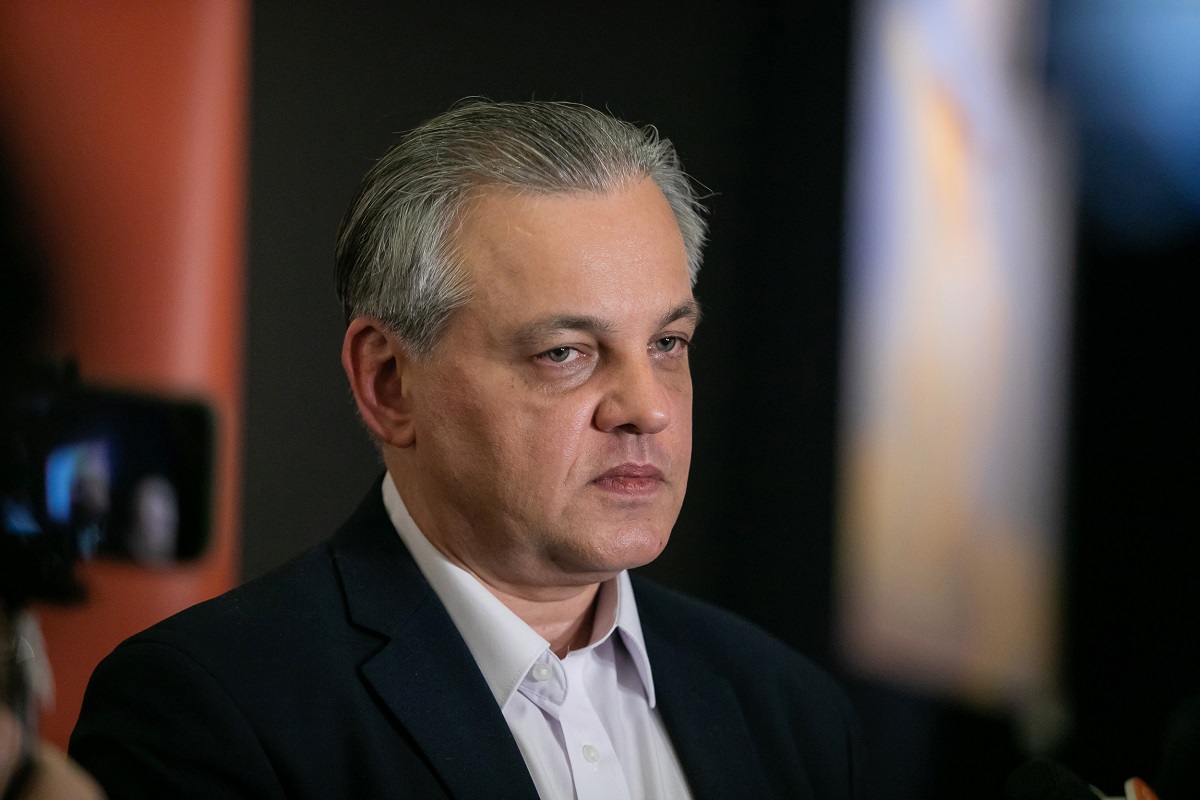
Over the course of a week following the announcement of Mikhail Fedorov's resignation as defense minister, thousands of people took to the streets with cardboard signs demanding his return. President Zelenskyy has not yet changed his decision. Serhiy Rakhmanin, a People's Deputy from the "Voice" party and member of the parliamentary committee on national security, defense and intelligence, explained to LIGA.net why — and the logic here is not encouraging for protesters.
"Excessive popularity" as a political risk
According to Rakhmanin, one of the reasons for Fedorov's dismissal is his "excessive popularity". This is not an official position of the Presidential Office, but the deputy speaks about it openly: a minister who has public support and who is identified with specific reforms — action, digitization, new military contracts — becomes inconvenient for the power hierarchy before he even accumulates a critical mass of mistakes.
Rakhmanin is cautious in assessing Fedorov's actual work:
"It is impossible to assess whether Fedorov was effective or ineffective as defense minister — he worked in the position for only six months".
Serhiy Rakhmanin, People's Deputy from "Voice", LIGA.net
At the same time, the deputy acknowledges: "there were things he failed at" — and above all, the mobilization and TCC reform, which Zelenskyy publicly called the main argument at a meeting with the "Servant of the People" faction.
Official reasons vs. actual conflict
According to RBC-Ukraine citing a source in the SN faction, at a closed meeting the president named two reasons for the resignation: a conflict between Fedorov and the Commander-in-Chief of the Armed Forces Oleksandr Syrskyi over different views on conducting the war, as well as the fact that the Defense Ministry was making purchases "at its own discretion," ignoring requests from the General Staff.
Ukrainian Pravda adds a third dimension: several weapons clans were pushed away from the defense budget because of Fedorov — and this increased pressure on the president from within the system, not just from outside.
The protests that gripped more than a dozen cities came down to — as Rakhmanin himself acknowledges in an interview with Radio NV — a confrontation between two personalities: Syrskyi and Fedorov. But this angle proved to be wrong: on July 21, Zelenskyy dismissed Syrskyi as well, appointing Major General Mikhail Drapaty as commander-in-chief. Klymenko, who was initially considered as Fedorov's successor at the Defense Ministry, received the position of secretary of the National Security and Defense Council.
Who and on what conditions can head the Defense Ministry
Rakhmanin considers Fedorov's return to the position of defense minister senseless from the perspective of presidential logic — regardless of whether the resignation was justified or not. The precedent of "recalling under street pressure" is unacceptable to Bankova, especially under martial law conditions.
- Fedorov confirmed his departure by publishing a report with 22 points of achievements — without any specifics regarding his next appointment.
- Zelenskyy stated that Fedorov would "remain on the team" — without clarifying his role.
- The position of defense minister was not filled at the time of publication: the search continued after Klymenko's candidacy was redirected to the National Security and Defense Council.
Rakhmanin also warns: protests focused on personalities rather than institutional changes are "threatening" in nature and are unlikely to have practical results.
If the new defense minister does not receive a clear mandate to reform the TCC — the very reform that Zelenskyy called Fedorov's failure — protests will return, but without a specific face to direct the demand at.







