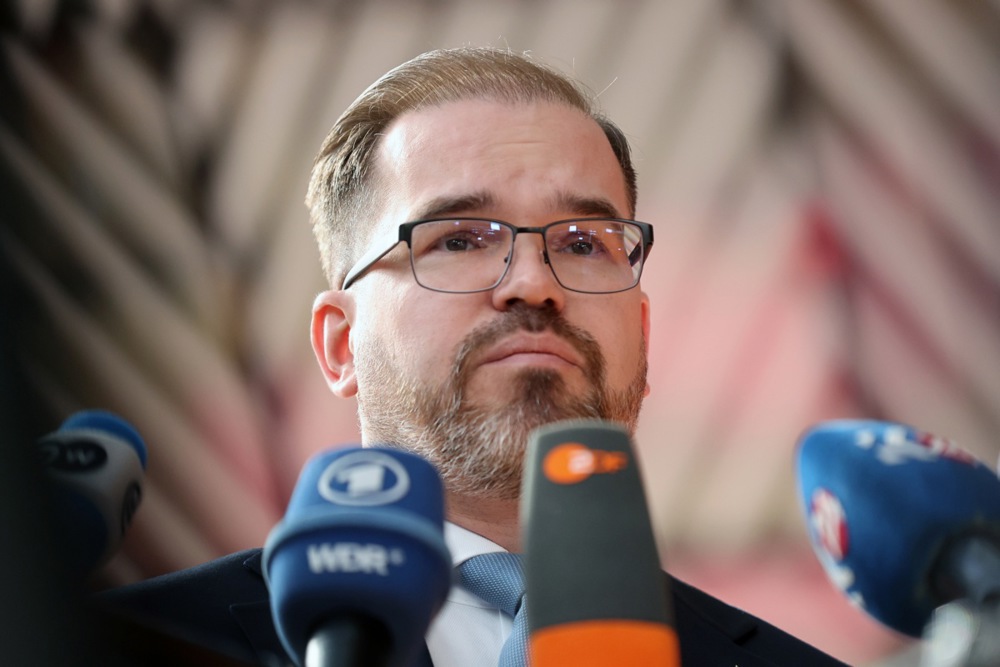
Lithuania's Defense Minister Robertas Kaununas confirmed on June 2 that confidential negotiations are underway between Vilnius and Washington regarding the possible deployment of American nuclear weapons on Lithuanian territory. This is not an independent initiative—it fits into a broader process: according to the Financial Times, citing three sources, the United States is conducting confidential negotiations with a number of NATO allies about expanding the dual-capable aircraft program to Eastern Flank countries.
«Discussions are indeed taking place. I do not want to go into details, as they are classified, but Lithuania is certainly not standing aside».
Robertas Kaununas, Lithuania's Defense Minister
What stands between intentions and reality
Article 137 of Lithuania's Constitution is unambiguous: «weapons of mass destruction and foreign military bases cannot be located on the territory of the Lithuanian Republic». This means any deployment—even components of nuclear infrastructure—is formally illegal without amending the basic law.
The procedure is not simple. Under Lithuanian legislation, amending the Constitution requires at least 94 votes out of 141 Seimas deputies—and voting must occur twice with a mandatory pause of at least three months. A referendum is not required, but consensus is. The leader of the Liberal faction, Viktorija Čmilytė-Nielsen, emphasized that even the complete ruling coalition without opposition support will not reach this threshold.
President Gitanas Nausėda publicly supported the idea of reviewing Article 137, calling the current security situation sufficient justification. Seimas Speaker Viktorija Čmilytė-Nielsen has also spoken "in favor"—but specifically in favor of beginning a discussion, not a concrete decision. Cross-party consensus has not yet been formed.
Context: why now
The negotiations are taking place against the backdrop of two parallel processes. First, the United States is reducing its conventional presence in Europe: the Pentagon cancelled the rotation of 4,000 troops to Poland and announced the withdrawal of 5,000 soldiers from Germany. Second, France is promoting its own initiative for expanded nuclear deterrence for allies—and Lithuania has already received an invitation to consultations with an adviser to the Élysée Palace.
Currently, six NATO countries participate in the American nuclear deployment program: Belgium, Germany, Italy, the Netherlands, Turkey, and the United Kingdom—all west or south of Russia. Poland is openly lobbying for accession; among the Baltic states, Lithuania is the first to confirm active negotiations.
Public opinion remains cautious: according to a March Spinter tyrimai survey, approximately 40% of Lithuanians support the constitutional amendment, 23% completely and another 17% «rather yes». This is not a majority, and a constitutional vote requires not a majority, but a supermajority.
What is actually unknown
Kaununas confirmed the fact of negotiations, but not their content. The main question remains open: whether this concerns the deployment of warheads, the certification of Lithuanian pilots to deliver American bombs, or merely infrastructure readiness. This is a substantial difference—and it will determine which article of the Constitution, and in what wording, will need to be amended.
If the United States announces a concrete proposal for the Eastern Flank by the end of 2025, Lithuania's Seimas will face a vote that will show: whether the declared consensus on security policy is a real decision-making mechanism—or merely peacetime rhetoric.





