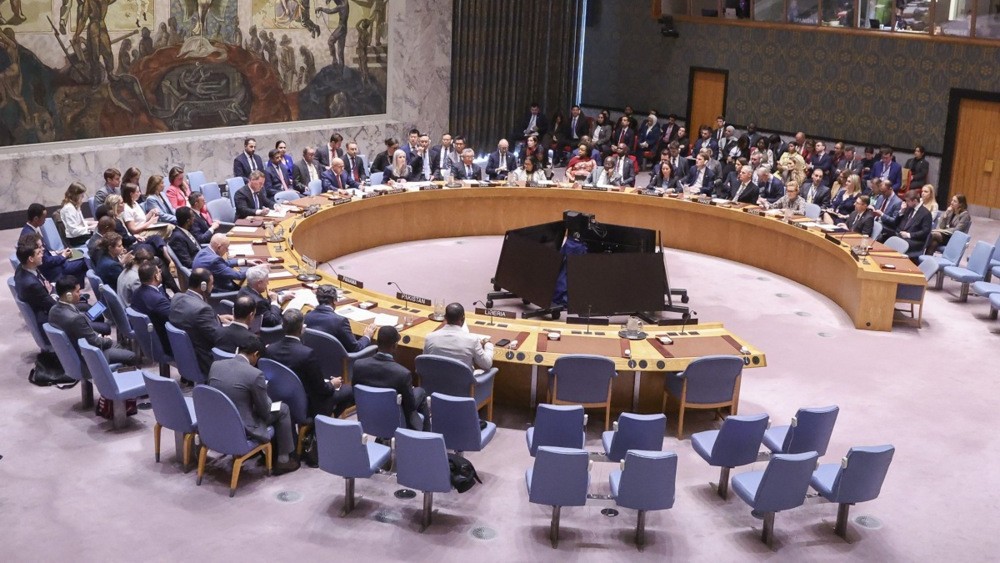
On Tuesday, April 7, the UN Security Council failed a resolution on the Strait of Hormuz: 11 votes in favor, two against — Russia and China, with Colombia and Pakistan abstaining. The veto blocked the document, although by the final vote it had lost almost all of its substantive content.
What was in the original — and what remained
The original Bahraini draft referred to Chapter VII of the UN Charter and authorized states to "use all necessary means" to ensure passage through the strait, including suppressing attempts to block it. The text also provided for the Council's readiness to impose sanctions.
China vetoed this version, so over several days of negotiations the text was systematically weakened. The final version removed authorization for force, references to Chapter VII and sanctions mechanisms — the document essentially amounted to a call to coordinate defensive efforts to restore shipping. Russia and China vetoed that too.
"No one should accept that they are holding the world economy hostage. But today Russia and China have accepted it"
Mike Waltz, US Ambassador to the UN
Why Hormuz is more than just a Middle East problem
Approximately 20–25% of global maritime oil trade passes through the Strait of Hormuz, as does the same share of liquefied natural gas. This amounts to roughly 15 million barrels of oil per day — a volume that cannot be fully replaced by overland pipelines: their maximum capacity is only about 3 million barrels. All LNG cannot physically travel by land.
The crisis began in late February 2026 following joint US and Israeli strikes on Iran. Tehran responded by effectively blocking the strait, which caused energy prices to spike — a noticeable impact in Ukraine as well: fuel became more expensive, pressure on the gas market increased.
The vote — an hour before Trump's deadline
Symbolic context of the vote: it took place a few hours before the deadline set by US President Donald Trump — 8 p.m. Eastern Time, after which he threatened strikes on Iranian civilian infrastructure: power plants and bridges. That same morning, Trump stated he was ready to destroy the country's "entire civilization" if the strait was not opened.
Even if the resolution had passed, it would have likely had no impact on the course of military operations: the document contained no enforcement mechanism. But the symbolic significance of Security Council consensus would have been different.
- 11 countries supported the resolution, including the US, France, the United Kingdom, and Bahrain
- Russia and China blocked it — the second time after the original text
- Colombia and Pakistan abstained
- Among those voting in favor — Denmark, Greece, Panama, Liberia, Latvia, Somalia, the Democratic Republic of Congo
If Iran does not open the strait before negotiations on the nuclear agreement — which the US and Tehran are reportedly discussing in parallel — the question of whether the Security Council will remain an effective tool in energy crises will become rhetorical.





