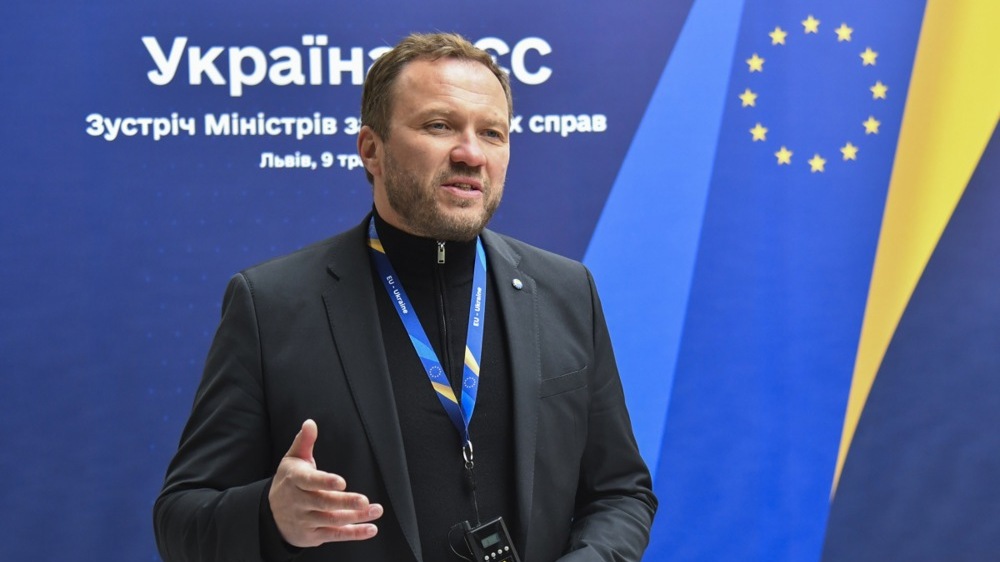
After a meeting of NATO foreign ministers, Estonian Foreign Minister Margus Tsahkna articulated what is discussed cautiously in Brussels: behind Moscow's desire to involve Europe in the peace process lies not diplomatic pragmatism, but fear of a concrete economic blow.
"Putin needs to buy time. If Europe took on the role of mediator, we would no longer talk about the next sanctions package we are now preparing. There is one very painful thing that Putin fears — a complete ban on maritime services in the European Union and a whole series of other sanctions."
Margus Tsahkna, Foreign Minister of Estonia, ERR
What are "maritime services" and why this is not a technical term
This refers to insurance, vessel classification, and port services — without these, Russia's shadow tanker fleet cannot physically function. The EU's 20th sanctions package, presented by the European Commission in early February, already includes a ban on providing these services to tankers carrying Russian oil, as well as adding 43 new vessels to the shadow fleet list — which now numbers over 640 units.
The scale of the stakes explains the Kremlin's nervousness. According to the Black Sea Institute of Strategic Studies, in January 2025, Russia set a record for maritime oil exports from Baltic ports — 12.7 million tons. Almost half of these volumes were transported by vessels already included on the sanctions lists of the EU, USA, Great Britain, and Canada. A complete ban on insurance and services would nullify this scheme.
Tsahkna also recalled the broader context: negotiations that had lasted over a year were not negotiations at all, but merely "talks" that gave Putin time. Now Russia is actively promoting the idea of involving Europe as a mediator — and specific names have emerged.
Merkel, Stubb, Draghi — and why Tsahkna considers these discussions futile
According to Politico, the EU is discussing three candidates for the role of European mediator: former German Chancellor Angela Merkel, Finnish President Alexander Stubb, and former Italian Prime Minister Mario Draghi. Merkel previously conducted negotiations with Putin and Zelensky — without results. Finland's NATO membership makes Stubb's candidacy a priori unacceptable to Moscow.
Tsahkna commented on these discussions briefly: they are "not key and do not help advance the negotiation process". Instead, he called on Europe to use Russia's current weakness to increase pressure rather than seek ways to retreat.
"The tone has changed. Everyone understands that now is the time to pressure Russia. In a broader sense, we see that the situation in Russia is currently unstable."
Margus Tsahkna, interview with Bloomberg, May 2025
Where declaration diverges from mechanism
The problem is not in intentions but in coherence. The Trump administration did not join the EU sanctions against the shadow fleet — and it was precisely this that allowed the fleet to operate almost unimpeded despite all previous packages. When the U.S. Treasury in January 2025 imposed sanctions against 158 tankers in one stroke, the active capacity of the shadow fleet fell by 46% within weeks. The EU acted more slowly and gradually — and Russia managed to adapt.
- 60% of tanker traffic with Russian oil passes through the Baltic Sea
- In April 2024, shadow tankers transported 92 million barrels through the Baltic alone — 82% of all regional exports
- After the U.S. "jumbo" sanctions, the share of shadow vessels at loading in Baltic ports fell from over 60% to less than 40%
If the 20th package is adopted and actually implemented — with revocation of insurers' and classification societies' licenses — the effect will be noticeable. If it is repeated as a declaration without an enforcement mechanism, Moscow will adapt again.
So the key question is not whether Putin fears sanctions — Tsahkna is convinced he does. The question is different: will all 27 EU member states agree to adopt and actually enforce a complete ban on maritime services if it means rising energy prices for their economies before the next elections?





