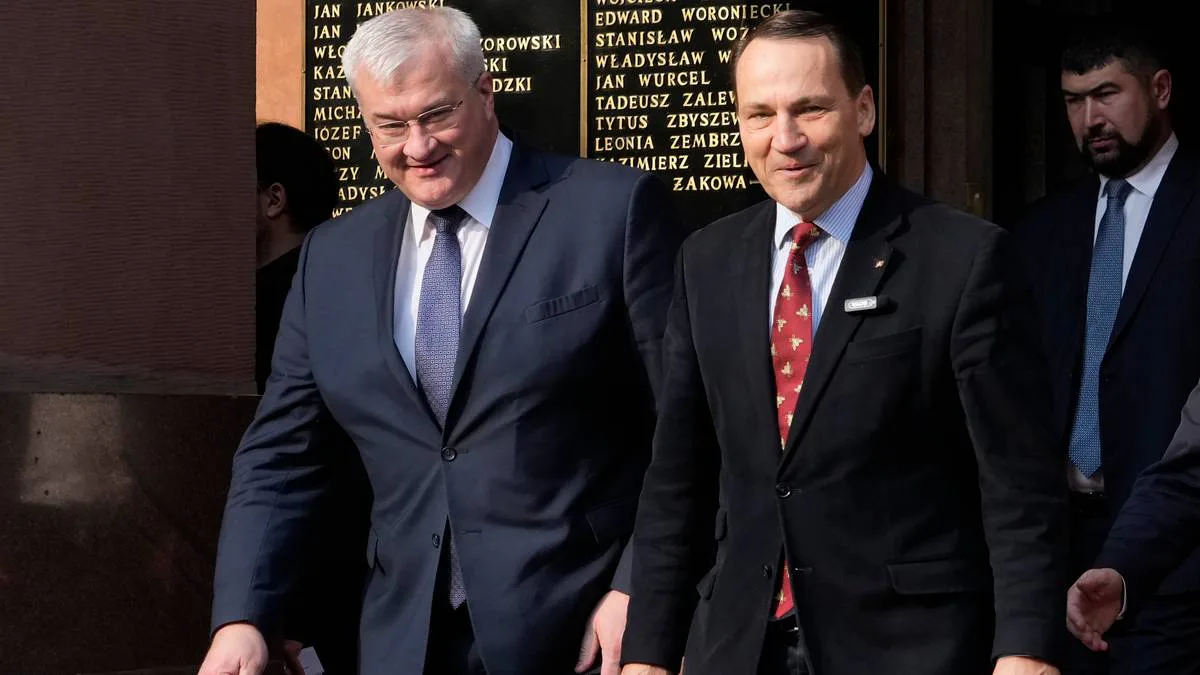
On July 3 in Warsaw, the foreign ministers of Ukraine and Poland will meet — Andrii Sybiha and Radoslaw Sikorski. Both sides confirmed the meeting: Polish Foreign Ministry spokesman Maciej Wewior and Ukrainian Foreign Ministry spokesman Heorhii Tykhyi.
Formally — working talks on bilateral relations and the situation at the front. But behind the scenes, it is about a crisis that has been dragging on since May.
How the crisis unfolded
On May 26, Zelenskyy signed a decree awarding the Separate Center for Special Operations "North" the honorary name "in honor of the Heroes of the UPA." The document explained this as "restoration of historical traditions of the national military." In Poland — a wave of criticism.
Polish President Karol Nawrocki recalled the Order of the White Eagle — the country's highest state award — from Zelenskyy. Zelenskyy sent the order back by mail. Former presidents Kuchma, Yushchenko, and Poroshenko also refused the award — showing solidarity with Zelenskyy's decision.
"Poland has repeatedly emphasized to the Ukrainian side the special importance of this issue. Awarding the unit a name in honor of the Heroes of the UPA goes far beyond Ukraine's internal affairs."
— Karol Nawrocki, President of Poland
It is telling that even Prime Minister Donald Tusk, traditionally pro-Ukrainian, stated that "the Ukrainian side caused this problem itself, so let it find a solution now" — and added that he "fully understands" Nawrocki's reaction. Minister Sikorski publicly called the recall of the order "inadequate," but acknowledged that the Polish side "has reasons to be dissatisfied."
What Sybiha brings to Warsaw
On July 1, the Verkhovna Rada passed a law on the National Pantheon — a registry of prominent figures who shaped Ukraine's development. On the same day, Polish publication Wirtualna Polska, citing sources in diplomatic circles, reported: Sybiha will arrive in Warsaw with a specific proposal.
According to the publication, Kyiv is prepared to propose including General Mark Bezruchko in the Pantheon — a commander of the UNR army who, together with Polish forces, participated in the Kyiv operation of 1920 and defended Zamosc against the Bolsheviks. Today a square in Warsaw's Wola district and an intersection in Wroclaw are named after him.
The logic of the proposal: Bezruchko is a shared figure respected by both nations, and his presence in the Pantheon would be a diplomatic signal of Kyiv's readiness for dialogue on painful historical issues.
Why Poland is not convinced
Sources of Wirtualna Polska in Polish diplomatic circles characterize the Bezruchko proposal as "welcome" — but one that does not guarantee "real qualitative changes." The concerns are specific: that later, figures associated with OUN-UPA will still enter the Pantheon — in particular, commanders whom Poland considers complicit in the Volyn tragedy. Polish MEPs have already brought this issue to the level of the European Parliament.
- The Pantheon law does not contain a list of persons — decisions on inclusion will be made separately
- There is no mechanism for coordination with foreign partners in the law
- The Polish side wants guarantees about the future composition of the Pantheon — not just symbolic gestures
Sybiha is flying to Warsaw from Japan — a stop on the way home, which in itself speaks to the priority of the meeting. But the diplomatic weight of it will depend not on what name is announced, but on whether Kyiv will agree to any form of consultations with Warsaw regarding the future content of the Pantheon.
If Poland receives only a gesture — the name of a general without a mechanism to influence subsequent decisions — then the question of whether it will be possible to stop escalation before Poland's presidential elections in 2027 remains open.







