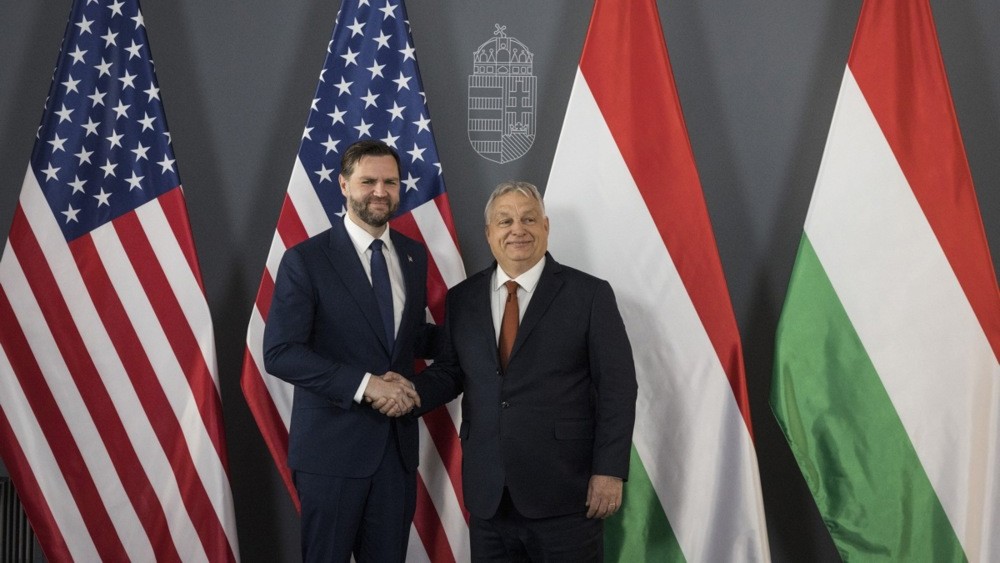
J.D. Vance arrived in Budapest at the hottest moment of the Hungarian election campaign. Five days before the vote, Orbán is trailing the opposition Tisza party of Péter Magyar by 14–20 percentage points depending on the poll — and it is precisely then that the U.S. Vice President appears in the capital.
What Vance said — and what he didn't say
At a joint press conference with Orbán, which was broadcast by AP, Vance stated that he personally does not know whether Zelenskyy threatened the Hungarian Prime Minister. But what comes next is more important: he accused "elements in Ukrainian special services" of allegedly attempting to interfere in elections in Hungary and the United States. No evidence was provided.
"I'm not here for economic cooperation. I'm here for moral cooperation between our two countries,"
— J.D. Vance, press conference in Budapest
Separately, Vance called the EU guilty of "one of the worst examples of foreign interference in elections," referring to Brussels' support for the Hungarian opposition.
Context: what preceded the accusations
Claims about "Ukrainian interference" in Hungarian elections are not new. Orbán has been making them since February 2025, when Ukraine cut off Russian oil transit through the Druzhba pipeline. In response, Budapest blocked the allocation of a 90 billion euro EU credit to Ukraine.
The grounds for the accusations are partially real: on March 5, Zelenskyy publicly stated that if "one person in the EU" does not stop blocking aid to Ukraine, he will give their address to the military — "so they can talk to them in their language." The hint at Orbán was so transparent that the European Commission officially condemned the statement: spokesperson Olof Gill called "such phrasing unacceptable" and stressed that "threats against EU member states are unacceptable."
Orbán, in turn, called Zelenskyy's words "political banditry" and "moral blackmail," and then announced that he had deployed troops to protect energy infrastructure. Hungarian security forces claimed they assessed the "Ukrainian attack" and recognized it as part of "coordinated measures to interfere in elections" — but without any public evidence.
Who benefits from this
The logic is simple: Orbán plays the "Ukrainian card" as his main mobilization argument. According to a Median poll for HVG, Magyar's Tisza leads Fidesz with a result of 55% to 35% among those certain to vote — and could potentially gain a constitutional majority. In this situation, Vance's visit gives Orbán something invaluable: the image of a legitimate Washington ally, not an isolated leader abandoned even by his own voters.
For the Trump administration, the stakes are also clear. According to Al Jazeera, in February Secretary of State Rubio assured Orbán: "As long as you are Prime Minister and leader of this country — it is in our national interest that Hungary be successful." If Tisza wins, Washington loses its most reliable Eurosceptic in the EU and NATO.
Reaction from opponents
- Péter Magyar — Tisza's leader — said directly at a rally: "Neither Ukraine nor Russia can blackmail a sovereign Hungary — a member of the EU and NATO."
- The European Commission condemned Zelenskyy's rhetoric, but took no practical steps against Kyiv.
- Analysts, including Péter Kreko from the Budapest analytical center, note in comments for Politico that Orbán's anti-Ukrainian rhetoric actually plays into Zelenskyy's hands — because it strengthens the image of the Hungarian Prime Minister as a pro-Russian leader in the West.
It is notable that Vance's claims about "interference by Ukrainian special services" in U.S. elections were made public for the first time at this level — and precisely in Budapest, not in Washington. This is either preparation for a new rhetorical line by the White House, or a gesture of solidarity calculated purely for the Hungarian audience.
If Tisza does win on April 12 despite Vance's visit — will Washington be as openly supportive of Magyar's pro-European government as it was of Orbán, or will the alliance with Budapest turn out to be tied to a specific person rather than the country itself?





