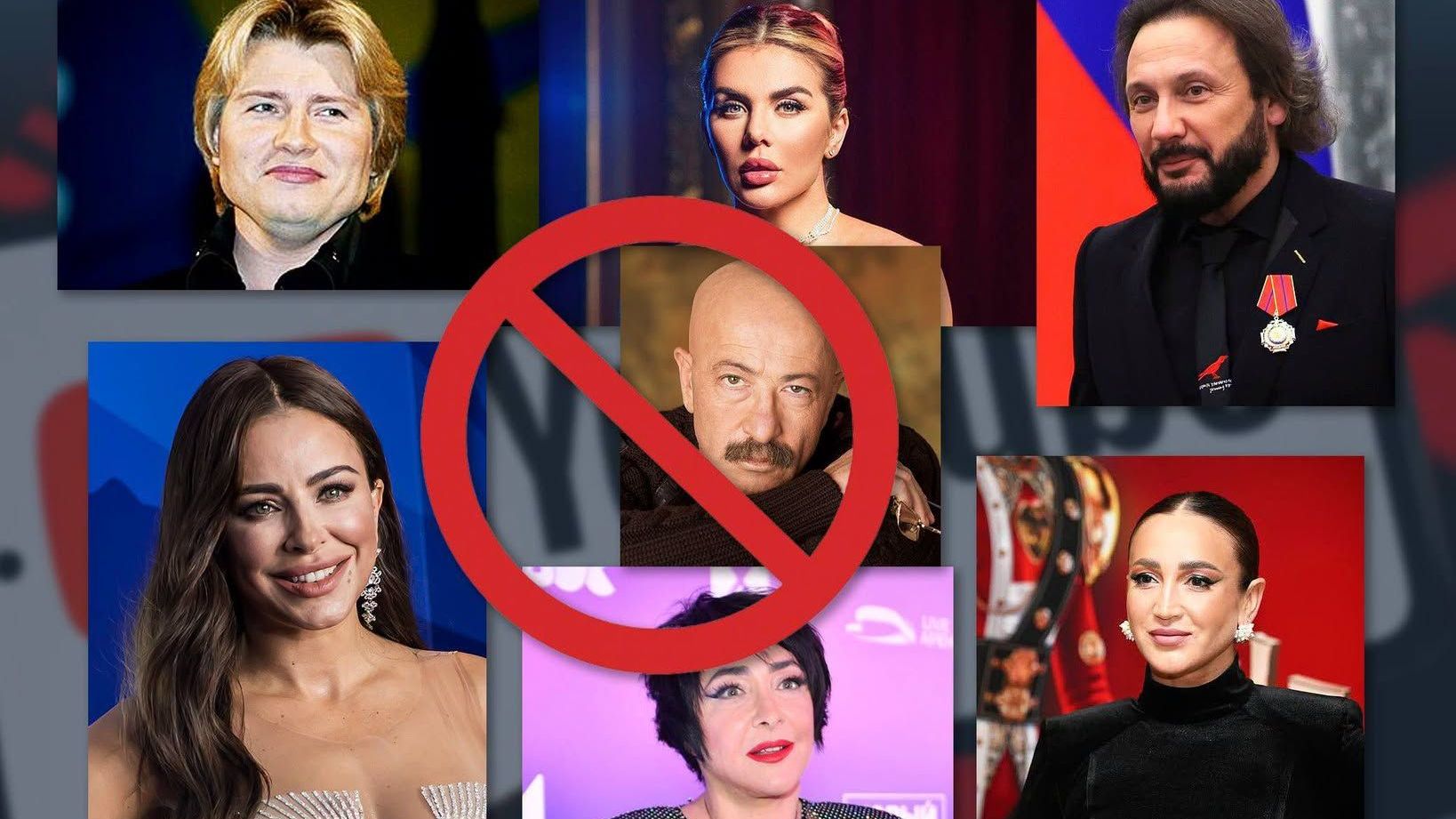
On July 24, the Disinformation Counteraction Center under the National Security and Defense Council reported: YouTube blocked the channels of seven artists in Ukraine — Nikolai Baskov, Ani Lorak, Lolita Milyavskaya, Stas Mikhailov, Olga Buzova, Anna Sedokova, and Alexander Rosenbaum. All seven were previously subject to Ukrainian sanctions, and all publicly supported the invasion.
Not the first list and not the first year
The current blocking is the third notable wave. In July 2024, YouTube had already restricted access to the channels of Shaman, Grigory Leps, Oleg Gazmanov, and Yulia Chicherin — the basis then was US and EU sanctions as part of the 14th package. Previously, Ukrainian figures on sanctions lists also experienced blockings: Arestovych, Mosiychuk, Dmytruk. According to the calculations of Ukraine's Foreign Intelligence Service, since the beginning of the full-scale invasion, YouTube has blocked over 200 accounts — media outlets, government bodies, and music figures connected to supporting aggression.
Sanctions against the current seven were imposed at different times. Against Baskov, Buzova, Mikhailov, Sedokova, and Ani Lorak — in October 2022 (the general list then numbered 2,251 people), against Lolita — in January 2023, against Rosenbaum — only in April 2025. That is, between the imposition of sanctions and the actual blocking of channels, between several months and more than two years passed.
What does "blocked" mean — and where does this word draw the line
Blocking is geolocation-based: channels are inaccessible from Ukrainian IP addresses, but technically exist and remain open to the rest of the world. Their content — songs, concerts, propaganda performances — can still be found on other accounts within the platform. As noted by Kyiv24, even after the previous wave, blocked material can be found on third-party reupload channels.
"All mentioned individuals actively participate in Kremlin propaganda activities, justify the war, use their media platforms to spread enemy narratives"
— Disinformation Counteraction Center under the National Security and Defense Council
A separate dimension is Ani Lorak. A native of Chernivtsi, a Ukrainian citizen (at least formally until recently), she became one of the most painful symbols of the choice "career in Moscow instead of a position" on the war. Her blocking on Ukrainian YouTube occurs against the backdrop of the fact that the artist herself left the public sphere regarding the war long ago — and this very silence, combined with past actions, became the basis for sanctions.
The mechanism works — but not for everyone and not always
The scheme looks like this: the NSDC imposes sanctions by presidential decree → the Disinformation Counteraction Center sends a request to YouTube → the platform geoblocks the channel on its servers. Google/YouTube fulfills Ukrainian sanctions requests voluntarily, without legal pressure from the American regulator — this is an important detail: the mechanism rests on corporate policy, not international law.
Two-year delays between sanctions and blocking, reuploads on third-party channels, and basic accessibility via VPN — all this means that blocking is a signal gesture no less than a technical obstacle. The Disinformation Counteraction Center does not hide this, promising to "continue working to stop the activities of sanctioned individuals in the digital space."
If next year YouTube agrees with the Disinformation Counteraction Center on automatic blocking simultaneously with the signing of a sanctions decree — the two-year delay will become impossible. While there is no such protocol, every blocking remains a manual operation with unpredictable timing.