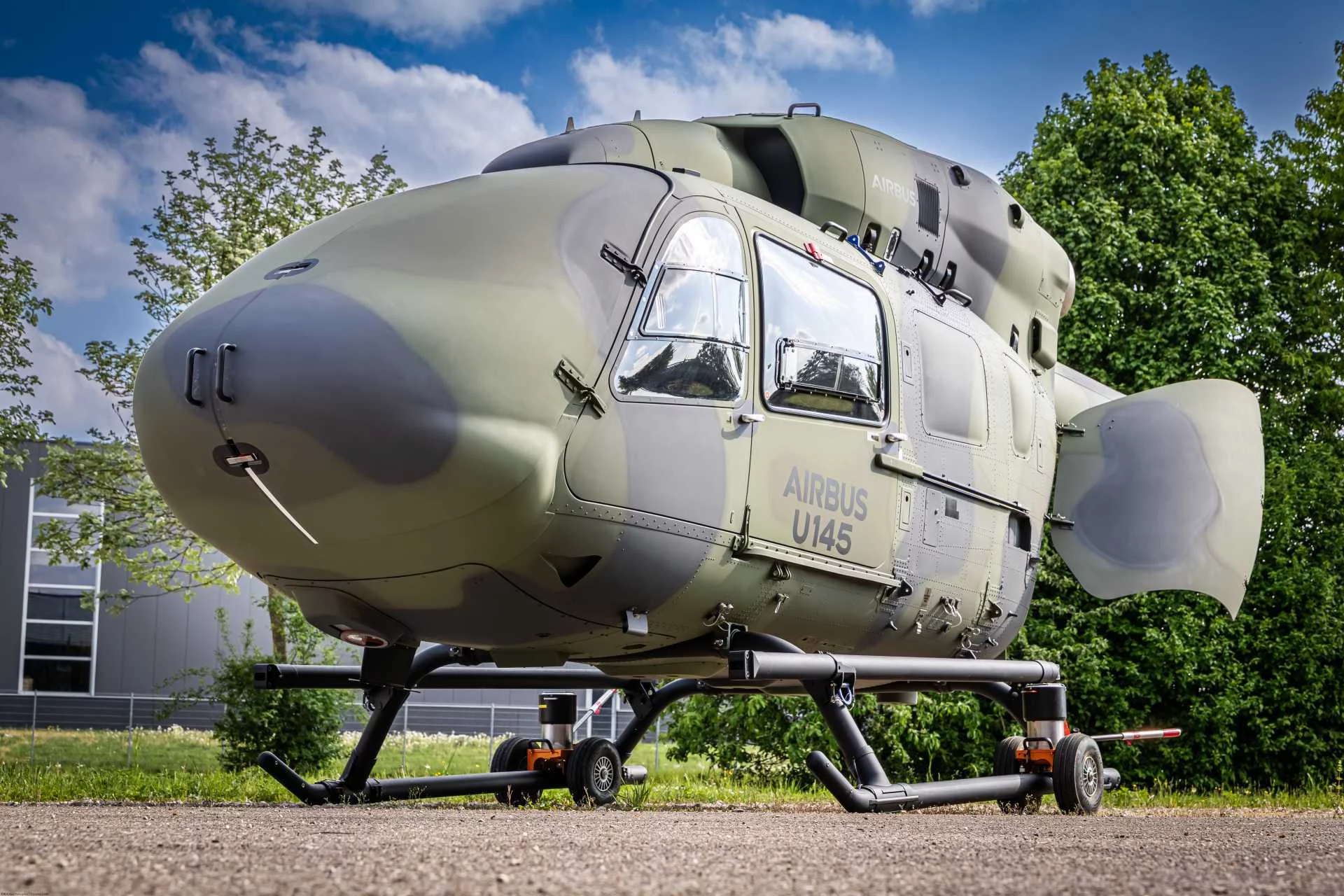
At the ILA Berlin air show, Airbus Helicopters presented the U145 — an unmanned version of its most popular light twin-engine helicopter, the H145. For now, it is only a full-scale mockup. But behind it lies a decision that is more important than technical specifications: Airbus is deliberately developing this aircraft outside the United States and independently of the American market.
One platform, two projects — and no overlap
In parallel with the U145, Airbus's American division, together with Shield AI, L3Harris, and Parry Lab, is developing the MQ-72C "Lakota Connector" — an autonomous variant of the UH-72B helicopter for the U.S. Marine Corps. Both aircraft are based on the same H145 platform, but these are completely separate programs. As noted by Aviation Week, Airbus's decision to launch a separate European project is driven by "dramatic geopolitical changes and Europe's desire for sovereign capabilities and reduced dependence on Washington."
This is not marketing rhetoric. The choice of the H145 as the base is explained by the fact that the unmanned version maintains maximum compatibility with the piloted H145M — a helicopter that is already in service or has been ordered by a number of European armies for strike and transport missions.
What changed in design
The U145 is not simply "H145 without a pilot." Airbus completely removed the physical cockpit. Instead, there is a cargo floor, nose doors with a flip-down loading ramp, and a full cargo compartment. Maximum takeoff weight — 3,800 kg.
- Primary mission: high-volume logistics — delivery of cargo to dangerous or hard-to-reach zones without risk to the crew
- Extended roles: reconnaissance, armed patrol, firefighting operations, casualty evacuation
- Most unexpected function: "drone mothership" — a carrier for launching smaller unmanned systems in combat. For this, Airbus has already partnered with missile manufacturer MBDA
- Team interaction: crewed-uncrewed teaming mode — joint operations with piloted aircraft
An advantage that is difficult to replicate from scratch
The U145 is Airbus's second aircraft converted from a piloted helicopter to an autonomous one (the first was the VSR700 based on the Cabri G2). Betting on a proven platform is not a compromise but a strategy: more than 1,800 helicopters of the H145 family have logged over 8.5 million flight hours. Existing supply chains, maintenance service networks, and flight data arrays make it possible to significantly shorten certification timelines and reduce development risks compared to aircraft designed from scratch.
"We are offering our customers an autonomous unmanned version of the H145 — a combination of a proven airframe, power and payload with unmanned aircraft system capabilities"
Matthieu Louvo, CEO of Airbus Helicopters
Where the line is between mockup and weapon
The first flight is scheduled for the end of 2026 — but with a safety pilot on board. Introduction into service is expected in the early 2030s. The aircraft currently exists only as a full-scale mockup, and no European customer has publicly confirmed an intention to purchase the U145.
That is, between "shown at an air show" and "delivered to the military" — at least five to seven years of development, certification, and budget decisions in parliaments. If Airbus is counting on the wave of European defense spending that is now growing, the window for contracts will open approximately when the U145 is ready for series production. The question is whether the aircraft will manage to receive its first customers before competitors — in particular American and Asian manufacturers — fill the same market segment with already certified platforms.








