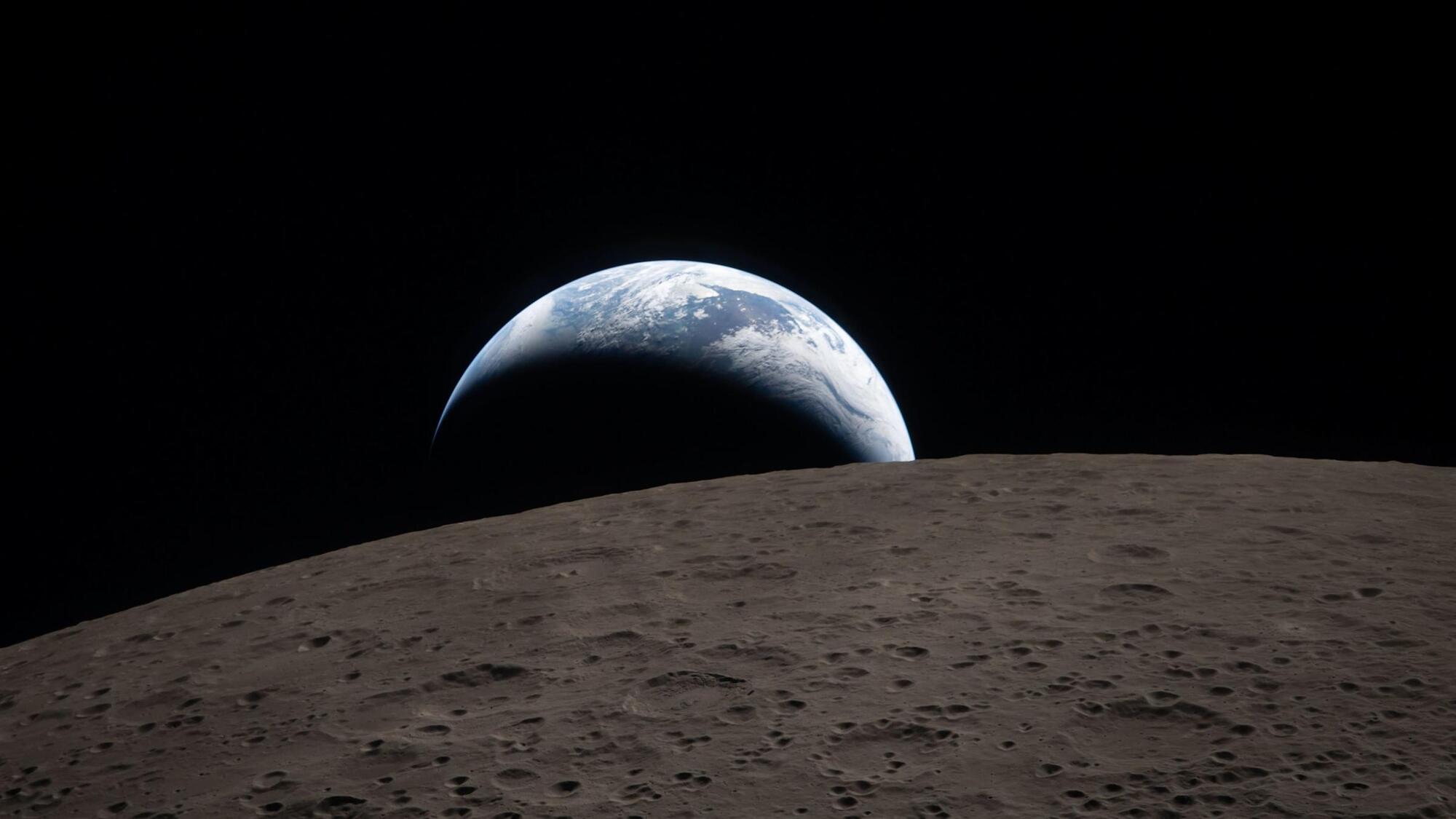
On April 6-7, 2025, four astronauts — Reid Wiseman, Christina Koch, Victor Glover, and Canadian Jeremy Hansen — completed a seven-hour lunar flyby aboard the Orion spacecraft. This was the first time since 1972 that humans traveled beyond Earth's orbit.
A distance record no one planned
In 1970, Apollo 13 went off course due to an accident and accidentally set a record — 248,655 miles from Earth. Artemis II broke it intentionally: the maximum distance reached was 252,756 miles (406,771 km) — 4,111 miles farther. The record was registered at 23:02 UTC on April 6.
40 minutes of silence — and two new craters
As Orion rounded the far side, the crew lost contact with Earth for 40 minutes. This was not a malfunction — a planned "blackout zone" when the Moon physically blocks the signal. It was during this time that astronauts saw the far side of the satellite for the first time in history — not in photos from probes, but through the spacecraft's window.
During the flyby, the crew discovered two previously unnamed craters. The proposed names are: Integrity — in honor of the spacecraft, and Carroll — in honor of Wiseman's late wife.
"Earthset" instead of "Earthrise"
The iconic "Earthrise" photo was taken by Apollo 8 in 1968. Artemis II captured the opposite — how Earth disappears beyond the lunar horizon. The first image from this series was published by the White House on X immediately after communications were restored.
"I know these photos are striking. But believe me — here, at the window, it's a completely different level"
Jeremy Hansen, CSA astronaut, during a live broadcast
Solar eclipse — for an hour, in glasses
After emerging from behind the Moon, the crew observed a total solar eclipse: the Moon completely blocked the Sun's disk for approximately an hour. The astronauts put on protective glasses — the same ritual as millions of people on Earth, but from a unique point in space. According to Scientific American, the Sun's corona was visible to the naked eye.
iPhone in lunar orbit
One of the sharpest images of Chebyshev crater on the far side was taken by Hansen — on an iPhone with eight-times zoom. NASA confirmed the location. For comparison: automated probes have been photographing this region for decades, but none held a phone in their hand.
After completing the flyby, Orion set course for home. Splashdown in the Pacific Ocean near San Diego is scheduled for April 10. On the way home, the crew will establish radio contact with the ISS — the first time in history that a lunar team will have colleagues in orbit simultaneously. Among them is Jessica Meir, who together with Koch performed the first all-female spacewalk in 2019.
If Artemis III indeed lands humans on the Moon's south pole — will the requirements for the spacecraft change based on what the Artemis II crew saw and documented on the far side?