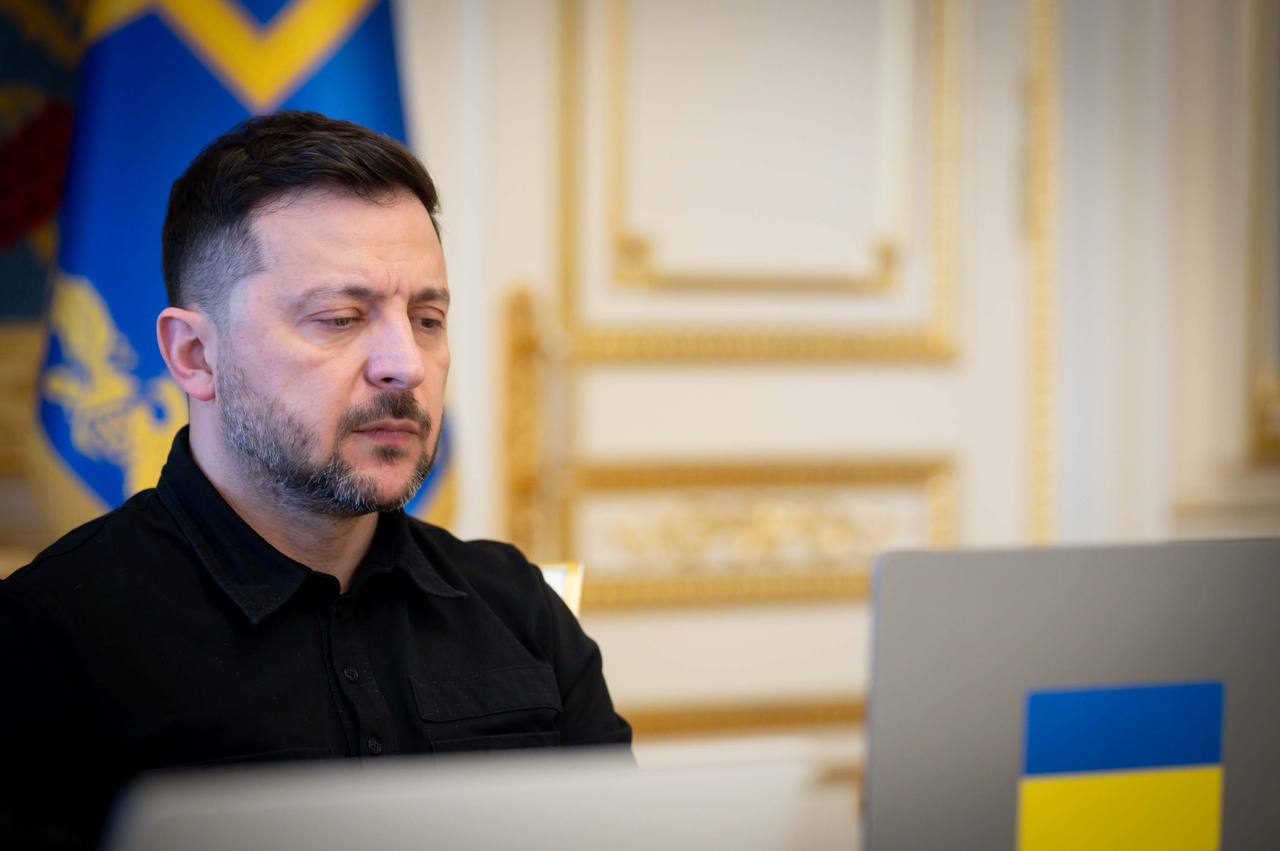
On May 25, President Volodymyr Zelensky met with the Servant of the People faction — and for the first time publicly tied the possible end of active combat to a specific timeframe. Details became known not from an official briefing, but from a post by MP Olha Vasylevska-Smahluk, who decided to share the information herself — "because it would leak to Telegram channels anyway."
What Zelensky said
According to Vasylevska-Smahluk, the lion's share of the meeting focused on deescalation prospects. The president outlined three things: a timeframe, a condition, and a threat.
"By November, there is a possibility, subject to the provision of security guarantees, to end the active phase of the war. Currently, we have an advantage on the battlefield that can be used. The main goal is to prevent Russia from deceiving us and starting new military operations after a brief pause."
Olha Vasylevska-Smahluk, MP from Servant of the People
Faction head Davyd Arakhamiya wrote after the meeting that "the next 6 months should become a time of maximum concentration and stabilization of the country's work". Among the priorities are the stability of state institutions, support for the military, timely payments to people, energy, and steps toward EU membership. Diplomacy was discussed separately: Zelensky expects Europe to decide who will become a mediator for the peace track, and expects a US delegation in the near future.
What lies behind "possibility"
The word "considered" is no accident. Zelensky did not announce negotiations and did not name a specific format for guarantees. The phrase captures a window of opportunity, not a decision. This is important to distinguish: Kyiv has repeatedly emphasized that a "freeze" without real guarantees is a worse scenario than continuing military operations, as it gives Moscow time to rearm.
This is why the discussion centers not on the date, but on the mechanism. Which countries will sign on to guarantees, what format, what obligations regarding response in case of a new attack — this has not yet been publicly determined.
The price of the question for the economy
For an average Ukrainian, the difference between "active phase by November" and "war for another year" is not abstract. It is the hryvnia exchange rate, the availability of credit, the return of displaced persons, and the pace of reconstruction of destroyed housing.
The EBRD in its latest report noted: Ukraine's real GDP in 2025 grew by only 2% — accounting for acceleration to 3% at year-end. The bank cut its 2026 forecast in half — from 5% to 2.5%, explaining: previous optimism was based on the assumption of ceasefire and the start of reconstruction. This did not happen.
Oxford Economics calculated the difference between scenarios more precisely: a stable ceasefire on Ukraine's terms allows reconstruction in 12.3 years; an unstable ceasefire on Russia's terms stretches this process to 40.8 years. The baseline scenario without any ceasefire is 27 years.
The Centre for Economic Strategy provides a minimum benchmark: if GDP grows at least 7% annually after the war ends through 2030, Ukraine will be able to reach a level of $300 billion — sufficient to finance defense, social benefits for veterans, and basic infrastructure simultaneously. Below this mark, compromises between security and social spending become inevitable.
What is missing from the public picture
The meeting was closed. Everything the public knows is what the deputies themselves decided to share. Arakhamiya confirmed: they discussed challenges for the economy and the main tasks of the state. No details. This means that between "November as a reference point" and actual negotiations on guarantees lies an entire structure that does not exist in the public domain.
The key question is not whether the active phase will end by November — but rather what specific security guarantees will be considered sufficient for Kyiv to agree to stop the fighting. If by autumn this mechanism does not appear in a specific legal form, the timeframe will become another reference point that has passed without consequences.





