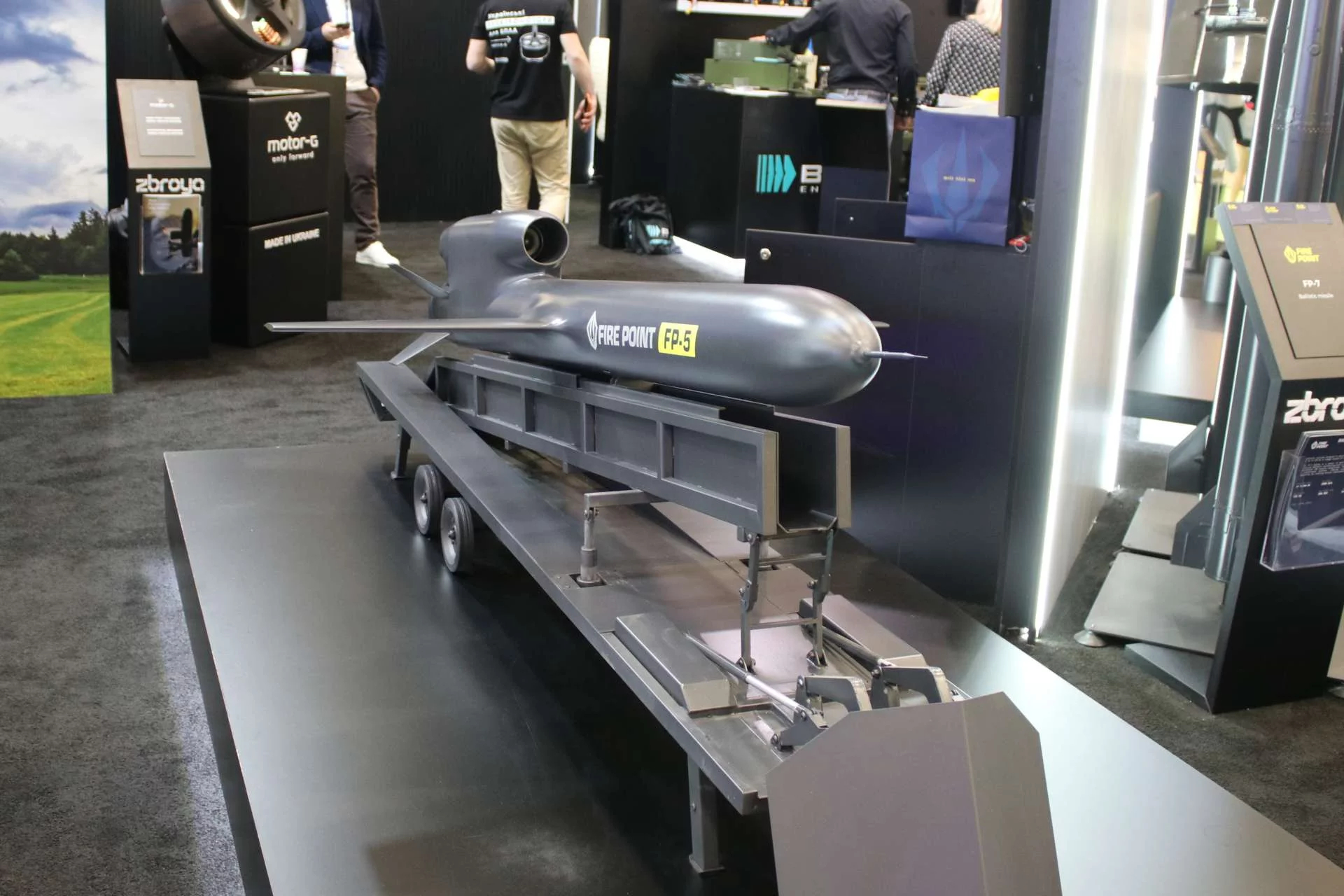
At the SAHA Expo 2026 exhibition in Istanbul, Fire Point again showcased the FP-5 Flamingo as a "deep strike platform" with a range of up to 3,000 km and a warhead of up to 1,150 kg. However, while presentations were underway, OSINT analysts already had six months of combat statistics — and they were more complex than any promotional brochure.
From mockup to combat deployment
The first documented combat use of FP-5 occurred on August 30, 2025 — a strike on an FSB outpost in Crimea. In October of the same year, President Zelensky publicly confirmed the use of the missile together with Neptune against targets on Russian territory.
In January 2026, the Armed Forces of Ukraine attacked the Kapustin Yar training ground in the Astrakhan region — a facility from which Russia launches Oreshnik missiles. According to CyberBoroshno analysts, several buildings were damaged, with one hangar sustaining significant damage. In February, Flamingo achieved its first confirmed hit: one of six launches against the GRAU arsenal in Kotluban destroyed a bunker with an area of 1,200 m², triggering ammunition detonation.
"Out of 23 verified launches, six reached targets, but only two actually hit the facility"
OSINT analyst Harbuz (Dnipro OSINT), cited by Ukrainska Pravda
Technical grounds for skepticism
Currently, the missile is equipped with an aviation engine AI-25 manufactured by Ivchenko-Progress — developed for training aircraft rather than low-altitude flight. As explained by Fire Point's chief designer and co-founder Denis Shtilerman to Militarnyi, the peak efficiency of this engine is at altitudes of 6,000 to 10,000 meters, while cruise missiles typically fly at 50–100 m. This is why the company is completing development of its own turbofan engine with low bypass ratio, optimized for low-altitude flight.
Russia claimed its first Flamingo shoot-down on October 10, 2025 — using the Buk complex. In published photos, the missile was flying at an altitude of about 100 m at a speed of approximately 600 km/h, notably lower than the claimed 950 km/h. A separate problem is the lack of detailed terrain maps of Russia to ensure flight at extremely low altitudes.
Production and scale
As of March 2026, Fire Point reported production of three missiles per day. The transition to its own engine is viewed by the company primarily as a way to increase production capacity rather than merely as a technical improvement — the AI-25 is a bottleneck in the supply chain.
The FP-5 is launched from a mobile platform based on a cargo truck, allowing for rapid position changes. The fuselage is made primarily of radio-transparent composite materials. According to the developer, the system is adapted to operate in radio-electronic warfare conditions — although verifying this claim independently is currently impossible.
What actually decides the matter
Flamingo has already accomplished what most Ukrainian strike systems cannot: reach Kapustin Yar — over 1,000 km from the front lines — and cause verified damage to Oreshnik infrastructure. It is neither a kamikaze drone nor a ballistic missile: comparatively low cost and mobile launch capability form a separate niche.
But 33% verified hits out of 23 launches is not merely an efficiency statistic. It is an argument in the discussion about whether to invest in increasing the number of launches or first in guidance accuracy and a low-altitude engine.
If Fire Point introduces its own engine into series production and solves the cartographic coverage problem for low-altitude flight profile — will the hit statistics change enough for the system to become a strategic rather than tactical tool?







