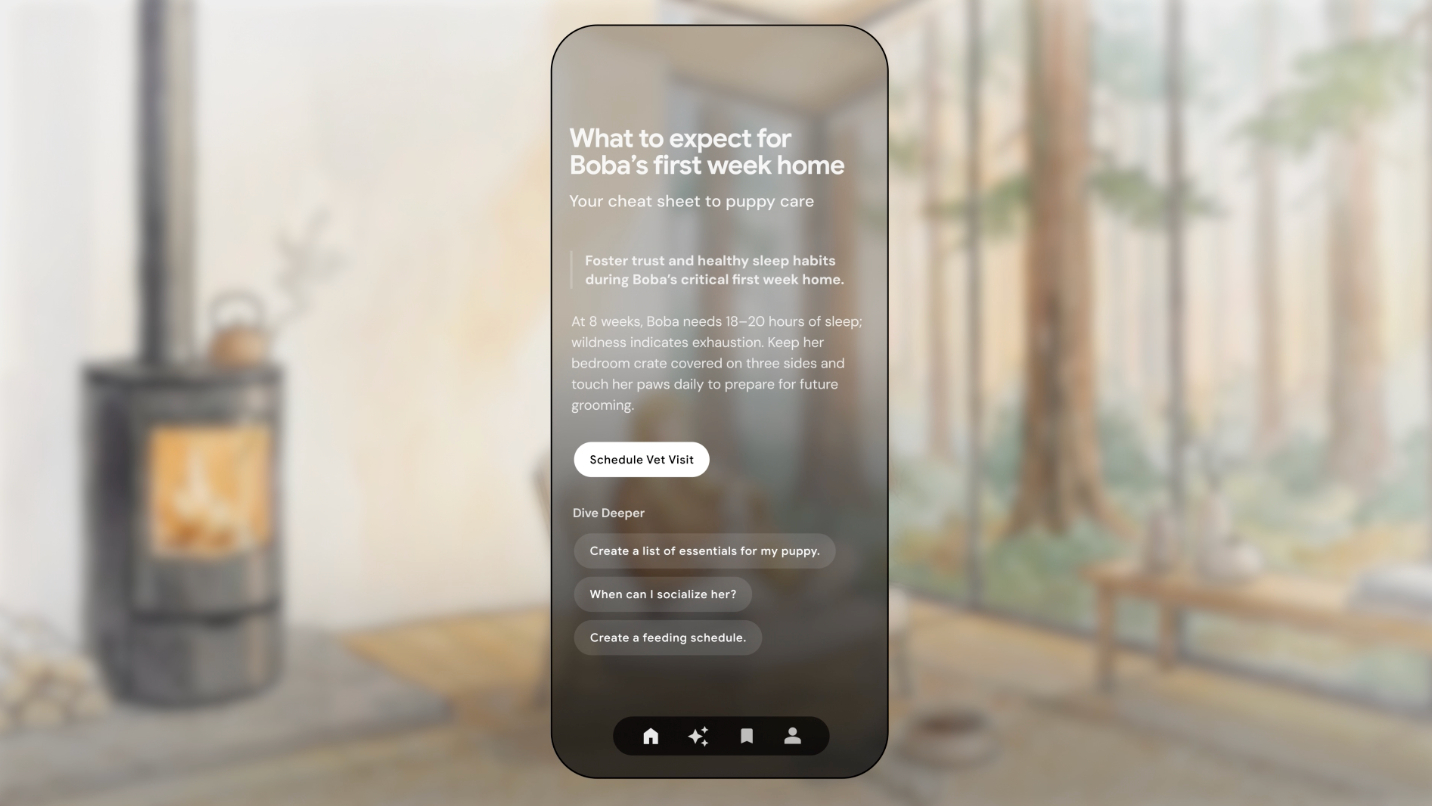
Imagine: you open an app in the morning, and it already knows you're planning to get a dog (because it read your emails) and suggests a list of things to buy — illustrated with a cartoon character that looks like you. That's exactly how Dreambeans works — a new Google Labs experiment launched on June 3, 2025.
A finite feed instead of endless scrolling
The main architectural difference from Instagram or TikTok isn't in the algorithm, but in the limitation. Instead of an infinite stream of content, Dreambeans forms a fixed collection of stories every day, which, according to Google, is designed to inspire users — and then stops. The app generates between 10 and 14 stories per day.
Under the hood is the Personal Intelligence system, the same one that powers Gemini and AI Mode. Illustrations use the Nano Banana 2 model with full-screen images and a stories-style interface. If you grant permission, the app connects to Face Grouping settings in Google Photos — and draws your actual face, as well as friends, relatives, and pets instead of abstract characters.
What exactly does the app read
With your permission, Dreambeans uses Personal Intelligence to link data from Gmail, Calendar, Photos, YouTube, and search history. The scope of access is up to the user: you can connect one service or all of them. But there's a catch.
"Dreambeans requires at least one connected Google app, but works best if you connect them all"
MakeUseOf on the service's operating conditions
In other words, advertised flexibility and actual effectiveness are different things. The full experience assumes complete access.
Privacy: isolated, but not anonymous
According to the developers, privacy is a key feature: generated stories are only visible to the user, data can be deleted at any time, and the choice of connected services remains with the person.
Google also emphasizes an important technical separation: choices and data processing in Dreambeans remain completely isolated — they do not affect Personal Intelligence's behavior in other Google products, such as Gemini or AI Mode.
However, independent reviewers frame it differently. Dreambeans requires broad access to virtually everything Google knows about you. This has always been the silent agreement with the company's free services — but packaging this access into illustrated stories makes the surveillance capitalism model more noticeable.
Accessibility and context
Dreambeans is available to Google AI Ultra subscribers (18+) in the United States on Android and iOS. Everyone else can join the waitlist. In parallel, Meta is expanding AI memory features in Instagram and WhatsApp, Apple is improving local intelligence in Photos — Google is acting more aggressively: not just recreating memories, but actively reinterpreting them through generative illustration.
If Dreambeans goes beyond an experiment and scales to all Google users — the question is no longer whether it's convenient, but whether regulators in the EU and the UK are willing to recognize "personalized cartoons" as sufficient grounds for access to mail and geolocation.







