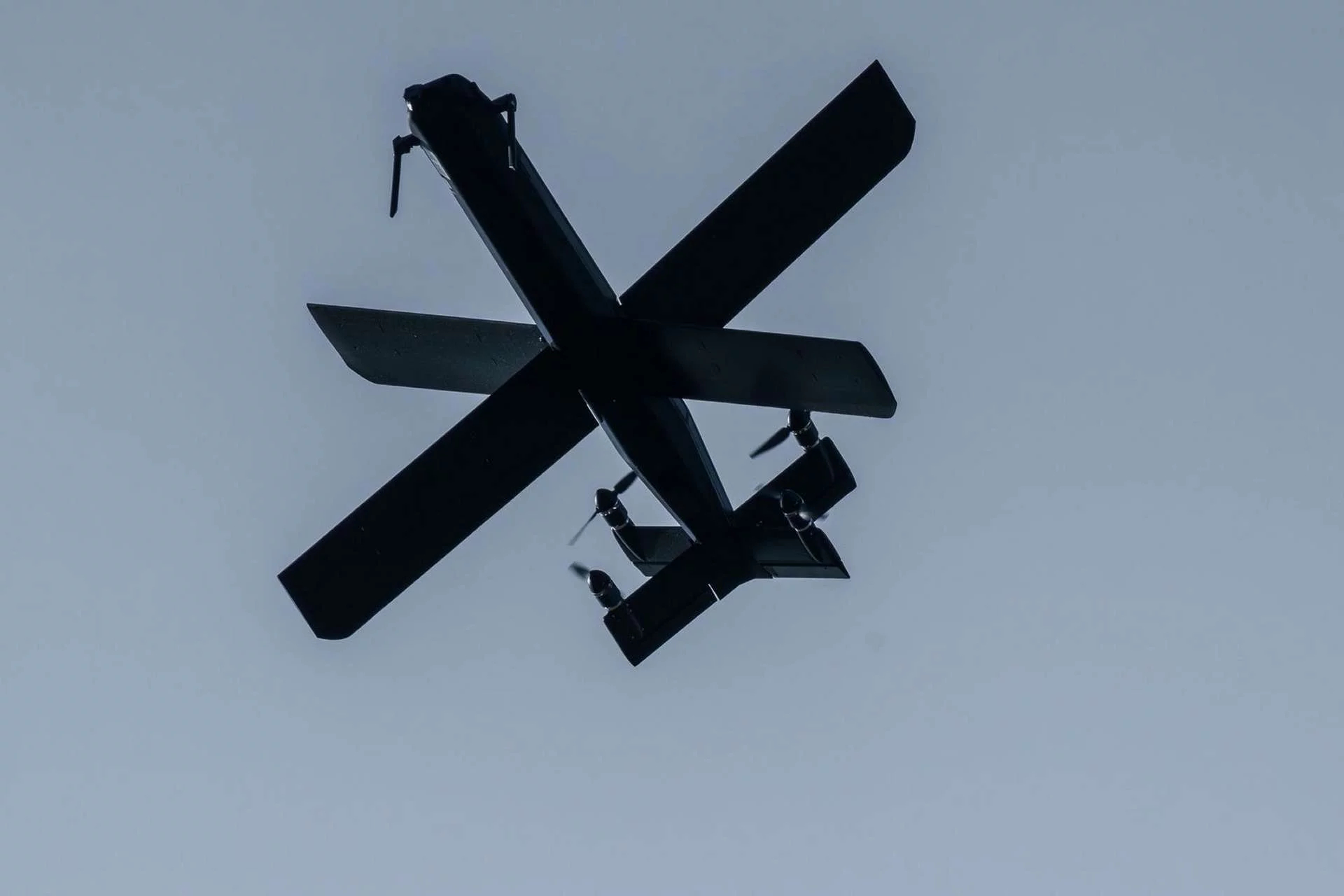
Project Flytrap 5.0 training took place from April 30 to May 19 at the Pabrade training ground in Lithuania — approximately 30 kilometers from the Belarusian border. Formally, this is part of the larger Saber Strike 26 exercises, but in fact — the largest NATO training ground to date for testing counter-drone systems in real electronic warfare conditions.
What was tested and how
The main unit — the 2nd Squadron of the 2nd Cavalry Regiment of the U.S. Army — for the first time practiced counter-drone tasks at the squadron level, rather than individual units. American forces were joined by British paratroopers from the 3rd Regiment and allies from Australia. In total, participants tested over 50 technologies from defense companies — radars, radio frequency jamming systems, kinetic interceptors.
Among all systems, the HX-2 from Munich-based company Helsing attracted the most attention. According to Axios, U.S. Army records documented at least one HX-2 launch, and in a separate photo, General Christopher Donahue, commander of U.S. Army forces in Europe and Africa, is seen leaning over a transport box of the unmanned aircraft.
"HX-2 was originally used as a kamikaze drone and counter-drone system. But soldiers I spoke with said they also used it as an intelligence platform and as a loitering munition — thanks to its ability to find and track targets with onboard vision even during jamming."
— Alex Miller, Chief Technology Officer of the U.S. Army, Axios
Results: what the numbers show
Out of 200 total sorties during the exercises, Helsing drones completed 17 combat episodes. Summary: 15 targets hit and two near-miss episodes. A key condition — all were practiced in an environment of active electronic warfare jamming, which simulated a real front.
This is the technical advantage of the HX-2: onboard AI allows the unmanned aircraft to operate without a continuous signal — independently search, re-identify, and attack targets even when communication is lost. Range — up to 100 km, maximum speed — 220 km/h, launch weight — 12 kg.
Lithuania — not the first, but a special testing ground
Project Flytrap is a series of exercises that General Donahue initiated in previous iterations. The goal — not a laboratory test, but verification in "dirty" conditions: when units are on the move, not at a static base.
"We are transforming to enable offensive maneuver in a drone and electronic warfare-saturated environment."
— Gen. Christopher Donahue, commander of USAEUR-AF
Flytrap 5.0 is formally included in the Eastern Flank Deterrence Initiative — NATO's land warfare concept that links the digital architecture of different countries to accelerate target detection and engagement.
The shadow of the Ukrainian front
The Lithuanian results look convincing — but there is a significant counterpoint. In early 2026, Bloomberg reported that Ukraine suspended additional HX-2 orders after front-line testing. According to the publication's sources, during trials by the 1st Separate Unmanned Aviation Systems Center, only 25% of the drones were able to take off. Among documented problems — unstable video transmission, limited target acquisition capabilities, and the fact that some declared AI components were absent from the actual product.
Helsing contested these findings, stating that they were based on an unverified internal document and that "it is too early to draw conclusions." As of November 2025, according to Bloomberg, approximately 40% of HX-2s delivered to Ukraine remained in warehouses.
- 2024 orders: contract for 4,000 units in co-production with a Ukrainian partner
- February 2025: Helsing announced an additional 6,000 HX-2s for Ukraine — Berlin did not confirm funding
- January 2026: Ukraine suspended new orders due to technical issues
- May 2026: successful testing at Flytrap 5.0 in Lithuania with American and British forces
Axios views HX-2 participation in Flytrap 5.0 as a potential signal of Helsing's entry into the American market and a symptom of broader European rearmament.
The question that will determine the real value of the Lithuanian result: will Helsing confirm HX-2 characteristics under real electronic warfare conditions on the Ukrainian front — and will Kyiv renew orders before the U.S. Army begins its own procurement procedure.