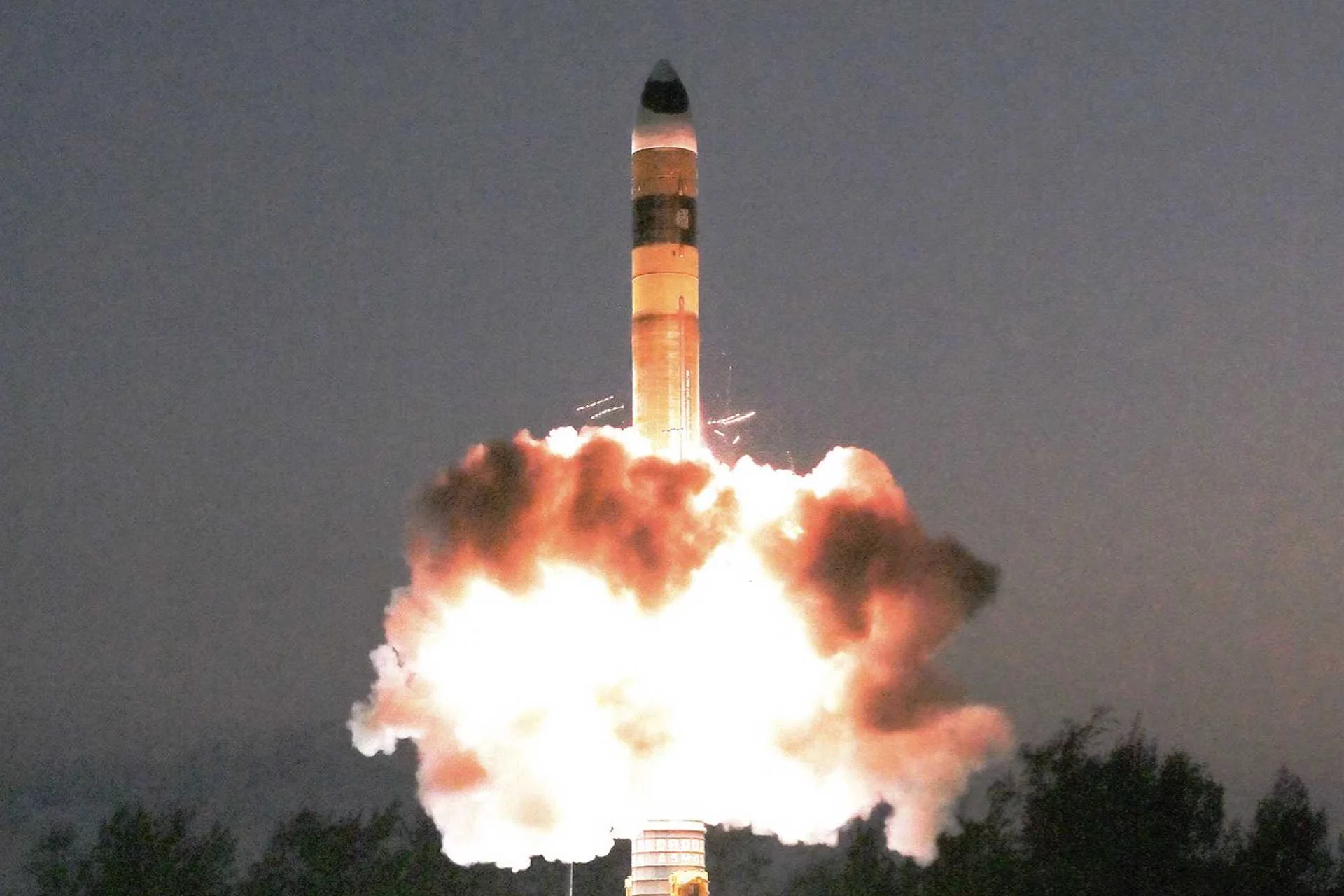
On May 8, 2026, an Advanced Agni-5 ballistic missile equipped with MIRV technology — multiple independently targetable reentry vehicles — was launched from Abdul Kalam Island in Odisha state. This was already the second publicly confirmed test of this class: the first, "Mission Divyastra," took place in March 2024. But there is a fundamental difference between the two tests.
DRDO confirmed the launch with an official statement on May 9. The Ministry of Defense reported that telemetry from ground and naval stations verified the complete trajectory — all warheads reached separate targets at different points in the Indian Ocean. The test's principal innovation was the integration of MIRV with a hypersonic glide vehicle (HGV): it maneuvers during the ascent phase at speeds exceeding Mach 5, making interception impossible using standard air defense algorithms.
What the technology changes in practice
A classical ballistic missile follows a predictable arc — which is precisely why air defense systems have learned to track it. An HGV has no such arc. The combination of MIRV and HGV on a single platform means that each missile carries multiple unpredictable final targets — a task that is essentially unsolvable for an interceptor.
"From Prithvi to MIRV-armed hypersonic ICBMs in four decades — India's strategic missile program has achieved what technology embargoes once made unthinkable."
gk365.in, analysis of May 8, 2026 test
According to indiandefensenews.in, by 2026 more than 50 Agni-5 launch units are in operational alert status. Part of them could theoretically be retrofitted with the MIRV+HGV variant — although there is no official data on serial production of the new configuration.
Who the test is addressed to
Defense Minister Rajnath Singh linked the test to "growing threats" to India — phrasing without names, but with an obvious addressee. As Defence Security Asia notes, despite China not being mentioned publicly, it is precisely the missile's range and MIRV configuration that point to Beijing as the primary strategic audience: Agni-5 covers China's deep infrastructure far beyond the Tibetan plateau.
Context: China is actively deploying DF-41 with its own MIRV, building new missile fields, and investing in layered air defense. Pakistan announced the Ababeel missile — also with MIRV — back in 2017, precisely as a response to Indian missile defense systems. The May 8 test fits into this three-way dynamic, where each "defensive" step is read by neighbors as an offensive one.
What remains off-screen
- The number of warheads on each missile is officially not disclosed — DRDO uses the term "several warheads."
- Operational readiness of the HGV version is not confirmed: the test could have been purely experimental.
- The "No First Use" nuclear doctrine formally remains in force — but analysts note its increasingly broader reinterpretation in Indian strategic circles.
India became the sixth country with confirmed operational capability for MIRV deployment from long-range ballistic missiles — after the USA, USSR/Russia, Great Britain, France, and China. The question is not whether Beijing will respond: it is already building up its potential. The question is whether this test will accelerate negotiations between Delhi and Beijing on strategic stability — or finally close that door.







