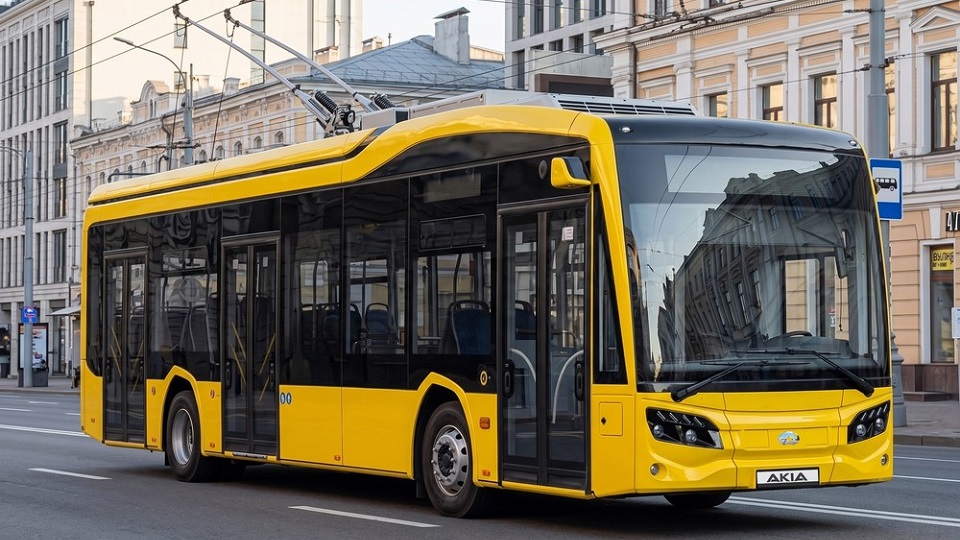
Turkish AKIA announced the delivery of the hundredth body of the Ultra TB12 model to its Ukrainian partner, the Chernihiv-based company "Politechnoservice" (PTS). The figure is symbolic, but the real story is more complex: what drives the streets of Mykolaiv, Chernivtsi, and soon Kyiv is not just a Turkish trolleybus.
Turkish body + Ukrainian electronics
Since 2022, Politechnoservice has been building the PTS T12309 trolleybus based on AKIA bodies. But under the hood is PTS's own control system, a Riga electric motor and ZF axles. The localization rate is 40%. In fact, AKIA is a supplier of the body platform, while PTS is responsible for the power and control components.
This matters for two reasons. First, the scheme made it possible to circumvent the 2022 logistics collapse, when the previous PTS-12 model was built using Belarusian components from MAZ-Eton — after the full-scale invasion began, this supply chain was broken. Second, 40% localization is a condition for funding from international organizations.
Where these 100 vehicles operate
A hundred AKIA bodies were distributed across several cities. Vinnytsia received the first vehicles at the beginning of the program, Chernivtsi — 10 trolleybuses during 2022–2025. Mykolaiv has received 19 units since April 2024, with another 21 planned for 2025. At the end of January 2025, Kyivpastrans signed a contract with PTS for 16 trolleybuses for 306.24 million hryvnias — the first replenishment of the capital's trolleybus fleet since January 2021.
"New trolleybuses mean less worn-out vehicles on routes, more stable traffic flow, comfortable conditions for passengers, and less burden on the environment".
Roman Klichuk, mayor of Chernivtsi, after signing a contract for 34 trolleybuses financed by the EIB loan
A market that collapsed and is recovering
Context is important: 2024 was the worst year for Ukraine's trolleybus market since 2009 — cities received only 34 vehicles. In 2025, the figure rose to 107 units, which became a record during the full-scale war. 66 out of 75 new trolleybuses were purchased as part of cooperation with international financial organizations — the EIB, the EBRD, and the Danish government.
On the new trolleybus market, PTS and Etalon (Chernihiv Automobile Plant) together hold 91% of the market. The difference between them is in the body: Etalon now also uses ChAZ production, while PTS continues Turkish cooperation with AKIA.
The price question
One PTS T12309 trolleybus for Kyiv cost 19.14 million hryvnias, or approximately $444,000. This is 700,000 hryvnias more expensive than a similar vehicle for Chernivtsi purchased at the end of 2025 — the industry publication Alltransua explains the difference by the conditions of the capital's tender. For comparison: Mykolaiv paid 430,000 euros per vehicle with Danish funding, Kremenchuk — 415,000 euros through an EIB loan.
Autonomous range is another parameter with nuances: Kyiv vehicles will have up to 1 km without contact overhead lines, which industry experts have already characterized as insufficient for a city with massive infrastructure damage.
If in 2026 announced deliveries to Lutsk, Ternopil begin and continue for Chernivtsi — and all of them again through PTS and AKIA bodies — this would mean the hundred becomes two hundred before the market returns to pre-war levels. The question is different: will dependence on a single Turkish body supplier become a vulnerability for cities if logistics change again.







