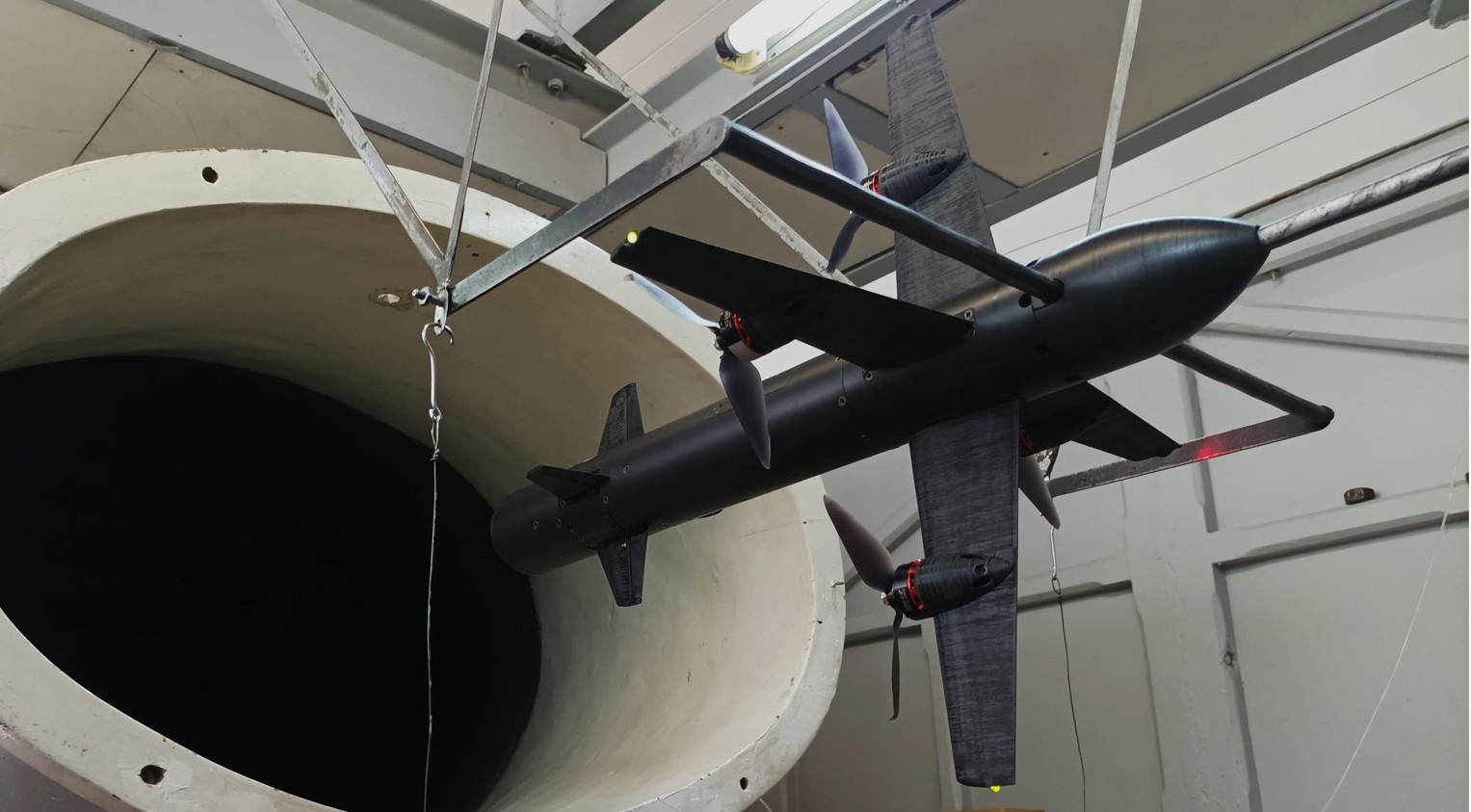
The interceptor drone "Kibchyk" (Kestrel) from OneDefence has appeared on the state marketplace Brave1 Market — a platform through which military units order equipment directly from manufacturers. According to Defender Media, the device has already passed ground testing, but the developer provides no confirmed combat applications.
What's Inside
According to declared specifications, "Kibchyk" reaches a maximum speed of 420 km/h with a cruising speed of 250 km/h. This exceeds the cruising speed of Shahed-136 by approximately three times — a fundamental requirement for interception. Tactical radius is up to 20 km, ceiling is 6,800 m, flight time is up to 10 minutes.
The design is modular: before takeoff, the operator can replace the battery, wings, camera, or warhead depending on the mission. On board are day and thermal imaging cameras and a guidance system. The key detail: the final interception stage is automatic — after capturing the target, a laser proximity sensor activates detonation without direct collision.
The cost of one device on Brave1 Market is 95,000 UAH.
Context: The Interceptor Market is Already Crowded
"Kibchyk" enters a market where competition is serious. According to Ukraine's National Security and Defense Council, in 2025 the country produced 100,000 interceptor drones, with combat effectiveness exceeding 60%. More than 20 companies are working in this direction.
"Destroying one Shahed with an interceptor costs more than 25 times cheaper than using a Western air defense missile"
National Security and Defense Council of Ukraine
Among existing solutions are "Shvidun" with a radius exceeding 70 km and confirmed strikes against around a hundred enemy drones, as well as the JEDI Shahed Hunter, adopted by the Ministry of Defense for operation. Against this background, "Kibchyk's" 20-kilometer radius and 10-minute flight time look modest — although modularity and autonomous detonation may compensate for limitations in specific scenarios.
What Remains Open
Autonomous detonation via laser proximity sensor is a technically more complex solution than kinetic collision or manual control on the final segment. This increases accuracy but also places demands on electronics reliability in a radio-electronic warfare-saturated environment. OneDefence does not publish data on resistance to electronic warfare suppression.
If "Kibchyk" passes combat codification and confirms the effectiveness of autonomous detonation in real conditions — 95,000 UAH for a device with thermal imaging and modularity becomes a competitive price. The question is whether the laser guidance system will withstand an environment where electronic warfare has long been the norm, not the exception.







