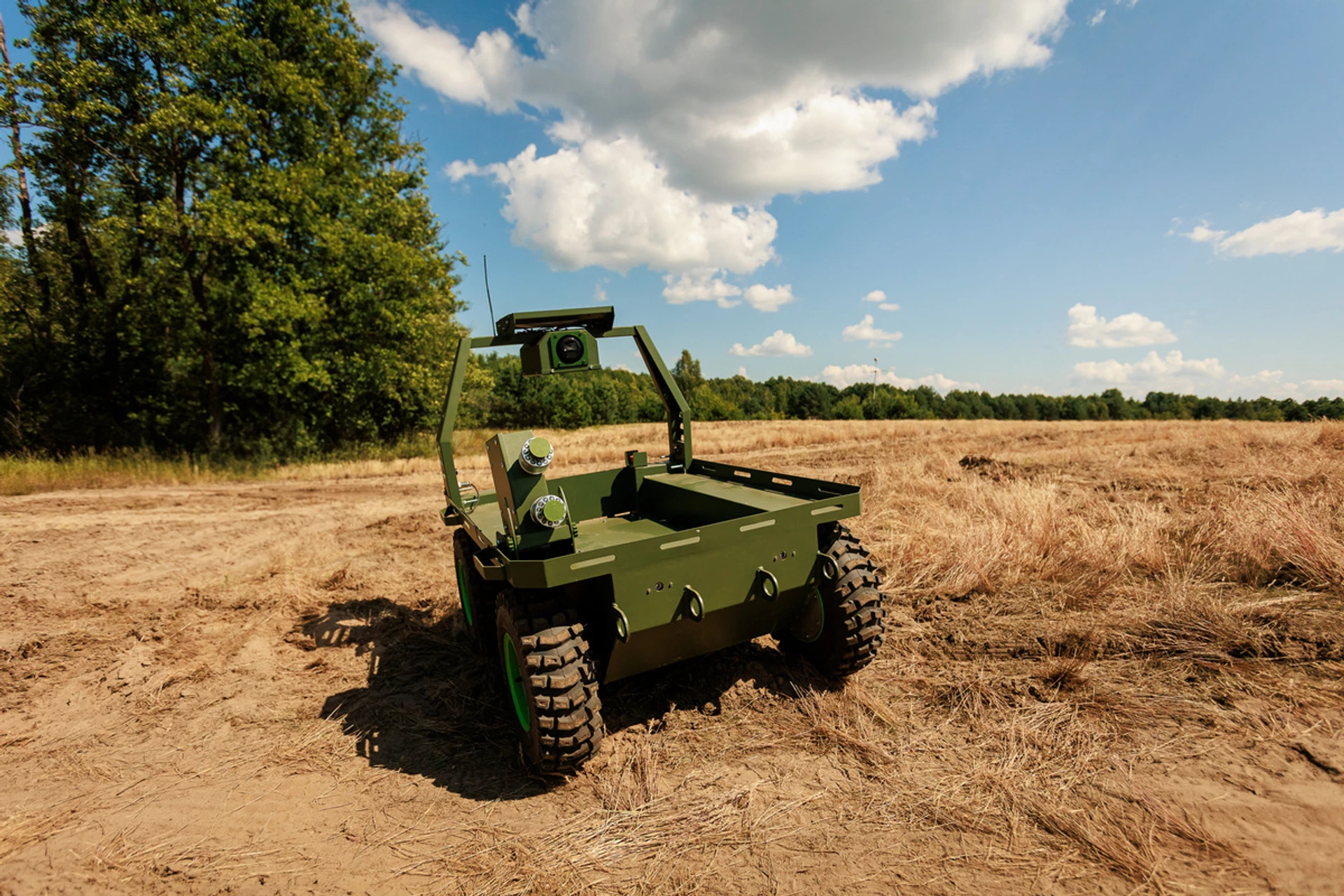
The most expensive enemy of a ground robot on the front is not a mine or artillery, but a kamikaze drone costing a few hundred dollars. An FPV drone hits a slow, heavy platform almost guaranteed if it lacks electronic warfare protection or its own defenses. Ukrainian company Smart Birds attempted to solve this problem not through signal jamming, but through physics: the "Raven" complex was equipped with net cannons that literally shoot drones out of the air.
Eight "slingshots" instead of one hope for electronic warfare
The protection system consists of "Spider" modules — up to eight units on a single platform, each capable of hitting a target at a distance of up to 45 meters. Circular placement means the robot is protected not from one direction, as most improvised anti-drone solutions are, but from almost all angles. Nets can be reloaded simply in the field after firing, which makes sense: ammunition is finite, drone attacks are not.
This is fundamentally different logic from electronic warfare systems that jam the control channel. A net cannon does not depend on the drone's communication frequency and is not afraid of fiber-optic FPV drones, which electronic warfare cannot counter in principle. The tradeoff is the weight and dimensions of the modules, which now need to be carried in addition to the useful load.
A robot that needs to earn its keep
The developers are straightforward: protection is an add-on, not the machine's essence. The "Raven" weighs 120 kg and carries 250–400 kg of cargo — essentially, it's a wheeled pack mule for ammunition delivery, evacuation of the wounded, and reconnaissance. Autonomy of up to 30 km and a speed of 15 km/h are parameters not for rapid breakthroughs, but for methodical logistics under fire, where each human trip is a risk.
The set of communication channels — ELRS, LTE, Starlink — looks like insurance against any single channel being suppressed or jammed. If one mode fails, the operator switches to another without losing control in the middle of a mission.
What codification will show
Currently, the "Raven" is undergoing codification — a formal stage after which the state can make mass purchases of the equipment instead of testing individual samples. This is where it will become clear whether the modular anti-drone system justifies the added weight and cost in combat conditions, or remains an interesting engineering solution for demos. If the net cannons confirm effectiveness on real platforms, the logical next step would be the same protection system on heavier armored personnel carriers and supply vehicles, where the stakes for each trip are much higher.