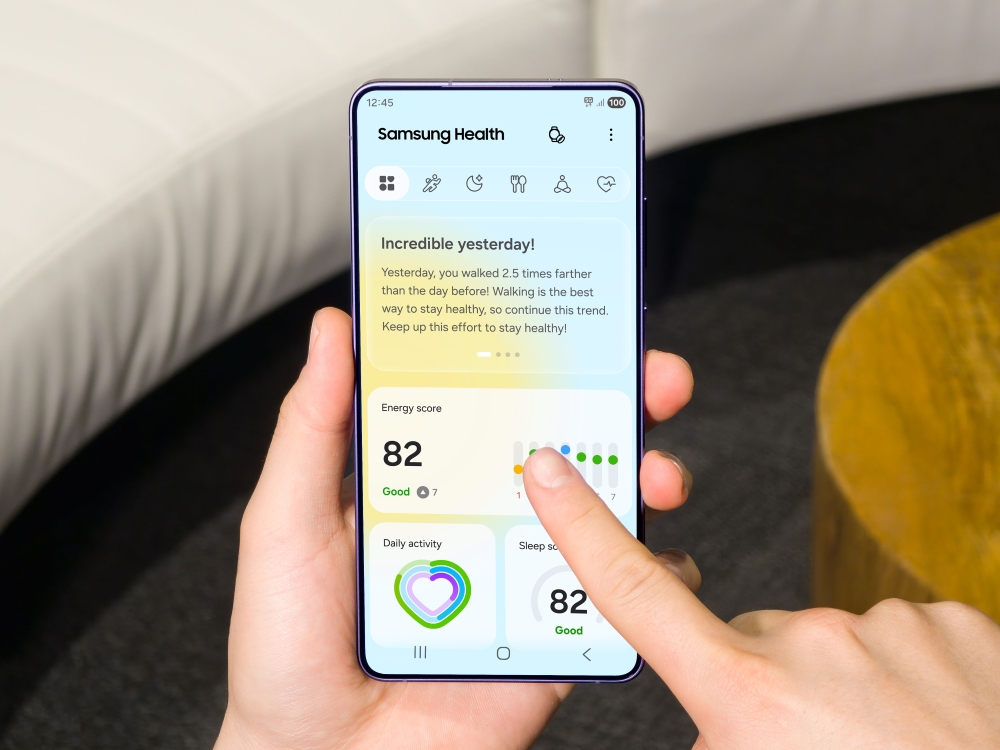
Samsung Health receives an update starting June 8 that changes its operational logic: instead of simply recording metrics, it begins comparing them to your individual baseline norm and alerting only about significant deviations. This appears to be a minor difference at first glance — but it's actually fundamental.
Five signals instead of one number
The new Vitals feature tracks heart rate, heart rate variability, breathing rate, skin temperature, and blood oxygen level during sleep. But the key is not the set of metrics, but the approach. According to Samsung's official announcement, the app sends notifications only when it detects deviations from the user's personal baseline level, not from an average norm. This means that bradycardia in a trained athlete won't trigger a false alarm.
In parallel, Heart Health Score appears — a single daily assessment of cardiovascular health that combines sleep, stress, activity, and body composition. Samsung positions this as an evolution of last year's Vascular Load feature. Also added is Daily Cardio Load — a measure of accumulated cardiovascular strain during the day, and Fitness Index — an integrated indicator of physical fitness.
Where the product is heading next
The June update is just the first step. According to The Korea Herald, by the end of the year Samsung plans to launch a beta version of AI Health Coach in the US — a chatbot based on generative AI that will analyze the user's medical records and provide personalized health recommendations. Samsung's digital health team head Park Hon-soo stated at the Galaxy Tech Forum in New York that the feature will "support implementation of doctor's recommendations through Galaxy Watch and mobile devices."
"We will use a hybrid approach that processes personal data on the device while leveraging the cloud for improved performance."
Park Hon-soo, Digital Health team lead, Samsung
This is a key sentence worth unpacking. Samsung promises a hybrid privacy model: some data stays on the device, some — in the cloud. The user supposedly has a choice. But specific details — which data exactly and under what conditions goes to the cloud — are absent from public materials.
A comparison Samsung doesn't make
As noted by 9to5Google, Samsung isn't the first: Oura has already launched a similar AI Advisor based on smart ring data. The difference is that Samsung Health is installed on virtually every sold Galaxy device, meaning the scale of biometric data collection is fundamentally different.
- Vitals — night analysis of five biosignals with comparison to personal norm
- Heart Health Score — single daily cardiovascular health assessment
- Daily Cardio Load — accumulated cardiovascular strain
- Fitness Index — integrated physical fitness indicator
- AI Health Coach — chatbot with medical record analysis (beta, US, end of 2025)
An app that started as a step counter now claims the role of a daily medical consultant. The question is not whether it will be accurate — but whether Samsung will gain the right to analyze your medical records at the moment you simply agree to another update of the terms of service.







