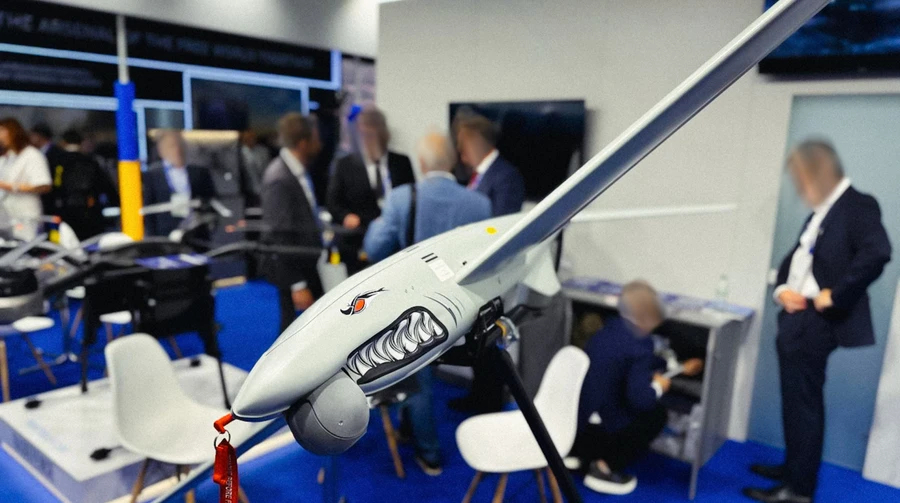
When Russian electronic warfare systems jam standard radio channels, a reconnaissance drone becomes blind — or crashes. Ukrainian company Ukrspecsystems solved this problem by integrating Starlink satellite communications into its Shark drone.
What Changed Technically
Starlink provides operators with continuous video, telemetry, and command control streams even in the event of complete GPS loss or failure of traditional radio channels. The key advantage is that the satellite signal comes from orbit rather than from a ground point that can be detected and jammed.
No less important is the change in deployment logistics. To operate the Starlink version of Shark, no separate ground antenna equipment is needed — a laptop is sufficient. This reduces preparation time before flight and decreases the amount of equipment on the front lines — and therefore reduces the target for the enemy.
"Drones controlled through Starlink are largely resistant to ground-based electronic warfare means — they cannot be jammed in the traditional way".
Ukraine's Arms Monitor, analysis of Starlink integration in unmanned aircraft
Shark-M: A Platform That's Already Evolving
Starlink is not the only upgrade to the product line. At the MSPO exhibition in Poland in September 2024, Ukrspecsystems presented the Shark-M with a new electro-optical station that combines day and thermal cameras simultaneously — previous versions could only use one. According to Army Recognition, the Shark-M can operate at ranges up to 180 km, climb to altitudes of 3,000 meters, and reach speeds of up to 130 km/h.
In parallel, the company is expanding its production base: Polish ALS Systems received a license to manufacture Shark, Mini Shark, and PD-2 at a factory in southern Poland. As Militarnyi reports, this is the first step toward entering NATO markets.
A Risk That's Not Discussed
Starlink in drones is not a Ukrainian monopoly. Analysts from Ukraine's Arms Monitor have recorded that Russian strike drones Molniya have also begun using Starlink terminals, making them significantly more resistant to Ukrainian electronic warfare systems. The question to SpaceX about blocking such terminals remains open — and is extremely sensitive given Elon Musk's statements regarding Ukraine in 2025.
In other words, the same technology that strengthens Shark simultaneously strengthens the threat from the opposite side. The advantage exists only as long as SpaceX controls which terminals are active.
Practical Summary
The integration of Starlink into Shark solves a specific tactical task — reconnaissance under conditions of active electronic warfare. Simplified deployment logistics make the system realistic for rotating units, not just special operations. However, large-scale deployment will depend on one factor beyond Ukrspecsystems' control: if SpaceX limits Ukraine's access to Starlink — as has already happened — the entire communications architecture built on a satellite channel will be threatened by a single decision from California.
Is Ukrspecsystems preparing a backup communications channel in case of Starlink restrictions — or is reliance on satellite communications a conscious but uncompensated risk?