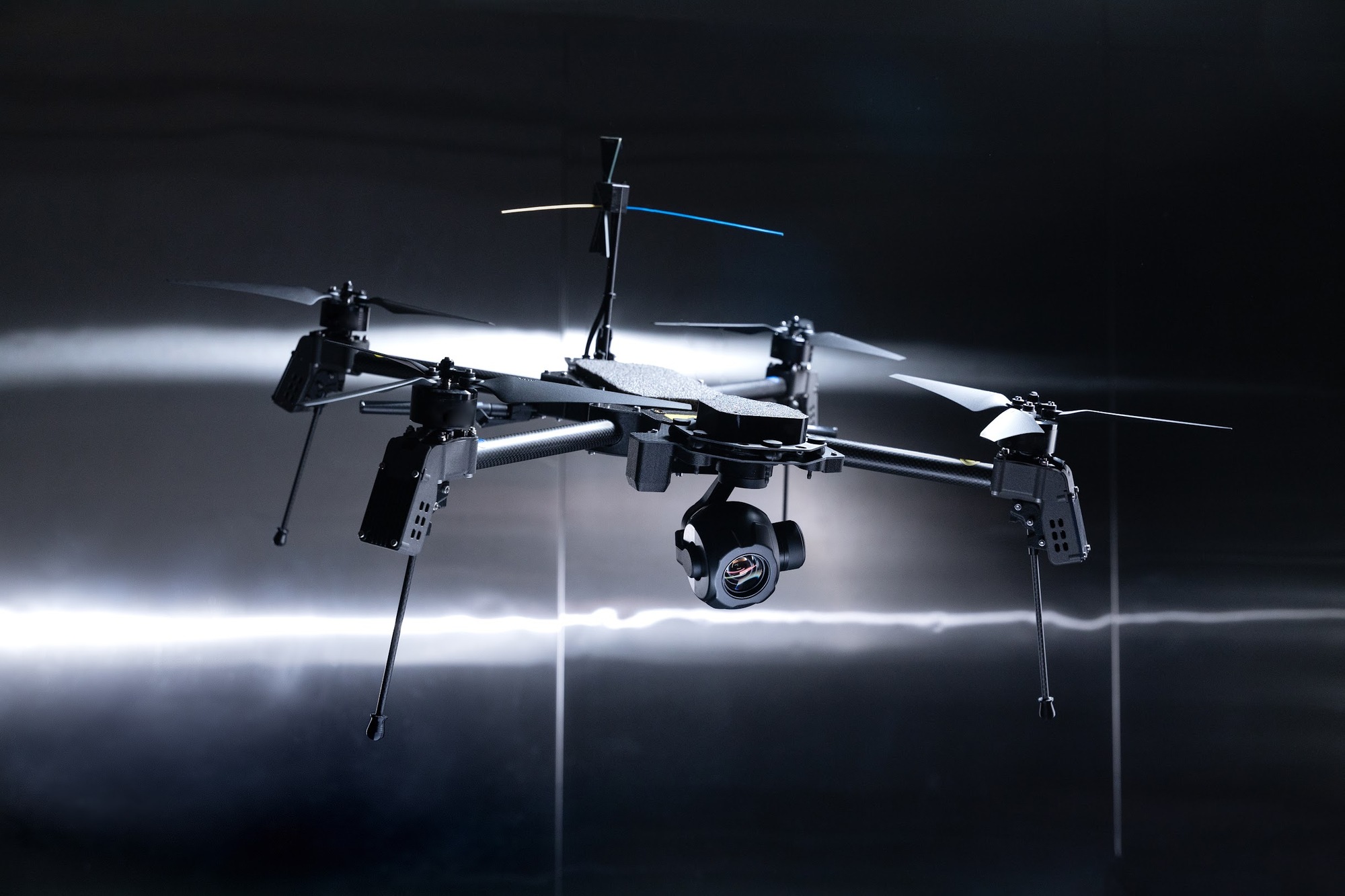
When a drone manufacturer emphasizes a camera with 90x hybrid zoom, it's an understandable marketing focus. But in the case of "Zoom 3.0" from Frontline Robotics, the more interesting part of the technical specifications is elsewhere — where it discusses communications and GPS-denied navigation.
What's Inside
The device received its own AI module for visual-inertial navigation developed by Frontline Robotics. It is responsible for position stabilization over a target at altitudes up to 250 meters, course maintenance, and route display on a map — all under conditions where GPS is jammed. The drone uses a dual-band encrypted frequency-hopping (FHSS) communication system and a separate secure video transmission channel.
Range — up to 15 km, flight time without payload — up to one hour. Payload capacity — up to 3 kg, which takes the device beyond the purely reconnaissance class: the company directly states that this expands possible application scenarios.
"Zoom 3.0 is the result of persistent work based on the previous drone modification. Constant communication with users and service support suggest where to focus in order to make the product better."
— Frontline Robotics
Broader Context: From Startup to a Factory in Bavaria
"Zoom 3.0" is not an isolated novelty. In December 2025, Frontline Robotics, together with German Quantum Systems, founded a joint venture Quantum Frontline Industries (QFI) in Bavaria — Europe's first fully automated industrial line for manufacturing tactical drones for the Armed Forces of Ukraine. In February 2026, Zelenskyy personally accepted the first "Linza 3.0" unmanned aircraft manufactured at this facility and announced a plan to open ten more such joint lines across Europe by year's end.
The division of roles in QFI is clear: Quantum Systems is responsible for industrial infrastructure and manufacturing automation, Frontline Robotics — for licensed developments, operator training, and service support to NATO standards. The first batch of "Linza 3.0" has already been sent to Defense Forces units; QFI declares its intention to scale up volumes and ensure regular supplies.
Where the Line Between Presentation and Mass Production Lies
"Zoom 3.0" is currently presented, not launched into production — at least not publicly. This is a fundamental distinction for a market where the cycle from prototype to frontline order can take months. The entire QFI infrastructure is currently oriented toward "Linza 3.0"; whether the Bavarian line will become a platform for "Zoom" as well remains an open question.
If QFI truly reaches the declared volumes and several more European lines are added to it by the end of 2026 — Ukrainian reconnaissance aviation will receive not only new capabilities, but also an industrial foundation for scaling. If not — "Zoom 3.0" will remain another quality prototype in the queue for mass production.