On June 25, President Volodymyr Zelensky announced a 40-day deadline for an operation by the SBU together with other components of the Defense Forces — pressure on the aggressor state to compel it to end the war. The deadline has passed. There is no official final report, but the array of damaged objects allows for an interim assessment without emotion — based only on facts.
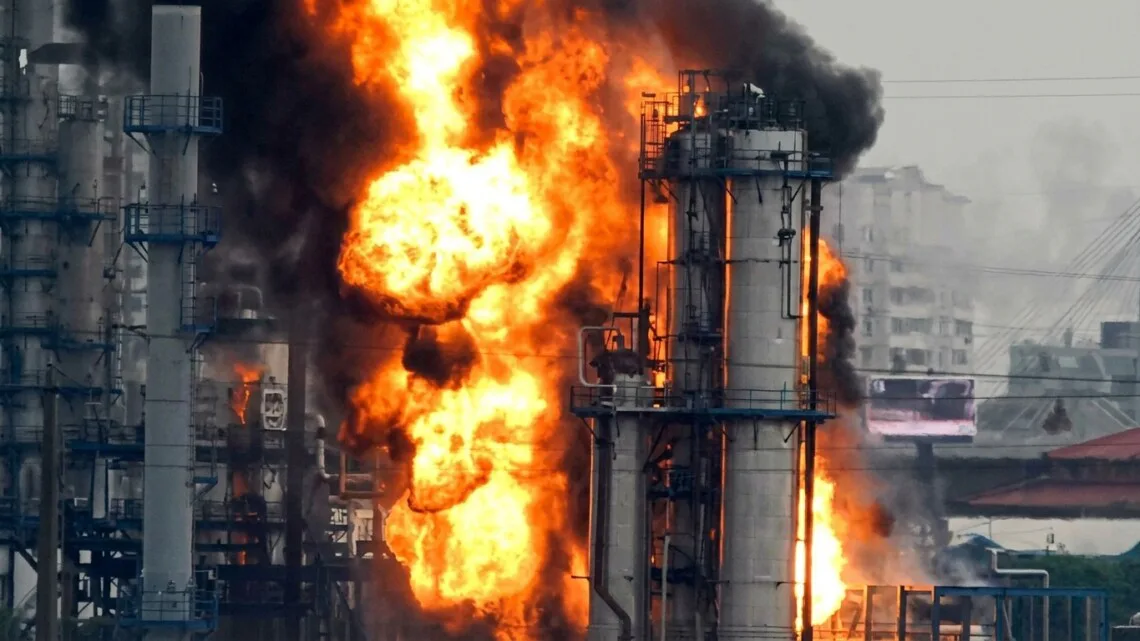
During this period, at least six oil refineries were struck, approximately ten other fuel infrastructure facilities, military airfields, hangars with unmanned systems, air defense systems, combat aircraft, supply vessels, and FSB facilities. A separate direction remains pressure on Russia's "shadow fleet" — over one hundred vessels fell under sanctions and military measures.
What specifically was struck
The chronology shows not isolated actions, but systematic work across several directions simultaneously — fuel, aviation, air defense, fleet.
- June 27 — "Vtorovskoye" oil pumping station (Vladimir region), "Titan-Barrikady" plant in Volgograd (manufacturing launch systems for Iskander-M and Topol-M)
- July 1 — "Saki" airfield in Crimea, hangars with Su-30 and Su-30SM aircraft; Roskosmos enterprise in Penza region manufacturing rocket sensors
- July 2 — Nizhny Novgorod oil refinery, 850 km from the border
- July 6 — Yaroslavl oil refinery, terminal in Vysotsk, Omsk oil refinery — 3,000 km from Ukraine
- July 17 — Tu-95 strategic bomber at Engels airfield
- July 29 — primary processing unit "Lukoil-Permnaftoorgsintez", over 1,500 km from Ukraine
- August 1 — cluster of three oil refineries in Ufa, 1,600 km from the border
The most noticeable consequence — gasoline shortage in a number of Russian regions, hours-long queues at gas stations, and public acknowledgment of problems by Russian authorities.
The main goal was not achieved — and this was expected
Military expert Ivan Stupak emphasizes: expecting the war to end in 40 days would have been unrealistic from the very beginning.
"We understood from the very beginning that after 40 days, the probability that the Russian Federation would be forced into peace was practically zero. To achieve this, one would need some kind of absolutely breakthrough tool," Stupak says.
According to him, the campaign cannot be viewed in isolation — it is part of a broader systematic effort that includes GUR operations, actions by unmanned systems forces, and strikes in the enemy's near and deep rear.
Aviation and air defense — the most sensitive losses
Among all the results, Stupak particularly highlights the destruction of two Su-35 aircraft.
"These are not new aircraft from the factory, but equipment that has been in use for a long time, with trained crews and well-practiced application algorithms. For Russia, such losses are very significant," the expert explains.
The second direction is the methodical destruction of air defense systems. The logic is simple: the fewer operational systems Russia has, the higher the chances for Ukrainian long-range drones to reach their targets undetected.
At the same time, Stupak warns against overestimating the effect: Russia is capable of redeploying air defense systems from other sectors and partially compensating for aviation losses, as Western analysts have already noted. The destruction of several systems does not mean the collapse of the entire system — but it forces the adversary to spend resources and weaken other areas.
Trust in the figures
On the question of the reliability of official data, Stupak responds without reservations.
"So far, we have seen no grounds to say that Ukrainian official structures are exaggerating their results. Most of the strikes are confirmed by photo and video materials. The Ministry of Defense explained that only results with confirmation — photos, videos, geolocation — are included in the statistics," the expert notes.
Logistics and Crimea — cumulative effect
Stupak highlights strikes on fuel infrastructure and Crimea as the most important component of the campaign — it is this that works on exhaustion, not a one-time effect.
"For Russians, Crimea is an enormous military hub. The supply of troops in southern Ukraine passes through the peninsula. The more problems that arise there, the harder it is for Russians to supply their forces at the front," he says.
In his assessment, systematic pressure on logistics has a longer-lasting effect than strikes on individual facilities: a tank can be manufactured anew, but rebuilding routes, repairing oil refineries, and redeploying air defense systems to the rear — these are expenditures of time and resources that cannot be compensated by a single decision.
What this means going forward
The campaign did not stop the war, but it has changed the adversary's behavior: Russia is redeploying air defense systems to the rear, repairing refineries, strengthening airfield security — spending resources on defending territory instead of the front. Zelensky has already confirmed new SBU operations for August, meaning the formal end of the 40-day deadline does not signify a pause in strikes.
The question that remains open: will Russia's fuel infrastructure withstand the pace of strikes longer than the Defense Forces can maintain the capacity for long-range attacks at the same distances — 1,500–3,000 km from Ukraine.