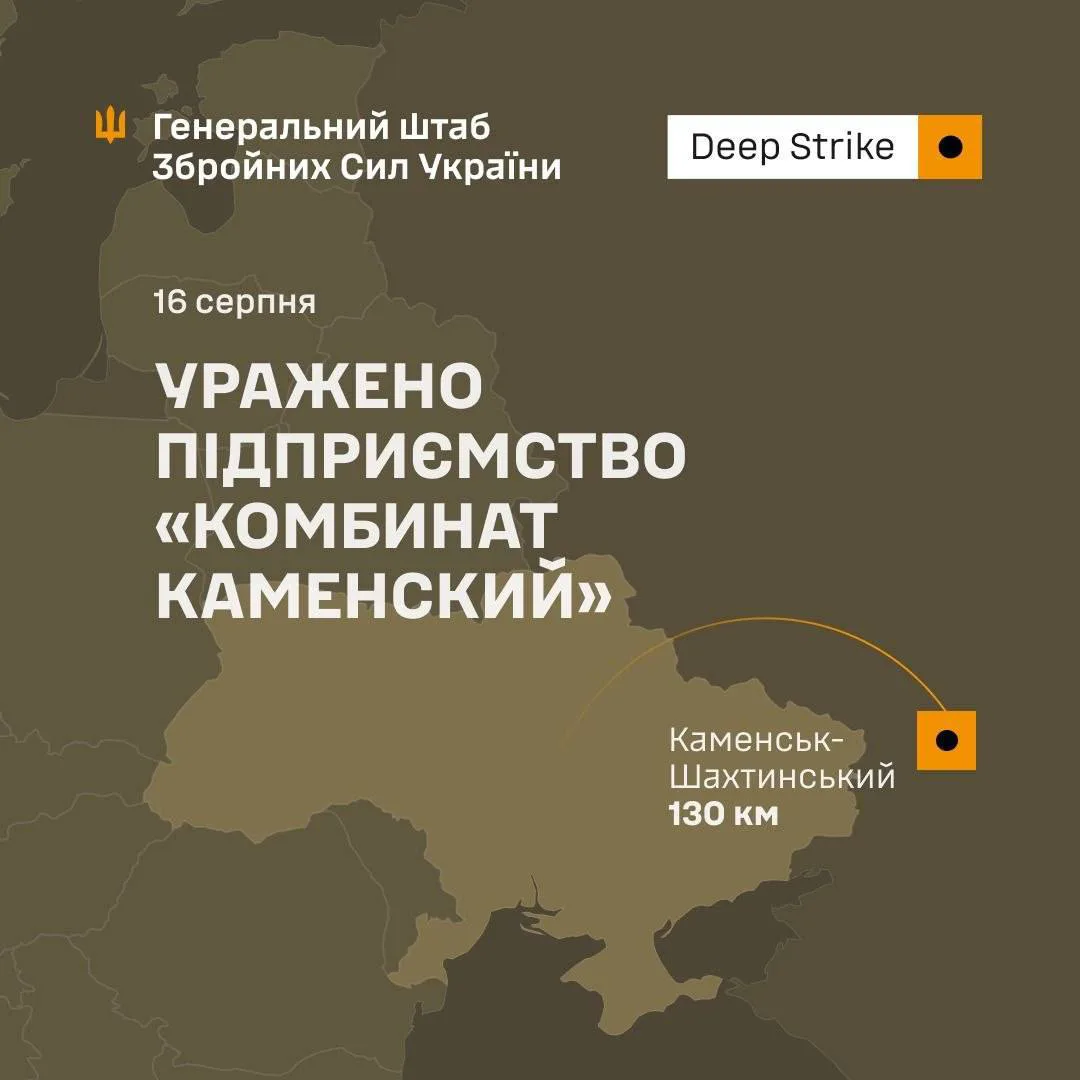
Among the night strikes on August 16, there is one that stands out against the backdrop of usual attacks on oil refineries. The "Kamensky Plant" in Rostov Oblast produces not fuel for civilian needs or even aviation — but solid rocket fuel, without which the MLRS "Uragan," "Smerch," and "Tornado-S" turn into scrap metal without ammunition.
The difference between oil and gunpowder
Oil refineries can be partially replaced: Russia has a dozen large refineries, and the loss of capacity at one is compensated by redistributing the load to others, albeit with losses in output. The production of solid rocket fuel is a different story: this is narrowly specialized chemistry with a limited number of manufacturers in the country, complex technology, and dependence on components, some of which were previously imported from countries now under sanctions.
That is, a strike against such an enterprise is not as quickly "cured" by redistributing capacity as a strike against an ordinary refinery.
Three targets in a week — not a coincidence
On the same day, the General Staff confirmed both the shutdown of "Zapsibneftechim" in Tobolsk following the August 10 strike, and damage to primary processing units at "Orsknefteorgsintez" on August 11. Together with the strike on the Progress Design Bureau in Samara on August 15, a coherent picture emerges: within a week, enterprises were struck that cover several links at once — fuel for aviation and MLRS, petrochemicals for the military-industrial complex, the space program.
These are not chaotic point strikes, but systematic work on production chains, where each link is difficult to replace.
The enterprise's products are directly involved in meeting the needs of Russia's armed forces
The question that remains open is whether Russia is capable of quickly deploying alternative capacity for solid rocket fuel production, or whether a shortage of ammunition for MLRS will become noticeable on the front lines as early as this autumn.