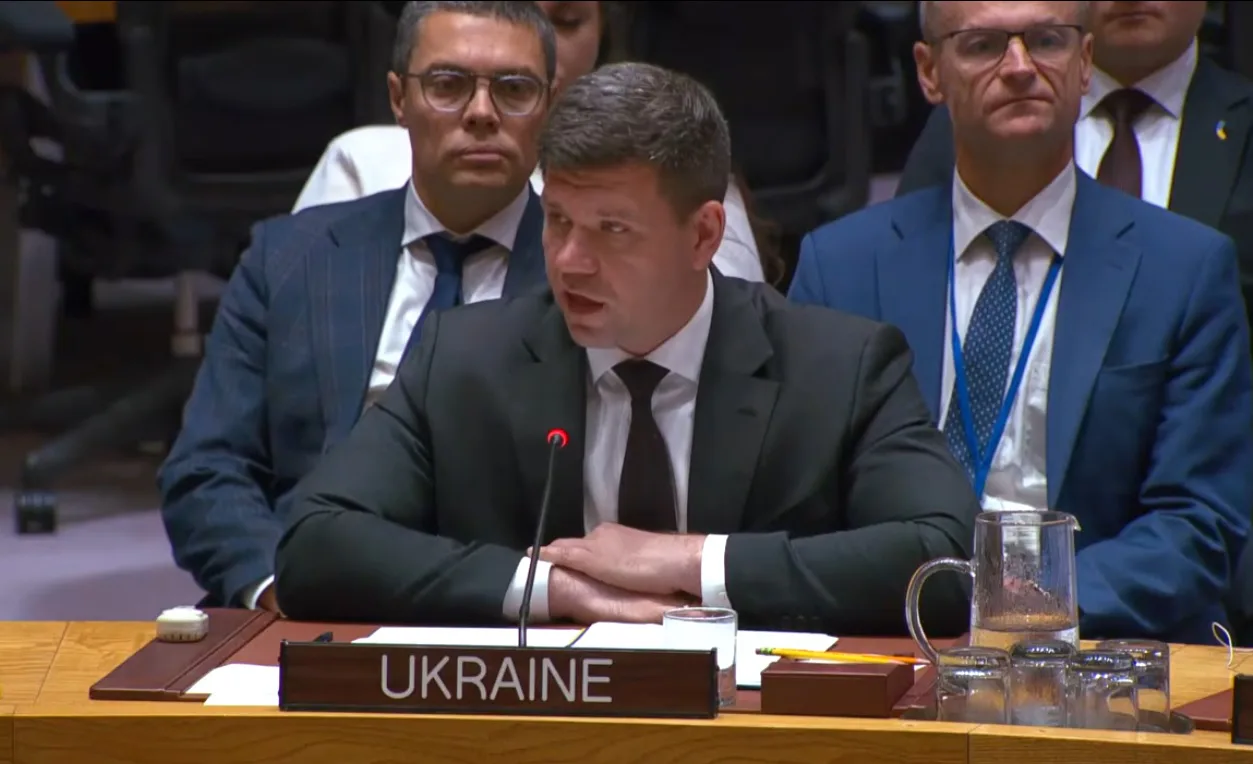
At an emergency meeting of the UN Security Council convened by Ukraine in response to massive Russian strikes, Deputy Permanent Representative Volodymyr Pavlichenko addressed the Council members with a demand: to immediately introduce a draft resolution on unconditional ceasefire.
«The paralysis of the UN Security Council on the issue of Russia's crimes must be ended by the international community, which still respects the rules-based international order that was established».
Volodymyr Pavlichenko, Deputy Permanent Representative of Ukraine to the UN
But the very word "paralysis" here is not rhetoric, but a technical description. Since February 2022, Russia has blocked with its veto every substantive resolution regarding its own aggression. In February 2025, the situation took on a new dimension: the USA, together with Russia, China and others, voted in favor of adopting a vague resolution 2774, which does not name the aggressor, does not mention Ukraine's sovereignty and amounts to an abstract call for "lasting peace". Britain, France and three Europeans abstained.
Why Kyiv continues to appeal to a blocked body
The logic is not to get a resolution — there won't be one. The logic is to publicly record the refusal. Each Russian veto is automatically referred to the UN General Assembly under the "Uniting for Peace" mechanism. That is where Kyiv gathers non-binding, but symbolically significant majorities — over 140 countries have repeatedly supported resolutions supporting Ukraine's territorial integrity.
In parallel, Pavlichenko emphasized the continuation of military support for Ukraine from its partners — and this is not a random mention alongside a call for negotiations. Kyiv consistently maintains two lines: diplomatic legitimization through the UN and military stability through allies — so that the first does not turn into capitulation.
- Resolution 2774 (February 2025): adopted with 10 votes in favor, 5 abstentions — does not contain any mention of the aggressor and Ukraine's sovereignty
- Three European amendments to it were blocked or failed: two by Russian veto, one due to insufficient votes
- The USA voted for the first time together with Russia on a "Ukrainian" resolution in the Security Council
What changed in the geometry of voting
Until 2025, the standard split in the Security Council looked like this: USA, Britain, France — against Russia and China. Now the Trump administration has shifted Washington to the opposite pole. This means that any resolution with a clear formulation about aggression will not gain the nine votes necessary for adoption — even without Russian veto.
This is precisely why Pavlichenko's appeal is addressed not so much to Council members as to the global audience: it documents who votes and how while diplomatic pressure on Kyiv increases.
If the USA does not return by the end of 2025 to supporting formulations about Ukraine's sovereignty in the Security Council — any future UN "peace" document risks cementing the current front line as a de facto border, regardless of what is written in the text.