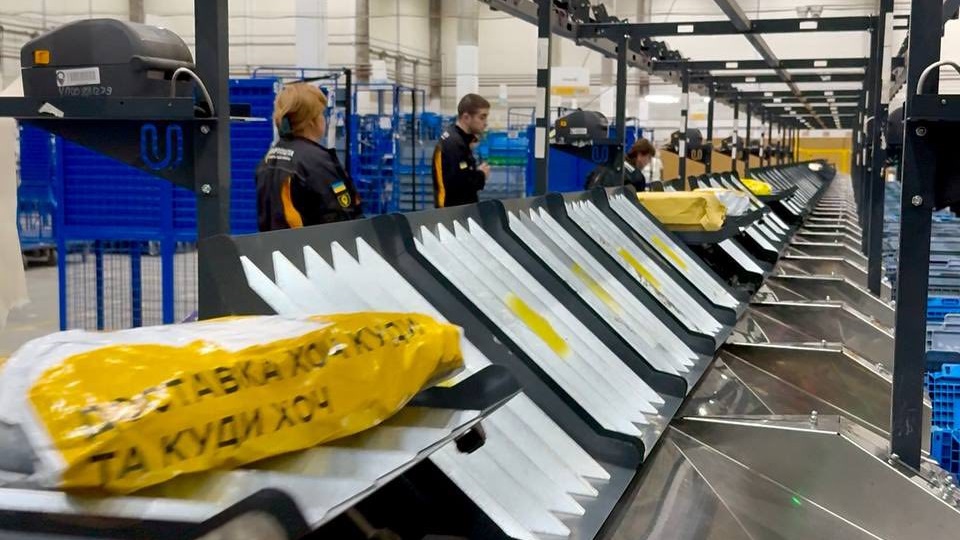
In February 2025, Ukrposhta opened a logistics center in Zaporizhzhia — completing a three-year project that fundamentally transforms the mechanics of the state postal service. From now on, every parcel, letter, newspaper, and pharmacy medication is sorted without human involvement. It sounds like a technical report — but behind the numbers are several details worth examining.
14 million euros versus 270 million: Where's the difference
Smilyanskyy posted a direct comparison on Telegram: automation of Croatian post cost 270 million euros, Poland plans to spend 330 million euros. Ukrposhta invested 690 million hryvnias — approximately 14 million euros at the current exchange rate. The difference is twentyfold.
The explanation lies in the supply chain. All sorting equipment was developed and manufactured by the Ukrainian company "Ukrainian Intelligent Systems," with 98% of components also of Ukrainian origin. This is not an import of expensive Vanderlande or Siemens Logistics lines, but a proprietary engineering solution tailored to specific conditions. The risk of this approach is that responsibility for support and scaling rests with a single supplier without a global service network. But the money stayed in the country.
"For comparison: automation of Croatian post cost 270 million euros, Polish Post plans to do it for 330 million euros, and we did it for 14 million euros"
Ihor Smilyanskyy, CEO of Ukrposhta
What this means for speed
The new lines provide capacity of over 3 million parcels per day, over 16 million letters and 14 million newspapers per month. According to the company, sorting speed and accuracy have increased eightfold — theoretically opening the possibility of next-day parcel delivery after dispatch. Key word — theoretically: sorting is only one link, with the "last mile" and branch network remaining.
Another concrete change: productivity of letter mail processing has increased almost threefold. This directly addresses a chronic problem — newspapers that arrive bundled once a month, four weeks late.
People — not cut, but redistributed
When directly asked about layoffs, Smilyanskyy said that labor shortage in sorting is now the "least of our problems." The company maintained market-level salaries and invested in working conditions — rest rooms, uniforms, proper infrastructure. No mass layoffs were announced.
Ukrposhta serves approximately 1.9 million pensioners, for whom pension payment day in cash is the only regular social contact. Automation of sorting does not directly affect this function, but among Ukrposhta's plans for 2025 are digitization of mail carrier operations and launch of a postal bank. If these two projects are implemented, the "person with a bag" model will begin to change more significantly than conveyor robots.
If the postal bank launches as planned — will Ukrposhta maintain presence in villages where there simply is no banking alternative, or will network optimization of branches become the next step after automation?







